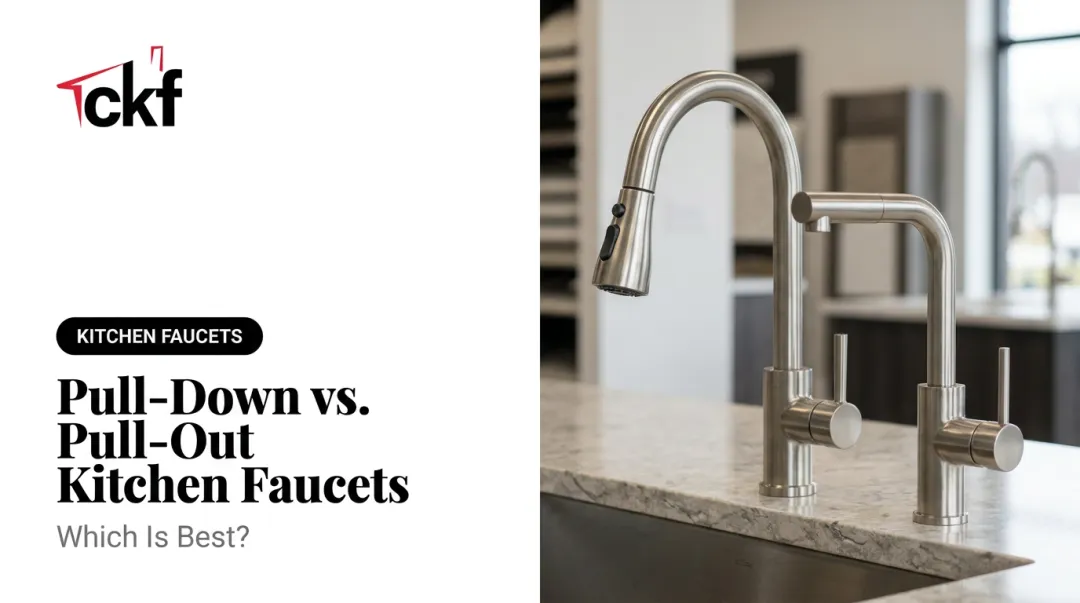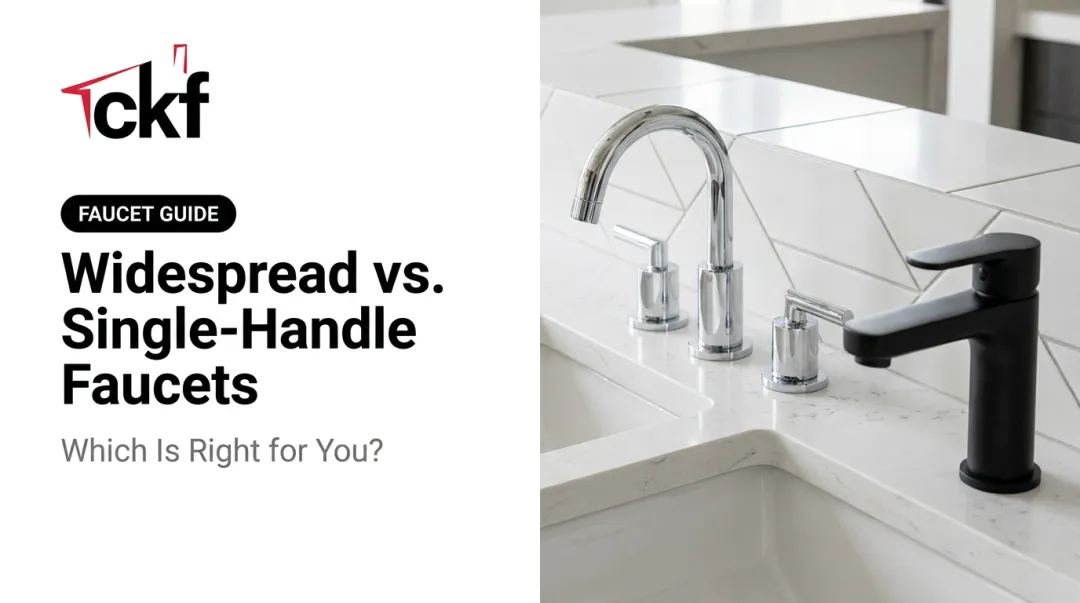

Choosing the wrong faucet for a bar sink versus a main sink creates real problems: mismatched water flow, cramped cabinet clearance, and a countertop cutout that doesn't match the fixture you actually wanted. Get this decision wrong during fabrication, and you're stuck retrofitting a hole that's already cut into stone.
This guide breaks down size, flow rate, use cases, and installation differences so you can match the right faucet to the right sink before the countertop templates go to the fabricator.
Key Takeaways
- Kitchen faucets are the primary, high-flow fixture built for daily dishwashing and food prep.
- Smaller and secondary, bar faucets serve prep sinks, wet bars, and beverage stations.
- Size, spout height, flow rate, and hole configuration are the main technical differences.
- Your sink size, kitchen layout, and entertaining habits should drive the final choice.
Bar Faucet vs Kitchen Faucet: Quick Comparison
Before we get into definitions, here's how the two fixtures stack up side by side.
| Feature | Bar Faucet | Kitchen Faucet |
|---|---|---|
| Spout height | Varies by model; many run 11-14+ inches depending on brand | Generally taller, built to clear large pots and stockpots |
| Flow rate (GPM) | Typically 1.5 to 1.8 gpm in residential models | Federal max of 2.2 gpm at 60 psi; efficient models run 1.5-1.8 gpm |
| Hole configuration | Single-hole, 2-3 hole at 4-inch centers, or 8-inch centers depending on model | Often single-hole pull-down/pull-out, sometimes wider centers |
| Cost | Generally lower, though filtration and premium finishes add cost | Wider range, from budget models to luxury touchless systems |
| Primary use | Beverage prep, entertaining, wet bars, secondary tasks | Daily dishwashing, food prep, main kitchen workflow |
A quick note on flow: the EPA's WaterSense program doesn't actually have a specification for kitchen faucets, though it recommends models capped at 1.8 gpm at 60 psi for efficient performance. Don't assume every faucet on the shelf is automatically water-efficient — check the model's actual rating first.
Keep in mind: bar faucet specs vary more than most buying guides suggest, since manufacturers label "height" differently and mounting styles range from compact single-hole setups to 8-inch three-hole configurations. Always check the spec sheet for your exact model — our design team can cross-reference it against your countertop template during a showroom consultation.
What is a Kitchen Faucet?
A kitchen faucet is the primary fixture paired with your main sink. It's built for constant, heavy-duty use, washing dishes multiple times a day, filling stockpots, rinsing produce, and running for years without failure.
Good kitchen faucets share a few core traits:
- Durability for high-frequency daily use
- Broad compatibility with top-mount and undermount sinks
- Higher flow rates for faster filling and rinsing
- Easy-clean finishes that resist water spots and fingerprints
You'll find kitchen faucets in several styles: single-handle, double-handle, pull-down, pull-out, and increasingly, touchless models that respond to a wave of the hand.
Use Cases of Kitchen Faucets
This is the fixture that anchors your kitchen, regardless of size or budget, and it handles:
- Daily dishwashing and pot filling
- Rinsing fruits, vegetables, and cookware
- General kitchen cleanup
Because it runs so often, flow rate matters more here than almost anywhere else in the house. Federal rules cap residential kitchen faucets at 2.2 gpm at 60 psi, but many efficient models now sit in the 1.5 to 1.8 gpm range, according to EPA WaterSense guidance for home builders.
A lower flow rate doesn't mean weaker performance. It usually means smarter aerator design, and CKF's faucet lineup, including Lulani models, is selected to balance that efficiency with strong performance.
What is a Bar Faucet?
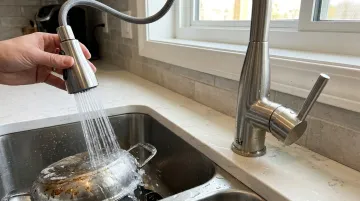
A bar faucet is a smaller, secondary fixture designed for prep sinks, wet bars, or beverage centers. Rather than a downgrade from a kitchen faucet, it's built for a different job entirely.
Bar faucets solve a specific problem: congestion. When one person is loading the dishwasher at the main sink, another can fill a water pitcher or rinse produce at the bar sink without waiting in line. Many models also come with built-in filtration, giving guests filtered drinking water without a separate under-sink system.
Common bar faucet variations include:
- Pullout spray heads for rinsing glassware
- Touch or touchless activation
- Integrated water filtration systems
Use Cases of Bar Faucets
Bar faucets show up wherever secondary prep or beverage service happens:
- Kitchen islands with a dedicated prep sink
- Butler's pantries
- Home bars and basement rec rooms
- Outdoor kitchens and patio bar setups
CKF's showroom displays illustrate this well. One outdoor kitchen build pairs a Dakota Genesis small bar sink with a Lulani Nassau faucet in gun metal, set into WeatherStrong Sapphire Blue cabinetry with a Dekton Trance countertop. It's a compact, entertaining-ready configuration built specifically for bar-scale use.
When you're planning a secondary sink cutout into a slab, the faucet, sink, and hole configuration all need to line up before fabrication starts. That's where working with a one-stop cabinetry and countertop provider like CKF pays off. Templating and fabrication happen under one roof, so the drilled holes match the faucet you've actually chosen, not a generic assumption.
Bar Faucet vs Kitchen Faucet: Which is Better?
Neither faucet wins outright. The right answer depends on a few practical factors:
- Available counter space - is there room for a second sink cutout?
- Number of sinks - are you working with one basin or two?
- Entertaining habits - do you host often, or is the kitchen mostly for daily cooking?
- Budget - can the project absorb a second fixture and its plumbing connections?
For most homes, the kitchen faucet stays the non-negotiable, primary fixture for heavy daily use. A bar faucet becomes worth adding when you frequently entertain, have a kitchen island with extra prep space, or want a dedicated beverage station separate from cleanup duty.
A Real Kitchen: Two Sinks, Two Faucets
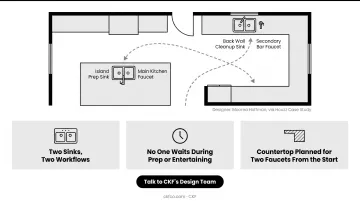
Designer Moorea Hoffman faced a common layout challenge: a single sink couldn't keep up with a client's cooking and entertaining needs. Her solution was to add an island prep sink alongside a separate cleanup sink on the back wall.
The result, detailed in Houzz's case study on dual kitchen sinks, gave everyone room to work without bumping into each other. No one was waiting for the sink to free up during meal prep or a dinner party.
That's the exact scenario where a second faucet and sink cutout earns its space. If you're weighing a similar layout change, CKF's design team can help. They'll plan a countertop that accommodates both a main kitchen faucet and a secondary bar faucet from the start, rather than retrofitting one in later.
Conclusion
The kitchen faucet remains the workhorse of any kitchen, handling the daily grind of dishwashing, food prep, and cleanup no matter the size of your space or your renovation budget. A bar faucet serves a different purpose: a specialized addition for households that entertain often, run a busy island, or want a dedicated beverage and prep station.
The right combination comes down to your layout, your lifestyle, and how much counter and plumbing capacity your project can support. If you're planning a remodel that includes a secondary sink, map out the faucet and hole configuration early, ideally before your countertop templates are finalized. Coordinating sink, faucet, and countertop cutouts during the design phase, rather than after fabrication, saves time and avoids costly rework. CKF's design consultants use digital templating to confirm these details before fabrication begins.
Frequently Asked Questions
What faucets do plumbers prefer?
Plumbers recommend solid brass or stainless-steel faucets with ceramic disc cartridges for durability and easier long-term maintenance. This applies to both bar and kitchen faucet installations.
Can you use a bar faucet in a bathroom?
Bar faucets are built and categorized for kitchen and bar use, not bathroom lavatories. Bathroom faucets follow separate flow limits and fit standards, so a dedicated lavatory faucet is the safer, code-compliant choice.
What is the new trend in kitchen faucets?
Motion and touch activation are gaining ground fast: 57% of designers expect motion controls and 55% expect touch controls to grow in popularity, per NKBA's 2024 trends report. Matte finishes and integrated filtration are trending too.
How big should a bar faucet be?
Bar faucet dimensions vary by manufacturer, with many models ranging from roughly 11 to 14+ inches in spout height. Always check the specific product's spec sheet, since "height" isn't measured the same way across brands.
Can one faucet serve both the main sink and a bar/prep sink?
Not practically. Each sink needs its own properly sized faucet, since a kitchen faucet's height and flow rate are usually mismatched for a smaller bar basin.
Do I need a separate water line for a bar faucet?
Most bar faucets need their own supply lines and a compliant drain connection, which should be mapped out during countertop and cabinetry design, not after the slab is cut.