This guide covers everything you need to make a confident decision: how to choose between refreshing and fully replacing, which materials hold up best, what realistic costs look like, and how to plan from first measurement to final installation.
Key Takeaways
- Countertop updates range from low-cost DIY refreshes (paint, vinyl film) to full stone slab replacements — the right choice depends on your budget, surface condition, and timeline
- Material choice drives both cost and longevity more than any other variable
- Engineered quartz led renovation choices at 39% in 2025, according to Houzz — granite ranked second at 19%
- For natural stone or engineered surfaces, an experienced local fabricator consistently outperforms big-box retailers on fit, finish, and support
- 73% of recent and prospective buyers rated a granite or natural stone countertop as essential or desirable
Renovate, Refresh, or Replace? How to Decide
Most homeowners face three options when countertops feel outdated or worn:
| Option | What It Involves | Best For |
|---|---|---|
| Surface refresh | Paint, vinyl film, or epoxy overlay on existing counters | Cosmetic updates on a tight budget |
| Resurfacing/refinishing | Professional treatment for repairable stone or solid surface | Sound substrates with surface-level wear |
| Full replacement | Removing existing countertops and installing new slabs | Structural damage, layout changes, or resale prep |
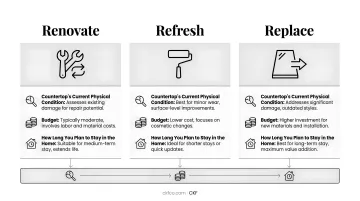
The right choice hinges on three factors: the countertop's current physical condition, your budget, and how long you plan to stay in the home.
Signs It's Time for a Full Replacement
A refresh won't solve structural problems. Replace your countertops when you see:
- Deep cracks or chips that compromise the surface's integrity
- Water damage or warping, especially common in laminate near sinks
- Severe staining that has penetrated below the surface layer
- Outdated countertop heights or configurations that no longer fit the kitchen's layout
- A pre-sale renovation where maximizing resale value matters
Laminate and tile countertops past a certain age often cost more to patch repeatedly than to replace once. Remodeling Magazine's Cost vs. Value report consistently shows minor midrange kitchen remodels recouping close to or above their cost nationally — making the case that well-targeted kitchen upgrades pay off, even when countertops are only part of the project.
When a Refresh or Refinish Makes Sense
Not every countertop needs to go. A refresh is smart when:
- The substrate is structurally sound and damage is purely cosmetic
- You're renting or plan to sell within one to two years
- Budget is tight and a temporary update buys time while you save for full replacement
The material also matters when deciding whether to refinish. Some materials respond to refinishing better than others:
- Granite and marble: A professional can buff out surface scratches and reseal the stone to restore a near-new appearance
- Solid surface (Corian): Sands and reseals cleanly, extending usable life without full replacement
- Laminate: Limited refinishing options — cosmetic overlays are possible, but deep damage typically warrants replacement
Popular Kitchen Countertop Materials: A Comparison
Material selection is the most consequential call you'll make in a countertop renovation. It determines how the surface performs daily, how much maintenance it demands, and what it costs upfront and over time. Here's how the most common options compare.
Natural Stone: Granite and Marble
Granite is one of the most durable kitchen countertop options available. According to the Natural Stone Institute, granite is heat resistant to approximately 250°C (480°F), though direct, localized heat is still discouraged because thermal gradients can initiate cracking. Each slab is unique — no two granite countertops look exactly alike. Where sealing is appropriate, NSI notes a quality sealer should last 10–15 years.
Marble offers unmatched veining and elegance, but it's a softer stone. Consumer Reports testing found marble vulnerable to heat damage, scratching, and some staining. The Natural Stone Institute warns that acids — lemon juice, vinegar, wine — can dull or etch calcareous stone surfaces. Marble suits lower-traffic areas or homeowners willing to commit to its maintenance.
Engineered Quartz
Quartz is a manufactured product, typically 90–95% ground natural quartz bound with resin. That composition gives it practical advantages over natural stone:
Quartz is a manufactured product, typically 90–95% ground natural quartz bound with resin. That composition gives it practical advantages over natural stone:
- Non-porous and requires no sealing
- Resists scratches and most common stains
- Holds up to hot pots and serrated knives in Consumer Reports testing
- Chipped edges need professional repair, but routine maintenance is minimal
According to the 2025 Houzz Kitchen Trends Study, engineered quartz led upgraded countertop choices at 39% — down from 46% the prior year but still ranked first. Its consistency in color and pattern across large slabs makes it especially practical for kitchens with islands.
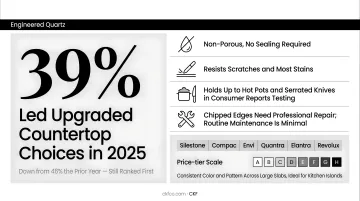
CKF carries a broad quartz portfolio across its Midwest showrooms, including Silestone, Compac, Envi, Quantra, Elantra, and Revolux — organized across eight price tiers (A through H) to suit renovation budgets from entry-level to premium.
Solid Surface
Solid surface materials (Corian is the most recognized brand) are seamless, moisture-resistant, and bacteria-resistant — practical qualities in a busy kitchen. Their defining advantage is repairability: minor scratches and surface damage can be sanded out. Corian documents professional refinishing as a viable option for scratches, and the material carries a 10-year transferable residential limited warranty for manufacturing defects.
CKF has fabricated solid surface countertops since entering the countertop business in 2000 — one of its longest-standing areas of in-house expertise.
Laminate and Budget-Friendly Options
Laminate remains the most affordable countertop material. It's widely available in patterns that convincingly mimic stone or wood, and Consumer Reports found it resists stains well. It scratches relatively easily, is vulnerable to moisture at seams, and cannot be refinished once damaged — worth weighing against the lower upfront cost.
Butcher block is susceptible to heat, cuts, and moisture, and requires regular oiling or sealing. The upside: nicks sand out cleanly, giving it some of solid surface's repairability advantage. It works especially well in farmhouse and transitional kitchens where a warmer, natural aesthetic is the goal.
How Much Does a Kitchen Countertop Renovation Cost?
Costs vary significantly by approach, material, and kitchen size. Here's an overview based on HomeAdvisor's 2024 cost data:
| Renovation Approach | Approximate Cost |
|---|---|
| Paint + sealant refresh (materials) | $6–$15 per sq. ft. |
| Epoxy refresh (materials) | $4–$8 per sq. ft. |
| Re-lamination | $3–$6 per sq. ft. |
| Professional resurfacing | $3–$20 per sq. ft. |
Note: Full replacement costs vary significantly by region, square footage, edge profiles, and cutouts. For full replacements, laminate sits at the low end, solid surface lands in the mid-range, and quartz, granite, and marble run progressively higher. Get quotes from local fabricators for current regional pricing.
Key Factors That Affect Your Total Budget
Beyond material price, several variables move the final number:
- Square footage — Larger kitchens and islands add significantly to material and labor costs
- Edge profile complexity — An eased edge (the most common residential choice) costs less than a waterfall, mitered, or ogee profile. CKF's portfolio shows waterfall and mitered edges appearing in design-forward projects where premium detailing is the priority
- Cutouts — Each sink or cooktop cutout adds fabrication time and cost
- Demolition and disposal — Removing and hauling away old countertops adds to full replacement projects
DIY vs. Professional Installation
DIY saves on labor, but measuring errors or bad cuts in natural stone are expensive to fix. CKF's fabrication process uses a RoboSawjet — combining a traditional saw with high-pressure water jets — followed by precision edge profiling and hand-polishing. That level of accuracy is difficult to replicate at home, particularly with granite, quartz, or marble.
Countertop Upgrade ROI
The 2025 Cost vs. Value data covers full kitchen packages, not countertops alone. What the research does show: 73% of buyers rate granite or natural stone countertops as essential or desirable — meaning the right material choice influences buyer perception.
Planning Your Countertop Renovation: Step by Step
Step 1 — Assess and Measure
Start by evaluating what you're working with. Check for:
- Structural damage: cracks, chips, or warping that rules out a simple refresh
- Water infiltration around sinks or seams
- Layout suitability — does the existing configuration still work for how you cook?
Measure total square footage including overhangs, islands, and any backsplash areas. Professional fabricators will always do their own templating before cutting, but having a ballpark number helps when budgeting and comparing quotes.
Step 2 — Choose Your Material and Style
Don't rely solely on online images for stone — slabs vary dramatically from piece to piece. For granite and quartz especially, veining patterns and color variation only read accurately at full-slab scale — viewing in person before committing is worth the extra step.
When you visit a showroom, look for one that displays countertop and cabinetry combinations together. Seeing how a specific quartz surface pairs with cabinet finishes, hardware, and sinks in one setting saves significant back-and-forth. At CKF's showroom locations, the design team works within your budget across all categories, so you're not piecing together selections from multiple vendors.
Before your visit, it helps to have a rough sense of:
- Your preferred material category (quartz, granite, quartzite, Dekton)
- Cabinet finish direction (painted, stained, or mixed)
- Any fixed budget ceiling for surfaces alone
Step 3 — Get Quotes and Plan the Timeline
Most fabricators require a site visit for templating before committing to a final price. For stone countertops, plan for 10–15 business days from templating to installation as a typical Midwest regional timeline. Templating itself typically runs 1–2 hours; installation usually takes one day.
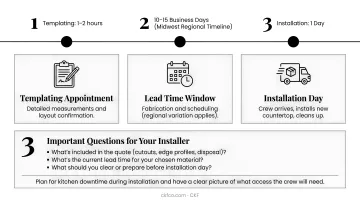
Ask your fabricator upfront:
- What's included in the quote (cutouts, edge profiles, disposal)?
- What's the current lead time for your chosen material?
- What should you clear or prepare before installation day?
Plan for kitchen downtime during installation and have a clear picture of what access the crew will need.
Frequently Asked Questions
How much does it cost to renovate countertops?
Costs range from under $10 per square foot for a DIY paint or epoxy refresh to significantly more for full natural stone replacement with professional fabrication and installation. The biggest variables are material choice and your kitchen's total square footage.
Is countertop refinishing worth it?
Refinishing is worth it when the substrate is structurally sound and the damage is cosmetic — particularly for natural stone and solid surface materials. For laminate or heavily damaged countertops, it's typically a short-term fix rather than a lasting solution.
What is the most durable countertop material for kitchens?
Quartz and granite consistently perform best. Quartz is non-porous and low-maintenance; granite resists heat and scratches well when sealed. Laminate and tile cost less upfront but show wear faster under heavy daily use.
Can you install new countertops over existing ones?
In some cases, yes — tile or thin overlays can go over a solid, level substrate. The catch: it adds height to your countertop, which can affect appliance clearances and cabinet drawer operation. Heavy stone overlays require a structural assessment first.
How long does a countertop renovation take?
A DIY paint or film refresh can be completed over a weekend. Full stone countertop replacement — from templating through installation — typically takes 10–15 business days with a professional fabricator, depending on material availability and scheduling.
What countertop material adds the most home value?
Natural stone (granite, quartzite) and engineered quartz are most frequently cited by real estate professionals as positively impacting resale value. Industry buyer surveys consistently show that granite and natural stone countertops rank among the top features homeowners look for — making them a smart choice before listing.