Introduction
You touch your bathroom faucet dozens of times a day, yet most homeowners spend less time picking one than they do choosing a paint color. That's a mistake.
The wrong faucet can mean daily annoyances: a spout too short for the basin, a handle that's hard to grip, or worse, a fixture that doesn't even fit your existing sink holes.
The stakes go beyond convenience. Faucet choice affects your monthly water bill, how often you'll call a plumber, and whether your bathroom feels finished or mismatched at resale.
Consider this: replacing an old, inefficient bathroom faucet with a WaterSense-labeled model can save the average family 700 gallons of water a year, roughly the equivalent of 45 showers, according to the EPA's WaterSense program.
This guide breaks down faucet types, the factors that actually matter, and how to coordinate your choice with the rest of your bathroom remodel.
Key Takeaways
- Faucet type (single-hole, centerset, widespread, wall-mount) must match your sink's pre-drilled holes
- Solid brass bodies and ceramic disc cartridges deliver the best long-term durability
- Flow rate and WaterSense certification directly affect your water bill
- Finish and style should coordinate with your vanity, countertop, and hardware
- Budget planning needs to include installation labor, not just the sticker price
What is a Bathroom Faucet? Understanding Types and Anatomy
A bathroom faucet is the fixture that controls water flow and temperature at your sink. It installs through one or more pre-drilled holes in the sink deck or countertop.
Faucet "type" is determined almost entirely by hole configuration and mounting style, not the finish you fall in love with first. That's why measuring your existing setup comes before anything else.
Faucet Configurations by Installation Type
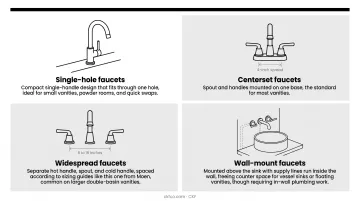
Four main configurations dominate the market:
- Single-hole faucets – A compact, single-handle design that fits through one hole. Ideal for small vanities, powder rooms, and quick swaps.
- Centerset faucets – Spout and handles mounted on one base, sized for a 4-inch spread between hot and cold handles. The standard for most vanities.
- Widespread faucets – Separate hot handle, spout, and cold handle, spaced anywhere from 8 to 16 inches apart, according to sizing guides like this one from Moen. Common on larger double-basin vanities.
- Wall-mount faucets – Mounted above the sink with supply lines run inside the wall. These free up counter space and pair well with vessel sinks or floating vanities, but they require in-wall plumbing work.
Core Components of a Bathroom Faucet
Beyond the configuration, three components determine how a faucet performs day to day.
- Spout: Height and reach should match your basin size. Too tall or too far forward, and you'll get splashing every time someone washes their hands.
- Handles and cartridge: Ceramic disc cartridges have become the industry benchmark for drip-free, long-lasting operation, with major brands like Kohler and American Standard building their valve technology around this durability standard.
- Finish: Chrome, brushed nickel, matte black, and brass each carry different maintenance needs. Matte finishes hide fingerprints better; polished chrome shows water spots faster.
CKF's Lulani faucet collection, for example, runs premium ceramic disc valves across its entire bathroom lineup, paired with brass bodies on models like the St. Lucia and Capri series (stainless steel on select models like the Aruba). Every Lulani faucet also carries a lifetime limited warranty on that valve technology.
Benefits of Choosing the Right Bathroom Faucet
Getting this decision right pays off in several concrete ways:
- Lower water bills through efficient flow rates that don't sacrifice pressure
- Fewer repair calls thanks to quality cartridges that resist mineral buildup and leaks
- A cohesive bathroom design that adds resale appeal instead of looking like an afterthought
Water efficiency is where the numbers really stand out. WaterSense-certified faucets cap flow at 1.5 gallons per minute, a 30% reduction from the standard 2.2 GPM baseline, while still meeting performance testing requirements set by the EPA.
There's also a compatibility angle people overlook. Buying a faucet that doesn't fit your existing holes often forces an unplanned sink or vanity swap. That single mismatch can turn a $200 faucet purchase into a much bigger, unplanned project.
What to Consider When Choosing the Best Bathroom Faucet
There's no universal "best" faucet. The right one depends on your sink's hole pattern, your household's needs, and your design goals. These six factors connect product specs to real outcomes: cost savings, longevity, and a finished look that lasts.
Sink Fit and Design Coordination
Measure the distance between your pre-drilled holes, called faucet centers, before you shop. This single measurement determines whether you need single-hole, centerset, or widespread hardware. Skip this step and you may end up replacing the whole sink or vanity just to make a faucet fit.
Once the fit is settled, finish matters just as much. Your faucet finish should talk to your cabinet hardware, lighting fixtures, and countertop color. Mismatched finishes are one of the most common regrets homeowners report after a remodel. If your vanity hardware is matte black, a polished chrome faucet will look out of place no matter how nice it is on its own.
Material, Efficiency, and Performance
Solid brass bodies resist corrosion better than lower-cost alternatives and tend to hold up longer, especially in hard-water areas, according to This Old House. Zinc alloy costs less but doesn't hold up as well over time. Internally, metal components outperform plastic or rubber parts, meaning fewer callbacks over a decade or more of daily use.
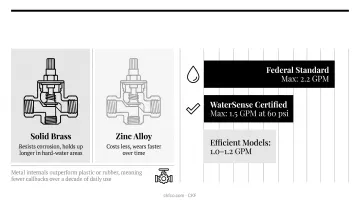
Build quality isn't the only spec that affects your bills; flow rate does too. GPM rating and WaterSense certification directly shape your monthly water bill. WaterSense-certified faucets max out at 1.5 GPM at 60 psi, compared to the federal standard maximum of 2.2 GPM, per the EPA's technical specification sheet. Many residential models now run as low as 1.0 to 1.2 GPM without sacrificing usable pressure.
Usability and Budget
Lever handles are easier to operate than round knobs, especially for kids, older adults, or anyone with limited hand strength. This matters most for multi-generational or aging-in-place households planning for the long haul. The ADA's own accessibility guidance specifically calls out lever-style controls as an acceptable design for one-handed, low-grip operation.
Ease of use is only half the equation; installation cost is the other. Wall-mount and touchless faucets typically cost more to install because they require additional plumbing or electrical work. Wall-mount conversions, in particular, involve opening walls to run new supply lines, which Angi classifies as advanced plumbing work best left to a professional. Factor installation labor into your budget upfront so it doesn't become a mid-project surprise.
How CKF Can Help You Choose the Right Faucet
Faucet selection rarely works well in isolation. It's a decision best made alongside your vanity, sink, and countertop choices, not after everything else is already picked out.
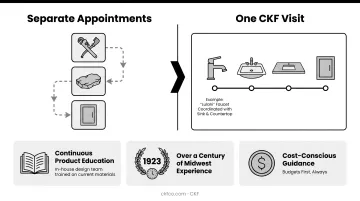
That's the logic behind CKF's one-stop-shop model. Instead of juggling separate appointments with a plumbing supplier, a countertop fabricator, and a cabinet showroom, you can select faucets, sinks, countertops, and cabinetry together in a single visit. This keeps your finishes consistent from day one.
A few things that set CKF apart:
- An in-house design team engaged in continuous product education, so recommendations reflect current materials and hardware, not outdated catalogs
- Over a century of Midwest industry experience, dating back to 1923, with showrooms across Omaha, Kansas City, and beyond
- Cost-conscious design guidance that keeps real budgets in mind rather than pushing the priciest option
If you're weighing a Lulani faucet against your sink and countertop options, that's exactly the kind of coordinated conversation a CKF showroom visit is built for.
Conclusion
Prioritize the faucet that fits your sink holes, your budget, and how your household uses that bathroom every single day, over the trendiest or most expensive option on the shelf.
A faucet is a long-term fixture. Weighing durability and water efficiency now, rather than settling for the cheapest option, prevents a costly replacement in five years instead of fifteen.
Pairing that decision with expert design guidance, such as the vanity and countertop consultations CKF's team provides, produces a more cohesive bathroom that lasts.
Frequently Asked Questions
How do I know which bathroom faucet to buy?
Start by measuring your sink's existing holes to confirm compatibility, then narrow your options by style, finish, and budget. Matching the rest of your bathroom's hardware and countertop color comes next.
What is the current trend in bathroom faucets?
Matte black has moved from an accent finish to a design mainstay, alongside brushed gold and mixed-metal pairings. Water-saving features and touchless technology are also becoming more common in residential lines.
How do I measure my sink for a new faucet?
Measure the center-to-center distance between your existing holes. A single hole means single-hole compatibility, roughly 4 inches indicates centerset, and 8 to 16 inches points to widespread.
Do bathroom faucets need to match other bathroom hardware?
Matching isn't required, but coordinating your faucet finish with cabinet hardware and lighting creates a more polished, cohesive look. Mismatched finishes are a common source of remodeling regret.
What is the average lifespan of a bathroom faucet?
A properly maintained bathroom faucet typically lasts 15 to 20 years, according to an Angi report on faucet lifespan. Water quality, installation quality, and faucet build all affect that range.
Can I install a bathroom faucet myself, or do I need a professional?
Swapping a like-for-like deck-mount faucet is a reasonable DIY project for someone comfortable with basic plumbing. Wall-mount or touchless conversions involve additional wall and electrical work, so CKF's installation team typically handles those conversions for customers.