Introduction
Countertops are one of the most visible, most expensive decisions in any kitchen remodel. Get it wrong, and you're staring at your mistake every morning while you make coffee.
Lately, quartzite has moved to the top of homeowner wish lists as homeowners move away from all-white quartz and the dated granite patterns their parents chose in the early 2000s. Taj Mahal quartzite, in particular, keeps popping up in design forums and showroom displays.
But most buyers don't actually know what it is. Is it real stone or an engineered look-alike? Will it blow the budget? Will it look tired in five years the way tumbled-edge granite did?
This review breaks down Taj Mahal's origin, appearance, and honest pros and cons. You'll also find real cost ranges, design pairings, care requirements, and tips for sourcing an authentic slab through a full-service fabricator like CKF.
Key Takeaways
- Authentic Taj Mahal quartzite is quarried in Ceará, Brazil, and tests far harder than marble on the Mohs scale
- Installed pricing runs $100 to $250 per square foot — premium-tier, but not the costliest stone on the market
- Sealing is still required despite "low maintenance" marketing claims
- Mislabeled dolomitic marble is often sold as "soft quartzite," so verify with your fabricator
- Its warm, neutral palette gives it more staying power than trend-driven stone colors
What Is Taj Mahal Quartzite?
True quartzite starts as sandstone. Over millions of years, heat and pressure from tectonic movement recrystallize the quartz grains into a dense, fused metamorphic rock.
That process separates it from granite, which is igneous and forms from cooled magma. It also differs from engineered quartz, a manufactured product made of roughly 90% ground quartz mixed with resins and pigments, according to Caesarstone's own material breakdown.
Taj Mahal is one such quartzite: authentic slabs are quarried specifically in the Ceará region of Brazil. It's fine-grained and white-beige, known for low water absorption and strong resistance to acid, according to Brachot's technical material sheet.
The signature look: a warm ivory or cream base flowing with soft taupe, caramel, and gold veining. Since it's a natural material cut straight from the earth, no two slabs are identical. That's the appeal, and also the reason two "Taj Mahal" slabs from different lots can look noticeably different.
Taj Mahal Quartzite vs. Granite, Quartz & Marble
Here's how the four main countertop materials stack up:
| Material | Formation | Hardness | Heat/Acid Resistance |
|---|---|---|---|
| Taj Mahal Quartzite | Metamorphosed sandstone | About 7 on the Mohs scale | High heat and acid resistance |
| Granite | Igneous, multi-mineral | Varies by mineral makeup | Resistant to common cooking heat |
| Engineered Quartz | 90% quartz + resin/pigment | Consistent, resin-limited | Heat-resistant, not heatproof |
| Marble | Metamorphosed limestone | Softer, calcite-rich | Etches easily from acids |
Taj Mahal is often marketed as a "marble alternative" for good reason. It delivers that same soft, veined movement people love in Calacatta or Carrara marble, but with far greater resistance to etching and heat damage.
Watch the naming. Authentic Taj Mahal comes from one specific Brazilian quarry. Visually similar stones like Perla Venata, Perla Bianco, Perla Santana, and Perla Rocca come from nearby quarries and often get sold under the "Taj Mahal" name at retail. Always confirm the exact material with your fabricator before you commit.
Pros and Cons of Taj Mahal Quartzite Kitchen Countertops
Is Taj Mahal quartzite good for kitchen countertops? Short answer: yes, but with real trade-offs worth understanding before you sign a contract.
The Advantages
- Superior durability: true quartzite scratches glass and doesn't etch from lemon juice or vinegar, unlike marble
- Heat resistance: handles hot pans far better than resin-based engineered quartz, though a trivet is still smart practice
- Design versatility: pairs with white, wood-tone, navy, black, or forest-green cabinetry without clashing
- Resale potential: a 2026 Zillow analysis of over 2 million listings found a quartzite mention correlated with a 5.3% higher-than-expected sale price, a correlation rather than a guaranteed remodel return
The Drawbacks to Watch For
- Higher price point: Brazilian quarrying, slab density, and specialized diamond-tool fabrication all add cost
- Still needs sealing: despite "low maintenance" marketing, it's a porous natural stone that requires periodic sealer application
- Mislabeling risk: softer dolomitic marble is sometimes sold as "soft quartzite" and etches easily; ask your fabricator to test an offcut with vinegar first
Cost, Authenticity & Choosing a Trusted Fabricator
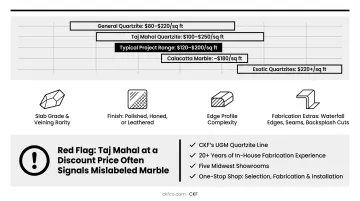
Pricing for natural stone countertops varies more than most buyers expect, and Taj Mahal sits comfortably in the premium tier.
| Material | Installed Cost Range |
|---|---|
| Granite | $10-$140 per sq. ft. |
| Engineered Quartz | $59-$130 per sq. ft. |
| Quartzite (general) | $80-$220 per sq. ft. |
| Taj Mahal Quartzite | $100-$250 per sq. ft. |
According to current industry benchmarks for quartzite countertop costs, general quartzite installs run $80 to $220 per square foot. Fabricator quotes for Taj Mahal specifically tend to land between $100 and $250, with most projects settling in the $120 to $200 range.
What drives the final number:
- Slab grade and rarity of veining pattern
- Chosen finish, whether polished, honed, or leathered
- Edge profile complexity
- Fabrication extras like waterfall edges, seams, or matching backsplash cuts
Is it the most expensive countertop material available? No. Rare marbles like Calacatta can run close to $180 per square foot, and some exotic quartzites push past $220. Taj Mahal is a premium, upper-mid-tier choice, not the absolute ceiling.
This is exactly why sourcing matters more than most homeowners realize. A slab labeled "Taj Mahal" at a discount price is a red flag for mislabeled marble.
CKF carries authentic Taj Mahal under its UGM Quartzite line. Its in-house fabrication team has worked with the material directly, including an eased-edge Taj Mahal countertop paired with painted hardwood and oak cabinetry in a recent Cedar Rapids display.
With over 20 years of stone fabrication experience and showrooms across the Midwest, CKF's one-stop-shop model, covering selection, custom fabrication, and installation under one roof, removes the guesswork of verifying slab authenticity on your own.
Design Ideas: Finishes & Cabinet Color Pairings
Finish options:
- Polished: Glossy and classic, the traditional choice that shows off veining depth
- Honed: Soft matte texture, trending for a more organic, understated feel
- Leathered: Textured surface that hides fingerprints and adds tactile interest
Cabinet pairings that work:
CKF's own project portfolio shows the range here. A home office featuring Sorrento maple cabinetry in an Almond finish paired beautifully with mitered-edge Taj Mahal countertops, creating a warm, light-filled look.
A Cedar Rapids display took the opposite approach, pairing the same stone with Retreat-finish painted hardwood uppers and Morel-finish oak island base for a cooler, more contemporary combination.
Other reliable pairings include:
- White or off-white cabinetry to brighten a space
- Natural wood tones for farmhouse warmth
- Navy, black, or forest green for bold contrast
- Gray or greige tones for a modern, sophisticated feel
One caution: avoid stacking too many warm-beige elements together. Beige cabinets plus beige walls plus Taj Mahal's caramel veining can slide into the "bland oatmeal kitchen" look fast.
Layout ideas: Waterfall islands and matching backsplash slabs cut from the same lot create a cohesive look, while brass or matte black fixtures add a finishing touch.
Is Taj Mahal Quartzite Timeless or Just a Trend?
Taj Mahal's explosion across Pinterest and design forums raises a fair question: is this the next Tuscan granite, destined to feel dated once everyone has it?
There's a real difference this time. Tuscan granite leaned heavily into a specific era's color palette. Taj Mahal's warm, neutral base is closer to the transitional design language that keeps resurfacing decade after decade.
The data backs this up. NKBA's 2026 Kitchen Trends Report found that 62% of design professionals surveyed ranked natural quartzite as a top countertop material preference, with warm neutrals appearing in 96% of projected kitchen palettes over the next three years.
Practical takeaway: choose a "quieter" slab with subtler veining rather than the most dramatic, high-movement pattern. Dramatic slabs photograph well for social media, but subtler patterns tend to age better as trends shift around them.
Care & Maintenance Tips
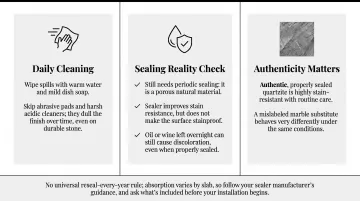
Day-to-day cleaning is genuinely simple. Wipe spills with warm water and mild dish soap. Skip the abrasive pads and harsh acidic cleaners; they can dull the finish over time even on a durable stone like this.
Sealing reality check:
- Yes, it still needs periodic sealing since it's a porous natural material
- Sealer improves stain resistance but doesn't make the surface stainproof
- Oil-based spills or wine left sitting overnight can still cause discoloration, even on dense, properly sealed quartzite
There's no universal "reseal every year" rule; absorption varies by slab, so follow your sealer manufacturer's guidance rather than a blanket timeline. Many fabricators, including CKF, address sealing as part of a professional installation, so ask what's included before your project starts.
As for moisture-related darkening some homeowners worry about: authentic, properly sealed quartzite is highly stain-resistant with routine care; the key word is "authentic." A mislabeled marble substitute will behave very differently under the same conditions.
Frequently Asked Questions
Is Taj Mahal quartzite good for kitchen countertops?
Yes. It's highly durable and versatile enough for daily cooking, but it still requires periodic sealing and a higher upfront investment than laminate or basic quartz.
Is Taj Mahal quartzite the most expensive?
No. It's premium-tier, typically $100-$250 per square foot installed, but rare marbles and exotic quartzites can cost as much or more.
Is Taj Mahal quartzite dated?
Its neutral palette keeps it adaptable across design styles. Because it's so popular right now, choosing a subtler, quieter slab pattern helps it stay timeless longer.
What kitchen countertops are trending in 2026?
Warm neutrals and honed or leathered natural stones are leading the shift, with quartzite, including Taj Mahal, ranking among design professionals' top choices.
Does Taj Mahal quartzite need to be sealed?
Yes. It's a porous natural stone, and periodic sealing is necessary. Many professional fabricators include sealing as part of the installation process.
What's the difference between Taj Mahal quartzite and Perla Venata?
Both originate from the same Brazilian region, but Perla Venata typically shows a lighter background with less pronounced veining. Always confirm the exact material with your fabricator before purchase.