Quartz gets pitched as a premium surface in nearly every showroom brochure. But homeowners don't care about marketing language. They care whether a countertop stains, needs babying, or cracks the first time a curling iron gets dropped on it.
This guide breaks down what quartz actually delivers in a humid, high-use bathroom, how it stacks up against granite and marble, what it costs, and how to pick the right slab for your space.
Key Takeaways
- Quartz's non-porous surface resists moisture, stains, and bacteria without sealing
- Daily maintenance is just soap and water, unlike granite or marble's periodic resealing
- Designs range from marble-look veining to granite-style speckling in repeatable patterns
- Pricing sits mid-range, but zero sealing costs and long durability add lasting value
- The right slab depends on your bathroom's size, lighting, and daily use
What Are Quartz Bathroom Countertops?
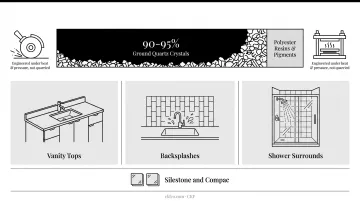
Quartz countertops are engineered surfaces, not quarried stone slabs. Manufacturers grind natural quartz crystals, roughly 90-95% of the mix, and combine them with polyester resins and pigments under heat and pressure. The result is a dense, uniform slab that behaves nothing like raw stone.
That engineering matters most in bathrooms. Because the material resists water penetration so well, it shows up in three main applications:
- Vanity tops — the most common use, standing up to daily splashing from sinks and faucets
- Backsplashes — protecting walls from water and product residue near the vanity
- Shower surrounds — a less common but growing use where water exposure is constant
Meeting these demands requires selecting the right product line. CKF, for example, works with quartz brands like Silestone and Compac, both of which offer marble-inspired collections built specifically for wet, high-traffic spaces. Quartz delivers a practical advantage over natural stone: the same upscale look without the maintenance schedule that stone demands.
Key Benefits of Quartz Bathroom Countertops
The benefits below focus on real, day-to-day performance rather than marketing claims. Each one ties to something homeowners actually care about: hygiene, upkeep time, longevity, and design flexibility.
Non-Porous and Highly Resistant to Moisture and Stains
Granite and marble both have natural pores that absorb liquid over time. Quartz doesn't. Because it's engineered rather than quarried, manufacturers report water absorption rates of 0.01% to 0.05% across leading product lines, effectively sealing out moisture at the molecular level.
That non-porous structure prevents:
- Water rings from wet toothbrush cups or soap dishes
- Cosmetic staining from makeup, perfume, or hair products
- Mildew growth in grout-free seams around the sink
Consumer Reports testing found quartz survived spills with top stain-resistance scores and required no sealing to maintain that protection. Guest bathrooms, kids' bathrooms, and other high-humidity spaces benefit most, since spills happen there constantly.
Low Maintenance With No Sealing Required
Granite and marble both need periodic sealing to stay stain-resistant. Quartz never does. Its resin binder already fills every gap, so there's no porous surface left for a sealer to protect.
The Natural Stone Institute notes that a quality penetrating sealer on granite typically lasts 10 to 15 years, though not every granite countertop needs sealing in the first place. Marble is less forgiving. A simple water test, letting a few drops sit for 15 minutes, tells you whether it's time to reseal.
Quartz skips that whole conversation. Daily care is just:
- Wipe with mild soap and water after regular use
- Avoid abrasive scrubbers that can dull the polished finish
- Skip the sealer altogether since there's no porous surface to protect
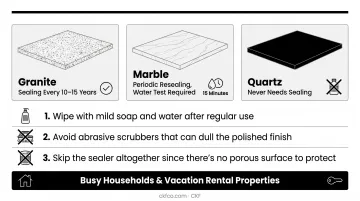
Busy households and vacation rental properties benefit most here, since nobody's tracking a resealing calendar.
Superior Durability Against Chips, Scratches, and Cracks
Quartz's engineered density holds up well against everyday bathroom impacts such as dropped bottles, hair tools, and jewelry. That toughness protects the investment through years of daily use without visible wear showing up on the surface.
There's one caveat worth knowing: quartz isn't heat-proof. MSI reports its Q Quartz line withstands temperatures up to roughly 300°F before the resin component risks discoloration or scorching. Manufacturers consistently recommend using a trivet or hot pad under curling irons and flat irons left resting on the surface.
Primary bathrooms with heavy daily traffic, or homes with active kids, benefit most from this durability, provided that heat limitation stays top of mind.
Extensive Design Versatility to Match Any Style
Quartz is manufactured, not mined, which means color and pattern consistency slab to slab. That's a real advantage over one-of-a-kind natural stone, where matching veining across a vanity and backsplash can be a gamble.
Options include:
- Marble-look veining, such as Silestone's Et Calacatta Gold or Compac's Unique Calacatta
- Granite-style speckling for a more traditional look
- Solid, minimalist tones for contemporary bathrooms
Most bathroom-grade quartz comes in a polished finish, commonly seen in CKF's Envi and Elantra collections. Some manufacturers also offer honed or textured finishes for a more matte, understated look, worth asking about for buyers who prefer a matte look. Design-driven remodels benefit most from this versatility, where a cohesive look across a small space is the whole point.
Quartz vs. Granite and Marble: Is It the Right Choice for Your Bathroom?
Homeowners often choose a countertop based on how it looks in a showroom, then discover the maintenance reality after installation. Porous stone in a humid bathroom without a sealing plan is how water rings and dull spots show up within the first year.
Here's how the three materials actually compare:
| Factor | Quartz | Granite | Marble |
|---|---|---|---|
| Sealing required | Never | Sometimes, product-dependent | Often, needs periodic testing |
| Stain resistance | Excellent, non-porous | Good, varies by density | Poor, highly porous |
| Heat resistance | Good, not heat-proof | Excellent | Vulnerable to heat and abrasion |
| Acid/etching risk | Low | Low | High, reacts with acidic products |
| Pattern consistency | High, repeatable | Low, one-of-a-kind | Low, one-of-a-kind |
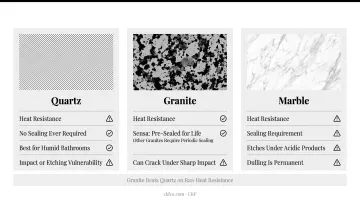
Granite holds up well against heat and doesn't always need sealing, though density varies by slab. Our Sensa granite line, for example, comes pre-sealed for life, while other granites still require periodic sealing. It can also crack under a heavy, sharp impact.
Marble is prized for its elegant veining, but it's calcareous stone. Acidic products like perfume, mouthwash, or certain cleaners can etch the surface, leaving a dull, permanent mark that no amount of polishing fully removes.
One fair tradeoff worth disclosing: granite generally beats quartz on raw heat resistance. If your bathroom sees direct sun through a large window or you want a slab with genuinely one-of-a-kind veining, natural stone still has a place.
For nearly everyone else prioritizing low-maintenance surfaces in a humid space, quartz remains the more forgiving choice.
Quartz Bathroom Countertop Cost and How to Choose the Right Slab
Quartz bathroom countertops typically run $50 to $200 per square foot installed, with material grade, color rarity, edge profile, and sink cutouts all affecting the final number. Standard or builder-grade materials sit toward the lower end; premium colors and complex edge details push costs higher.
For comparison, granite materials alone run roughly $40 to $60 per square foot before installation, while solid surface alternatives land in a similar mid-range bracket, with pricing varying widely by brand.
Choosing the Right Slab
A few practical factors make the difference between a countertop that photographs well and one that actually works for your space:
- Bathroom size and lighting: lighter quartz colors help small, dimly lit bathrooms feel more open
- Finish type: polished finishes reflect more light; consider a honed option if you want to soften glare
- Edge profile: a simple eased edge suits modern bathrooms; more detailed profiles fit traditional decor
- Daily use patterns: a busy family bathroom benefits from patterns that hide water spots better than solid white
Working with a one-stop fabricator simplifies these decisions considerably. CKF, for example, custom-fabricates quartz countertops in-house across its Midwest showrooms in Des Moines/Urbandale, Omaha, Kansas City, Lincoln, and Cedar Rapids, and coordinates cabinetry, sinks, and installation under one roof. That means fewer separate appointments and less risk of mismatched pieces from different vendors.
Conclusion
Quartz earns its reputation in bathrooms by combining three things homeowners actually need: moisture resistance, low maintenance, and design flexibility, all in one durable surface. Quartz requires none of the periodic sealing or careful acid-avoidance that natural stone demands.
Those advantages compound over time. No resealing costs, fewer repairs, and a surface that still looks new years after installation add up to real savings compared to granite or marble.
Choosing the right slab, and a fabrication partner who can execute it well, turns that potential into an investment that pays off in daily function and long-term home value. CKF's in-house fabrication team and Midwest showrooms make that choice easier, from slab selection through installation.
Frequently Asked Questions
Is quartz a good countertop for a bathroom?
Yes. Its non-porous, engineered composition resists moisture, staining, and bacteria growth without any sealing, making it ideal for humid bathroom environments.
How much does a quartz bathroom countertop cost?
Quartz bathroom countertops typically run $50 to $200 per square foot installed. Final cost depends on color rarity, edge profile, and any sink or outlet cutouts.
Does quartz need to be sealed like granite or marble?
No. Quartz is engineered to be non-porous, so it never requires sealing to stay stain-resistant, unlike granite and marble, which may need periodic sealing.
Can quartz bathroom countertops be damaged by heat?
Quartz resists heat well but isn't heat-proof. Manufacturers recommend using a trivet or hot pad under curling irons or other heat-producing styling tools.
What's the difference between quartz and quartzite?
The two materials differ at the core: quartz is engineered from crushed quartz and resin binders, while quartzite is a natural metamorphic stone that requires periodic sealing.
How long do quartz bathroom countertops typically last?
With proper care, quartz countertops can last for decades. Its stain resistance and durability, backed by manufacturer warranties often ranging from 10 years to lifetime, support long-term performance.