Introduction
You just pulled a cast-iron skillet off the burner. Every second counts before that heat starts radiating through the handle, and you need somewhere to set it down right now. What happens next depends entirely on what's under that pan.
Not every countertop handles this moment the same way. Some natural stones shrug off a 400-degree pan without a second thought. Others, especially popular engineered surfaces, can scorch, discolor, or crack under that same stress.
This guide breaks down which countertop materials genuinely resist heat, which ones you should keep hot pans away from, and how to pick the right surface for your kitchen.
We'll also cover what matters for Midwest homes, where seasonal temperature swings between a cold kitchen and a hot oven can add another layer to the equation.
Key Takeaways
- Granite and quartzite handle hot pans better than almost any other countertop material
- Soapstone resists thermal shock best, a favorite among bakers and frequent cooks
- Engineered quartz struggles most with heat, as resin content can soften or discolor
- "Heat resistant" doesn't mean "heatproof" — trivets matter for every material, even the toughest stone
- Your cooking habits and budget should drive the decision, not showroom marketing
What Does "Heat Resistant" Mean for Countertops?
Heat resistance describes a material's ability to handle brief contact with something hot, like a pan, baking sheet, or coffee mug, without cracking, discoloring, or warping. It's a relative measure, not an absolute guarantee.
Here's the distinction that matters most: heat resistant is not the same as heatproof.
Caesarstone makes this point directly in its own product literature, noting that quartz countertops resist some heat exposure but are not heat proof and can suffer permanent damage from excessive or prolonged heat. That same logic applies across nearly every countertop category, natural stone included.
Thermal Shock Is a Different Threat
Direct heat and thermal shock aren't the same problem.
| Threat | What Happens |
|---|---|
| Direct heat | A hot object transfers warmth into one localized spot on the countertop |
| Thermal shock | A rapid, significant temperature swing, such as ice water hitting a spot that just held a hot pan, strains the material through internal stress |
Rapid temperature changes can cause the outer layer of a material to contract while the interior stays warm, creating internal stress that leads to cracking. This is a separate risk from simply being able to "take the heat" in a static sense.
Given these risks, even stones with excellent heat tolerance still carry a trivet recommendation. The Natural Stone Institute notes that many stones handle heat well, but it still recommends using trivets or mats to protect surfaces long term. If an industry group representing stone fabricators recommends caution, that's worth listening to.
Types of Heat-Resistant Countertops
Heat performance varies a lot depending on what the material is actually made of. Natural stone, engineered stone, and metal all respond to heat differently, largely because of how they're formed and what holds them together.
The practical question is how often hot cookware will touch the surface directly versus how consistently you'll reach for a trivet.
Granite
Granite forms deep underground from magma that cools slowly over thousands of years under extreme heat and pressure. That origin story is exactly why a hot pan barely registers as a threat to it.
- Best for: busy kitchens and frequent cooks who don't want to think twice about setting something hot down
- Trade-off: granite typically needs periodic sealing to guard against stains and keep its finish looking sharp
CKF carries granite through its Sensa collection, including entry-level colors like Via Lattea and Tangier that sit at accessible price tiers, proving heat-tolerant stone doesn't have to break the budget.
Quartzite
Quartzite is a natural metamorphic rock, not to be confused with engineered quartz, and its heat tolerance matches or exceeds granite. It appeals to homeowners chasing that soft, marble-like veining without sacrificing durability.
One catch worth knowing before you buy: verify what you're actually getting. Some slabs marketed as "quartzite" in showrooms are really softer marble or dolomite in disguise.
The Use Natural Stone Institute's identification guide notes that true quartzite scratches glass and resists etching from acidic substances like lemon juice, while mislabeled stones will etch within minutes.
- Best for: homeowners who want marble aesthetics with much stronger scratch and heat performance
- Trade-off: higher price point, plus the extra step of confirming authenticity
CKF's UGM Quartzite line, including the Zenith Lux color, gives Midwest homeowners a way to get that veined look without guessing at what's actually in the slab.
Soapstone
Soapstone manages heat differently than other stones. Its composition allows it to absorb heat gradually and radiate it evenly, which is why it's historically shown up in chemistry labs and fireplace surrounds.
That gradual absorption makes soapstone the most resistant material to thermal shock on this list. It's less likely to crack from that ice-water-on-a-hot-spot scenario than harder stones.
- Best for: bakers, pizza makers, and anyone who regularly sets very hot bakeware directly on the counter
- Trade-off: soapstone is softer than granite, so it scratches more easily and develops a patina over time (some homeowners love this aged look, others don't)
Porcelain and Other High-Heat Options
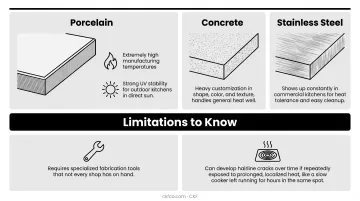
Porcelain slabs get fired at extremely high manufacturing temperatures, which builds in serious heat tolerance along with strong UV stability, a nice bonus for outdoor kitchens exposed to direct sun.
Two other materials worth a mention:
- Concrete offers heavy customization in shape, color, and texture, and handles general heat well
- Stainless steel shows up constantly in commercial kitchens because of its heat tolerance and easy cleanup
Limitations to know: Porcelain requires specialized fabrication tools that not every shop has on hand. Concrete, meanwhile, can develop hairline cracks over time if it's repeatedly exposed to prolonged, localized heat, like a slow cooker left running for hours in the same spot.
Materials That Struggle With Heat
Engineered quartz is everywhere in modern kitchens, and for good reason: low maintenance, consistent patterns, and a wide color range. But it has one real weakness.
Quartz countertops are made from crushed stone bound together with polymer resin. That resin is the vulnerability.
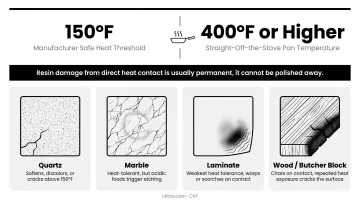
Manufacturer guidance across the industry consistently points to the same warning: direct exposure to hot pans and pots can cause the resin to soften, discolor, or crack. Most manufacturers set the safe threshold around 150°F, and a pan straight off the stove can easily hit 400°F or higher.
Here's the part that catches people off guard: this damage is usually permanent. Unlike a scratch you can buff out, resin breakdown can't be polished away. The standard fix is replacing the affected section of the slab.
A few other materials worth flagging:
- Marble tolerates heat well on its own, but acidic foods like tomato sauce or citrus trigger etching, a separate reaction common in real kitchen use
- Laminate has the weakest heat tolerance of any common countertop material, warping or scorching from brief direct contact with hot items
- Wood or butcher block chars and scorches on contact with hot pans, and repeated heat exposure dries out the surface until it cracks
If you're leaning toward quartz for its looks and low upkeep, that's a reasonable trade-off, just build trivet habits into your kitchen routine from day one.
How to Choose the Right Heat-Resistant Countertop for Your Kitchen
Start with an honest look at how you actually cook, not how you imagine cooking in a dream kitchen.
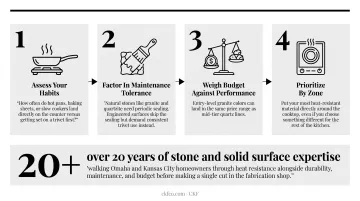
- Assess your habits. How often do hot pans, baking sheets, or slow cookers land directly on the counter versus getting set on a trivet first?
- Factor in maintenance tolerance. Natural stones like granite and quartzite need periodic sealing. Engineered surfaces skip the sealing but demand consistent trivet use instead.
- Weigh budget against performance. Heat resistance doesn't automatically mean higher cost. Entry-level granite colors can land in the same price range as mid-tier quartz lines.
- Prioritize by zone. Put your most heat-resistant material directly around the cooktop, even if you choose something different for the rest of the kitchen.
There's no universal right answer here. A household that bakes every weekend has different priorities than one that mostly reheats takeout.
This is where working with an experienced fabricator pays off. CKF's in-house design team and craftsmen bring over 20 years of stone and solid surface expertise, walking Omaha and Kansas City homeowners through heat resistance alongside durability, maintenance, and budget before making a single cut in the fabrication shop.
Conclusion
Heat resistance isn't a single standard across countertop materials; it varies a lot depending on composition. Granite, quartzite, and soapstone lead the pack for handling direct contact with hot cookware. Engineered quartz, laminate, and marble each carry their own specific vulnerabilities.
No countertop is fully heatproof. That's worth repeating because it changes how you should actually use your kitchen: trivets remain a smart habit no matter what material you choose.
Match your countertop to how you really cook, not just what looks best in a showroom photo. When you're ready to compare materials in person, CKF's Midwest showrooms let you handle slabs firsthand and get guidance from our in-house fabrication team on the trade-offs that matter most for your kitchen.
Frequently Asked Questions
What countertop is most heat resistant?
Granite and quartzite are the most heat-resistant countertop materials for residential kitchens. Both tolerate brief direct contact with hot cookware without cracking or discoloring.
Which is better, heat-resistant quartz or granite?
Granite outperforms quartz on heat resistance since it has no resin to break down under high temperatures. Quartz offers more consistent patterns and lower sealing maintenance, making it better suited for kitchens with lighter cooking habits.
Can you put a hot pan directly on granite countertops?
Granite handles brief direct contact with hot pans without damage. That said, a trivet is still recommended to protect any surface sealant and prevent scratching from the pan's rough bottom.
Is quartz heat resistant to hot pans?
Quartz has limited heat tolerance because of its resin content, and it can discolor or crack from hot pans. Trivets should always be used with quartz countertops.
Do heat-resistant countertops still need trivets?
Yes. Even the most heat-tolerant materials benefit from trivets, which also protect against scratching and reduce long-term wear around the cooktop area.
What is the least heat-resistant countertop material?
Laminate is the least heat-resistant option, easily warping or burning from direct contact with hot items. Engineered quartz follows close behind due to its resin content.