Here's the short answer: no. The silicosis crisis making news is a fabrication-shop hazard, not a household one. Once quartz is cut, polished, and installed in your kitchen, it's chemically inert. The danger lives entirely in the manufacturing process — specifically, in the airborne silica dust created when slabs are cut and ground. Two very different risk profiles, one material.
This guide breaks down exactly where the real risk sits, what protects fabrication workers, and what (if anything) you need to worry about at home.
Key Takeaways
- Installed quartz countertops pose no known inhalation or chemical exposure risk during normal daily use.
- Silicosis is caused by airborne dust from cutting, grinding, or polishing — a fabrication-only hazard.
- Quartz is non-porous, needs no sealing, and doesn't off-gas volatile organic compounds (VOCs) once cured.
- Granite carries a small radon consideration; quartz doesn't share that same profile.
- Fabricator dust-control practices matter more for safety than the material itself.
Safety Guidelines for Quartz Countertops
"Is quartz safe?" is really two separate questions bundled into one. First: is it safe for the people who cut and fabricate the slabs? Second: is it safe for the family cooking dinner on it every night?
The answers couldn't be more different. Fabrication workers face a documented, serious respiratory hazard from crystalline silica dust. Homeowners face almost no risk at all once the slab is cured and sitting in your kitchen: no radioactivity, no chemical leaching, no off-gassing. Your safety here comes down almost entirely to one decision: who you choose to fabricate and install your countertop.
General Safety Precautions
For everyday use, finished quartz needs zero special handling. There's no PPE required to chop vegetables, no waiting period after installation, and no coating that needs to cure before you can prep food directly on the surface. It's ready the moment it's installed.
The one exception: at-home DIY modification. If you're adding a new sink cutout or drilling for a faucet, never do it dry. Per OSHA guidance, any cutting or drilling of quartz should use wet-cutting methods and a NIOSH-approved respirator. Fabrication shops are legally required to follow this exact standard, so treat it as a requirement rather than a suggestion.
- Never dry-cut or grind quartz with a standard rotary tool at home, even for a small trim
- Always use water suppression if you're modifying a slab yourself
- When in doubt, call a professional fabricator instead of improvising
Safety During Installation & Fabrication
This is where the real risk lives, and the numbers back that up. Engineered quartz typically contains a higher concentration of crystalline silica than natural granite. Some formulations run considerably higher than granite's silica content, which is one reason cutting and polishing quartz slabs generates a more concentrated dust hazard when left uncontrolled.
The scale of the problem is well documented. In OSHA's 2022 sampling of stone fabrication shops, roughly one-quarter of breathing-zone air samples exceeded the permissible exposure limit for respirable crystalline silica, according to OSHA's worker exposure alert on countertop fabrication. That's a meaningful share of shops falling short of the standard.
Responsible fabricators close that gap with layered engineering controls:
- Wet-cutting and water suppression systems that keep silica dust from becoming airborne in the first place
- Local exhaust ventilation (LEV) to capture what dust does get generated
- HEPA-filtered dust collection for fine particulate that escapes other controls
- Employee medical surveillance and respiratory screenings, which signal a shop taking worker health seriously rather than treating it as a checkbox
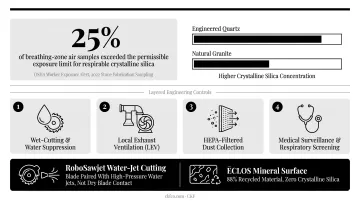
When you're evaluating fabricators, these controls are worth asking about directly, the same way you'd ask about warranty terms. At CKF's in-house fabrication facility, cutting is handled through RoboSawjet technology, which pairs a traditional saw blade with high-pressure water jets rather than dry blade contact, a notably different approach than the dry-cutting equipment still used in some shops.
CKF also carries ĒCLOS, a mineral surface made with 88% recycled material that contains zero crystalline silica, giving customers a silica-free alternative where reducing fabrication risk further is a priority.
Safety While Using Quartz in Your Home
Once installed, quartz behaves nothing like a fabrication hazard. Its non-porous surface means bacteria can't burrow into it the way they can with untreated wood or grout lines, and it never needs a sealant that could off-gas indoors, unlike some treated natural stone.
There are still a couple of practical limits worth knowing:
- Heat: Manufacturer guidance consistently warns against placing hot pans, crockpots, or griddles directly on quartz. Rapid temperature swings can cause thermal shock, cracking, or scorch marks on the resin. Use a trivet, always.
- UV exposure: Direct sunlight over years can fade or shift the color of quartz. This is a durability and appearance issue for outdoor installs, not a toxicity concern. Most quartz brands simply aren't rated for outdoor use.
- Cleaning products: Bleach, ammonia, and abrasive scouring pads can dull the resin binder over time. Mild soap and water handle daily cleanup without any risk.
Neither of these is a health hazard. They're maintenance considerations, the same category as "don't cut directly on your countertop" advice you'd get for any surface.
Environmental and System Safety Considerations
Two comparisons come up often when homeowners research countertop safety, and both deserve a straight answer.
Radon: Natural granite can contain trace radioactive elements, but the EPA states it's "extremely unlikely" that granite countertops raise radiation exposure above normal background levels, per the EPA's page on granite countertops and radiation. Engineered quartz isn't flagged as a notable radon source at all, since it's manufactured rather than mined.
Adhesives and seam fillers: Installation involves epoxies for seams and sink mounts, which can carry some VOCs during curing. Ask your installer about low-VOC seam filler options and keep the kitchen ventilated during and right after installation, a simple precaution that costs nothing and eliminates any lingering concern.
Common Safety Mistakes to Avoid
Most quartz safety missteps happen before the countertop is even installed, or right after, when homeowners take shortcuts.
- DIY cutting without wet methods. Dry-cutting quartz like ceramic tile releases concentrated silica dust indoors, precisely the scenario OSHA regulations exist to prevent in commercial shops.
- Choosing a fabricator on price alone. Skipping questions about dust control, ventilation, or safety certifications to save money often means the shop cuts corners on worker protection, too.
- Assuming "engineered" means "unsafe indoors." A cured, sealed quartz slab is chemically stable. The word "engineered" describes how it's made, not an ongoing risk once it's sitting in your kitchen.
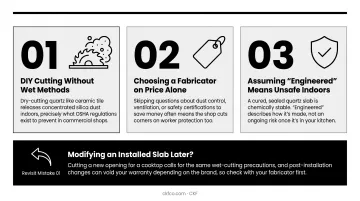
That first mistake matters again if you modify an installed slab yourself later, say, cutting a new opening for a cooktop. The same wet-cutting precautions apply, and post-installation changes can also void your warranty depending on the brand, so check with your fabricator before picking up a tool.
Conclusion
Quartz countertop safety comes down to timing and location. A finished slab in your kitchen is safe for everyday cooking, cleaning, and living, with no ongoing precautions needed. The documented health risk, silicosis, belongs entirely to the fabrication stage, where uncontrolled dust from cutting and polishing puts workers at risk.
That shifts the real safety decision onto who fabricates the stone, not the material itself. Add dust-control practices, ventilation, and worker safety to your vetting checklist, right alongside style and price. Quality fabricators, including CKF's in-house team, already treat worker safety as a baseline standard, not an afterthought. Expect nothing less from anyone cutting stone for your home.
Frequently Asked Questions
Are quartz countertops safe for health?
Yes. Installed, cured quartz is chemically inert and safe for everyday kitchen use. The documented health risk, silicosis, is linked specifically to inhaling dust during cutting and fabrication, not from living with a finished countertop.
What is the least toxic countertop?
Materials like stainless steel, glass, and unsealed solid wood carry the lowest risk profiles. Properly fabricated quartz and natural stone without harsh sealants are also solid, low-concern choices for most kitchens.
Does silicosis affect homeowners who already have quartz countertops installed?
No. The silica dust that causes silicosis only becomes airborne during cutting or grinding. Everyday activities like touching, cooking on, or cleaning a finished, sealed countertop don't create that exposure.
Is quartz radioactive like some granite countertops?
Not meaningfully. Granite can contain trace natural radioactive elements, though the EPA considers the added exposure minimal. Engineered quartz doesn't produce measurable radon or radiation.
Can I cut or drill my quartz countertop myself at home?
It's not recommended. Dry-cutting quartz releases concentrated silica dust. If you need a new cutout or fixture hole, have a professional fabricator handle it with wet-cutting equipment and proper ventilation.
How can I make sure my new quartz countertop was fabricated safely?
Ask your fabricator directly about dust-control methods, ventilation systems, and employee safety protocols before signing a contract. CKF's in-house facility, for example, uses water-jet cutting technology and offers silica-free ĒCLOS as an alternative material.