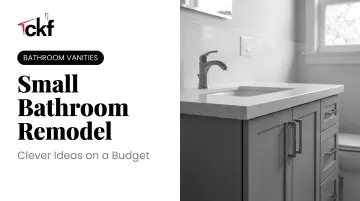
Here's the good news. Small bathrooms are actually the easiest room in the house to remodel affordably. Less square footage means less tile, less flooring, and lower labor bills across the board. That math works in your favor. It means you can splurge on one or two things that matter without wrecking your budget.
This guide covers budget planning, room-by-room savings tricks, where to spend versus save, DIY versus hiring pros, and what a realistic remodel actually costs.
Key Takeaways
- Small square footage lets you splurge on pricier materials in small doses, like a marble accent or statement tile.
- Keeping your existing layout and plumbing is the single biggest cost-saver in any remodel.
- Paint, refinishing, and peel-and-stick products transform a space for a fraction of replacement costs.
- Pick one or two focal points to splurge on; keep everything else simple and classic.
Plan Your Budget Like a Pro
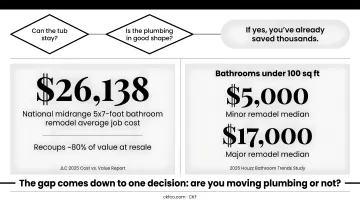
Before you touch a paint swatch, decide what actually needs to change versus what just needs a cosmetic refresh. Can the tub stay? Is the plumbing in good shape? If yes, you've already saved thousands.
What the numbers actually say:
- A national midrange 5x7-foot bathroom remodel averages $26,138 in job cost, recouping about 80% of that value at resale (JLC 2025 Cost vs. Value Report).
- For bathrooms under 100 square feet specifically, Houzz's 2025 homeowner survey found a $17,000 median for major remodels and just $5,000 median for minor ones (2025 Houzz Bathroom Trends Study).
That gap between $5,000 and $17,000+ comes down almost entirely to one decision: are you moving plumbing or not?
The "Keep the Footprint" Rule
Relocating a toilet, sink, or shower drain means opening walls and floors, rerouting pipes, and often pulling permits. It's the single most expensive change you can make in a bathroom remodel.
Skip it, and you free up your entire budget for finishes instead of infrastructure — that's where a new vanity, countertop, or shower wall panel can make the biggest visual impact per dollar spent.
Prioritize Before You Shop
Make two lists before you buy anything:
- Must-haves — things that are broken, unsafe, or non-negotiable (a leaking faucet, cracked subfloor, failing grout)
- Nice-to-haves — things that would be lovely but aren't essential (a heated towel rack, designer wallpaper)
This keeps spending intentional instead of reactive once you're standing in a showroom aisle.
Finally, set aside a 10-15% contingency buffer. Demo often reveals surprises like water damage behind a tub surround or ancient plumbing that needs attention. Budget for it now so it doesn't derail you later.
Clever Budget-Friendly Ideas by Area
Walls & Flooring
Full retiling is one of the most expensive line items in any bathroom job, largely because of labor. A cheaper path: paint or limewash instead of new tile.
A quality bathroom-rated paint or a limewash finish delivers texture and depth for a fraction of what retiling costs, and you can do it yourself in a weekend.
For flooring or a backsplash refresh, peel-and-stick tile has come a long way. It mimics marble, encaustic patterns, and even zellige at a much lower price point, and it's renter-friendly if you're not ready for a permanent commitment.
Vanity & Countertops
Your vanity doesn't need to be custom to look custom. Consider:
- Refinishing and repainting an existing vanity, then swapping the hardware for an instant style update
- Repurposing furniture, since an old dresser or nightstand converts into a characterful vanity with a sink cut
- Shopping stock vanities instead of fully custom builds, which cuts both cost and lead time
Even on a tight budget, this is the one place worth stretching for. A quality remnant slab or prefabricated stone countertop elevates the entire room, since it's the surface your eye lands on first.
Remnant slabs are the key to making this affordable: they're leftover pieces from larger projects, sized just right for a small vanity, and typically sold at a steep discount off full-slab pricing.
Storage & Fixtures
Small bathrooms live or die by storage. Affordable wins include:
- Floating shelves for towels and décor
- Open shelving above the toilet or beside the vanity
- A new medicine cabinet, which adds storage and a mirror in one move
Storage isn't the only place small upgrades pay off. Swapping an old toilet for a WaterSense-certified model saves both space in your renovation budget and money over time. Toilets installed before 1980 use roughly 5 gallons per flush, and even the pre-1994 federal-standard models use about 3.5 gallons. A WaterSense toilet uses 1.28 gallons per flush or less, at least 20% less than the current federal standard (EPA WaterSense). That swap alone can save a household nearly 13,000 gallons and about $170 a year in water costs.
Splurge vs. Save: Where to Spend Your Money
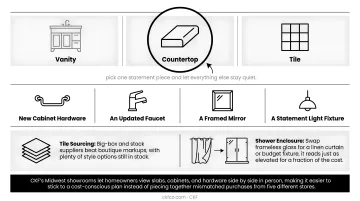
The smartest small-bathroom remodels follow a simple rule: pick one statement piece and let everything else stay quiet.
Choose your anchor — vanity, countertop, or tile — and invest there. Keep the rest of the palette simple and classic so the splurge item actually stands out instead of competing for attention.
Low-cost upgrades with outsized visual impact:
- New cabinet hardware
- An updated faucet
- A framed mirror
- A statement light fixture
These four changes cost relatively little but touch every surface you look at daily.
A few more ways to stretch dollars further:
- Tile sourcing: Big-box and stock suppliers beat boutique markups, with plenty of style options still in stock.
- Shower enclosure: Swap frameless glass for a linen curtain or budget fixture — it reads just as elevated for a fraction of the cost.
Sourcing decisions add up fast, so where you shop matters as much as what you buy. CKF's Midwest showrooms let homeowners view slabs, cabinets, and hardware side by side in person, making it easier to stick to a cost-conscious plan instead of piecing together mismatched purchases from five different stores.
DIY vs. Hiring a Professional
Not every task belongs on your to-do list, and not every task needs a licensed pro either. Knowing the split saves both money and headaches.
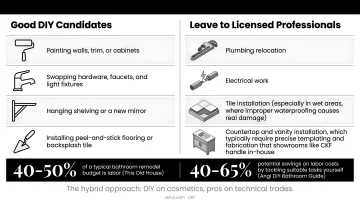
Good DIY candidates for most homeowners:
- Painting walls, trim, or cabinets
- Swapping hardware, faucets, and light fixtures
- Hanging shelving or a new mirror
- Installing peel-and-stick flooring or backsplash tile
Leave these to licensed professionals:
- Plumbing relocation
- Electrical work
- Tile installation (especially in wet areas, where improper waterproofing causes real damage)
- Countertop and vanity installation, which typically require precise templating and fabrication that showrooms like CKF handle in-house
This Old House estimates labor makes up 40-50% of a typical bathroom remodel budget (This Old House). That's a substantial enough chunk that deciding what to DIY carries real weight — and Angi notes homeowners can save 40-65% on labor costs by tackling suitable tasks themselves (Angi DIY Bathroom Guide). That's savings on labor specifically, not the whole project, once you factor in tools, permits, and your own time.
The hybrid approach — DIY on cosmetics, pros on technical trades — tends to deliver the best balance of savings and quality.
What a Small Bathroom Remodel Really Costs
Scope changes everything. A cosmetic refresh and a full gut renovation can differ by tens of thousands of dollars, so it helps to see the range side by side.
| Remodel Type | Typical Cost | Source |
|---|---|---|
| Minor refresh (under 100 sq ft) | ~$5,000 median | Houzz 2025 |
| Major remodel (under 100 sq ft) | ~$17,000 median | Houzz 2025 |
| National midrange 5x7-ft remodel | $26,138 average | JLC 2025 |
Timeline affects cost too. A small bathroom renovation handled by a professional runs around 2 weeks for active construction (Bob Vila), though that excludes preconstruction — design and budgeting typically take 2-4 weeks, permits and hiring another 2-3 weeks, and ordering materials 4-8 weeks. A purely cosmetic refresh (paint, hardware, accessories) can wrap in as little as 1-2 days.
Countertops and cabinetry are frequently the biggest line items in these budgets, since material choice and fabrication complexity swing costs more than almost any other decision. Beyond materials, DIY labor is where real savings happen. Doing suitable tasks yourself can cut 40-65% off labor costs specifically, though that's before accounting for tools, potential rework, and your own time investment.
Frequently Asked Questions
What is the bathroom design trend for 2026?
Warm neutrals dominate, with off-white, tan, and white as the leading palette choices. Wood-toned vanities, organic shapes, and statement lighting (especially integrated mirror lighting) are also trending strongly this year.
What is the average cost of a small bathroom remodel?
Recent data puts minor refreshes around $5,000 and major remodels closer to $17,000 for bathrooms under 100 square feet. Keeping your existing layout and choosing prefab over custom materials are the biggest ways to stay on the lower end.
How long does it take to remodel a small bathroom?
A professional remodel typically takes about 2 weeks of active construction, though preconstruction planning and material ordering can add several more weeks. A cosmetic-only refresh can be done in 1-2 days.
Which upgrades add the most value to a small bathroom?
Countertops, updated flooring, shower or tub upgrades, better lighting, and improved storage consistently rank as the top value-adding changes. Durable surfaces like quartz or granite hold up well in small, high-moisture spaces, which is why they're a common upgrade pick. A full midrange remodel recoups about 80% of its cost at resale nationally.
Can you remodel a small bathroom without changing the layout?
Yes, and it's the smartest budget move you can make. Keeping the existing plumbing and footprint intact avoids the most expensive category of remodel costs entirely.
What's the cheapest way to update a small bathroom?
Paint, hardware swaps, peel-and-stick tile or flooring, and refinishing existing fixtures deliver the biggest visual impact for the lowest cost. Combine two or three of these for a dramatic refresh without a full renovation budget.