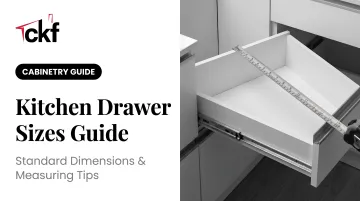
Kitchen drawer sizing follows a logical system built on cabinet standards, hardware requirements, and function. Once you understand how width, height, and depth interact — and how drawer box dimensions differ from drawer front dimensions — the math becomes straightforward.
This guide covers standard dimension ranges by drawer type, how to measure correctly, and the most common mistakes to avoid before you order anything.
Key Takeaways
- Standard drawer widths run from 12 to 36 inches in 3-inch increments
- Drawer height varies by function: 3–6 inches for utensils, 8–12 inches for pots and pans
- Drawer box depth typically lands between 20 and 22 inches in a standard base cabinet
- Drawer box width runs approximately 1 inch narrower than the opening when using side-mount slides
- Always measure the opening itself, not the existing drawer box or front
Standard Kitchen Drawer Dimensions
Cabinet sizing follows modular rules, and drawer dimensions are no exception. Manufacturers like Aristokraft and KraftMaid structure their drawer bases in 3-inch increments, ranging from 12 to 36 inches — the same module system used for base cabinets overall. This consistency is what makes drawers, appliances, countertops, and hardware all fit together predictably.
Width Standards
Commonly offered drawer base widths include: 12, 15, 18, 21, 24, 30, and 36 inches. Residential kitchens most frequently use widths between 15 and 24 inches for everyday storage. Wider configurations — 30 to 36 inches — typically appear in pot-and-pan drawers or island base cabinets where the extra width pays off.
One critical point: the drawer box is always narrower than the opening. Clearance requirements vary by slide type:
- Side-mount slides (e.g., Accuride 3832E): ~½ inch per side, so subtract roughly 1 inch from the opening width
- Undermount slides: ~¼ inch per side — a tighter fit that allows slightly wider boxes
Always confirm the spec sheet for whichever hardware you're using before sizing the box.
Height Standards
Drawer height is tied directly to function. KraftMaid's specification guide documents three distinct height bands:
| Drawer Type | Box Height | Typical Use |
|---|---|---|
| Shallow | ~4 inches | Cutlery, utensils, wraps |
| Mid-depth | ~7 inches | Stacked containers, lids |
| Deep | ~10 inches | Pots, pans, cookware |
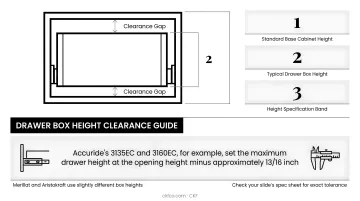
These aren't rigid universal standards — Merillat and Aristokraft use slightly different box heights — but they serve as reliable planning benchmarks. The drawer box must be shorter than the opening height to allow clearance above and below.
For the exact tolerance, check your slide's spec sheet. Accuride's 3135EC and 3160EC, for example, set the maximum drawer height at the opening height minus approximately 13/16 inch.
Depth Standards
KCMA identifies 24 inches as the standard base cabinet depth. The usable drawer box depth within that cabinet is shorter — typically 20 to 21 inches, based on documented specs from Aristokraft, KraftMaid, and Merillat. The difference accounts for the face frame, the cabinet back panel, and the clearance needed behind the closed drawer.
Slide length sets the ceiling on drawer depth. Accuride's 3832E, for instance, comes in lengths from 6 to 28 inches in 2-inch increments — so a 20-inch drawer side requires a 20-inch slide. Choosing a shorter slide will limit how far the drawer opens; a longer one won't fit the cabinet.
Types of Kitchen Drawers and Their Size Requirements
Different functions demand different dimensional profiles. Here's how each drawer type maps to its size requirements.
Standard Utility Drawers
These sit at the top of a base cabinet stack and handle the highest daily traffic — utensils, wraps, small tools, and odds and ends. Common widths range from 15 to 24 inches, with box heights around 3–5 inches. Because these open and close dozens of times a day, quality soft-close slides are worth the investment.
Deep Pot and Pan Drawers
Deep drawers replace the traditional lower shelf-and-door configuration and are far more practical for cookware access. Box heights typically run 8–12 inches with a full 20–21-inch depth. These drawers carry significant weight, so slide selection matters — Blum's MOVENTO system, for instance, is rated at 170 lbs for wide, high, and deep drawer applications, which serves as a useful benchmark when evaluating hardware for heavy pots and cast iron. Interior organization systems like peg rails or stainless dividers also help prevent pots from shifting during opening and closing.
Specialty and Pull-Out Drawers
Narrow pull-outs — typically 3 to 6 inches wide — are used for spice storage, cutting boards, oils, or to fill gaps at the end of a cabinet run. KraftMaid offers a 3-inch spice rack model and a 6-inch mini-pantry configuration as examples of what's available in this category. Full-extension slides are essential here; items stored at the back of a 6-inch pull-out are completely inaccessible without full travel.
Multi-Drawer Base Configurations
A three-drawer base cabinet is one of the most common configurations in modern kitchens. The typical breakdown:
- Top drawer: 4–5 inches (shallow, for utensils)
- Middle drawer: 6–8 inches (mid-depth, for containers or lids)
- Bottom drawer: 8–10 inches (deep, for larger cookware)
The sum of all drawer opening heights plus the face frame rails (usually ¾ inch each) must equal the total interior cabinet height. This is where cumulative measurement errors surface; a small discrepancy repeated across three drawers adds up fast.
How to Measure Your Kitchen Drawers the Right Way
Measurements must come from the opening — the actual space the drawer will occupy inside the cabinet — not from the cabinet face, the existing drawer, or the drawer front.
Step 1: Measure the Opening
Use a tape measure to record three dimensions:
- Width: Measure at the widest interior point of the opening, not the face frame
- Height: Measure from the bottom of the opening to the top, not including the face frame rail
- Depth: Measure from the back of the face frame to the cabinet back panel
Take each measurement twice and use the smaller number if they differ.
Step 2: Calculate Drawer Box Dimensions
Apply these formulas based on your slide type:
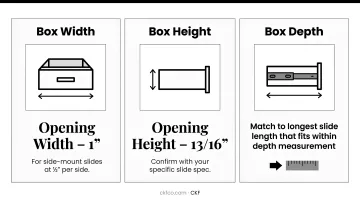
- Box width: Opening width minus ~1 inch (for side-mount slides at ½ inch per side)
- Box height: Opening height minus ~13/16 inch (confirm with your specific slide spec)
- Box depth: Match to the longest slide length that fits within your depth measurement
Step 3: Determine the Drawer Front Size
The drawer front — sometimes called the false front — is a separate calculation from the box. It needs to overlap the opening on all four sides. A common overlay approach adds approximately ½ inch per side, meaning:
- Front width: Opening width plus ~1 inch
- Front height: Opening height plus ~1 inch
Full-overlay fronts cover nearly the entire face frame; partial-overlay fronts leave a visible reveal. The exact overlap dimension varies by cabinet line and manufacturer spec — Aristokraft's 2024 documentation, for example, shows different front widths for 7/16-overlay versus full-overlay styles on the same opening. Always verify the overlay spec against your specific cabinet line before cutting.
Step 4: Account for Stacked Drawers
When multiple drawers share one base cabinet, verify that the sum of all opening heights plus the face frame rails equals the total interior cabinet height. Even a ⅛-inch discrepancy per drawer can compound quickly across a full stack.
These stacking calculations are where measurement errors tend to surface late in a project. For homeowners planning a full kitchen renovation, CKF's cabinet design team reviews these configurations during the planning phase — before anything goes to fabrication.
Drawer Box vs. Drawer Front: Understanding the Size Difference
These two components are never the same size, and confusing them is one of the most common ordering mistakes.
The drawer box is the structural storage container. It slides on the hardware and must fit inside the cabinet opening with clearance on all sides.
The drawer front is the decorative face panel you see and touch. It attaches to the box and is sized to overlap the cabinet opening — so it runs larger, not smaller.
A concrete example makes this clear:
- 24-inch-wide cabinet opening
- Drawer box: approximately 23 inches wide (after slide deduction)
- Drawer front: approximately 25 inches wide (after overlay addition)
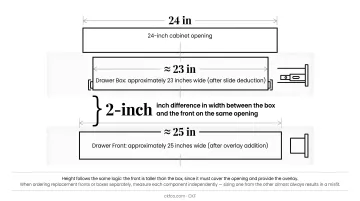
That's a 2-inch difference in width between the box and the front on the same opening.
Height follows the same logic: the front is taller than the box, since it must cover the opening and provide the overlay. When ordering replacement fronts or boxes separately, measure each component independently — sizing one from the other almost always results in a misfit.
Common Kitchen Drawer Sizing Mistakes to Avoid
Three mistakes account for most drawer sizing problems:
1. Measuring the existing drawer instead of the opening. If the original drawer was built incorrectly, measuring it compounds that error into the replacement. Always measure the opening — whether you're replacing a single drawer or ordering a full set.
2. Ignoring slide clearance when sizing the box. Side-mount slides each take up approximately ½ inch of space. Forget that deduction and your drawer box won't fit, or it will bind during operation. Undermount slides have different clearance requirements, so know which system you're using before you calculate anything.
3. Assuming overlay dimensions are universal. Front sizing depends on the specific cabinet line and overlay style. Confirm the overlay specification with your cabinet manufacturer or supplier before ordering fronts — getting this wrong means remakes, not just adjustments.
Getting these three details right upfront saves you from the most common — and costly — drawer sizing errors.
Conclusion
Kitchen drawer dimensions follow a system — modular widths, function-driven heights, hardware-specific clearances, and overlay conventions that vary by cabinet line. Understanding that system means fewer surprises when drawers arrive.
The non-negotiable starting point is always the opening measurement. Not the old drawer, not the front, not a rough estimate from the cabinet face. The opening. From there, the formulas for box size and front size follow logically, provided you've confirmed which slide hardware you're using.
With measurements locked in, match drawer type to function, verify stacked drawer heights before ordering, and treat box and front dimensions as two separate calculations. Those three habits eliminate most sizing problems before they reach your kitchen floor.
Frequently Asked Questions
What size are kitchen drawers in inches?
Standard kitchen drawers range from 12 to 36 inches wide in 3-inch increments. Height varies by function — roughly 3–5 inches for shallow utility drawers, up to 10–12 inches for deep pot drawers. Drawer box depth typically runs 20–21 inches inside a standard base cabinet.
What is the 1/3 rule for drawer pulls?
The 1/3 rule states that a bar pull should be roughly one-third the width of the drawer front — so an 8-inch pull on a 24-inch drawer front. It's a proportional guideline, not a structural rule. Before ordering, confirm whether the product lists center-to-center spacing or overall length.
What is the standard depth of a kitchen drawer?
The standard base cabinet is 24 inches deep, but the drawer box inside typically runs 20 to 21 inches — the difference accounts for the face frame, the cabinet back panel, and clearance behind the closed drawer. Slide length sets the ceiling on usable drawer depth.
What is the difference between drawer box and drawer front measurements?
The drawer box is the interior container sized to fit within the opening — narrower and shorter than the opening itself. The drawer front is the decorative panel sized to overlap the opening by roughly ½ inch on each side, making it wider and taller. Both must be measured and ordered independently.
How much clearance do you need for drawer slides?
Standard side-mount slides require approximately ½ inch per side, so subtract 1 inch total from the opening width when sizing a drawer box for that hardware type. Undermount slides generally require less — around ¼ inch per side. Always confirm clearance requirements from your specific slide's specification sheet.
When should you opt for custom drawer dimensions instead of standard sizes?
Custom dimensions make sense in a few specific situations:
- Non-standard or irregular cabinet openings
- Architectural constraints like columns or uneven walls
- Accessibility requirements that standard sizes don't accommodate
- Layout gaps that filler panels can't resolve