This choice affects more than looks. It shapes installation cost, compatibility with your existing sink or countertop, how precisely you control water temperature, and how easy the faucet is to maintain years down the road.
Below, you'll find a side-by-side comparison, clear definitions of each style, real use cases, and a practical framework to help you choose with confidence.
Key Takeaways
- Single-handle faucets use one hole and lever, making installation faster and cheaper.
- Widespread faucets need three holes, spaced 8 to 16 inches apart, for independent hot and cold control.
- Your sink or countertop's existing hole configuration often constrains your choice.
- Budget, room size, aesthetics, and repair preferences all factor into the decision.
- Coordinating faucet choice with your countertop selection early prevents costly mismatches.
Widespread vs. Single-Handle Faucets: Quick Comparison
Here's how the two styles stack up across the factors that matter most during a remodel:
| Factor | Single-Handle | Widespread |
|---|---|---|
| Cost | Lower fixture price, less labor (one hole) | Higher fixture price, more installation labor |
| Installation Complexity | Straightforward, often DIY-friendly | Requires precise alignment of three separate pieces |
| Style & Aesthetic | Modern, minimalist, streamlined | Classic, formal, traditional or transitional |
| Space Requirements | Fits compact vanities and single-bowl sinks | Needs 8-16 inches of open deck space |
| Maintenance | One cartridge, fewer connections to service | Handles can be repaired independently, but more supply lines overall |
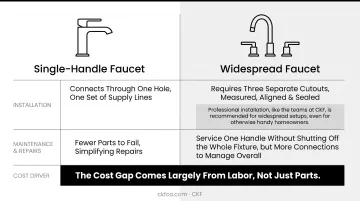
The cost gap comes largely from labor, not just parts. A single-handle faucet connects through one hole with one set of supply lines, while a widespread model requires three separate cutouts to be measured, aligned, and sealed correctly. That extra precision is why professional installation — like the teams at CKF — is recommended for widespread setups, even for otherwise handy homeowners.
Maintenance tells a similar story. Single-handle faucets have fewer parts to fail, which simplifies repairs. Widespread faucets let you service one handle without shutting off the whole fixture, a real advantage if a hot-side cartridge wears out, but you're managing more connections overall.
What Is a Single-Handle Faucet?
A single-handle faucet requires just one hole. The handle and spout are built into a single unit, and one lever controls both temperature and flow. Push it up for more water, swing it left or right to adjust hot and cold.
This design offers real practical advantages:
- Faster, cheaper installation since there's only one hole to drill or fit.
- Fewer parts and connections, which means less that can leak or wear out.
- Easier one-handed operation, useful for anyone juggling dishes, kids, or mobility limitations.
That last point connects to accessibility standards. The 2010 ADA Standards for Accessible Design require faucet controls to work with one hand, without tight grasping, pinching, or wrist twisting, and with no more than 5 pounds of activation force.
This rule governs how a faucet operates, not how many handles it has. Not every single-lever model is automatically ADA-compliant, so check the manufacturer's specification sheet to confirm.
There's also a middle-ground option worth knowing: the centerset faucet. It uses three holes like a widespread model, but the handles and spout are fused onto one base plate, spaced just 4 inches apart. It splits the difference between single-hole simplicity and widespread's independent controls.
Where Single-Handle Faucets Work Best
Single-handle faucets tend to fit best in:
- Small bathrooms and powder rooms with limited counter space
- Kids' bathrooms or senior-friendly spaces where one-hand operation matters
- Minimalist kitchen designs favoring clean lines
For kitchens especially, pull-down single-handle faucets have become a popular retrofit choice. CKF's Lulani collection includes several examples, like the Soneva, with its coil-style pull-down spout, and the Yasawa, which pairs a curved high-arc design with a two-function spray head. Both keep the single-lever simplicity while adding functional flexibility at the sink.
What Is a Widespread Faucet?
A widespread faucet uses three separate components: a hot handle, a cold handle, and a spout, none of which are physically connected above the counter. According to Kohler's widespread faucet specifications, these pieces are typically installed 8 to 16 inches apart, measured center to center between the hot and cold handles.
This spacing creates two meaningful benefits: precise independent temperature control, since each handle operates its own valve, and modular repairability, meaning a worn cartridge on one handle can be serviced without shutting down the entire faucet.
Handle style adds another layer of choice. Widespread faucets come in lever, cross, or knob configurations, and the spread width itself (closer to 8 inches versus a full 16) affects both how the faucet functions and how it reads visually on a large vanity.
Where Widespread Faucets Work Best
Widespread faucets are generally better suited to larger sink decks, where their separately installed pieces allow more layout flexibility. That makes them a natural fit for:
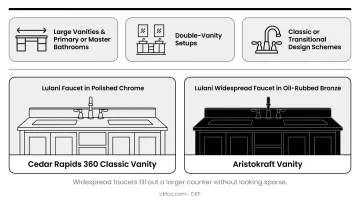
- Large vanities and primary or master bathrooms
- Double-vanity setups where symmetry and spacing matter
- Classic or transitional design schemes
In CKF showroom displays, this pairing shows up often. A Cedar Rapids 360 Classic vanity, for instance, uses a Lulani faucet in polished chrome across a double-sink layout, while an Aristokraft vanity display pairs a Lulani widespread faucet in oil-rubbed bronze with a double-sink configuration. Both illustrate how widespread faucets fill out a larger counter without looking sparse.
Which Faucet Is Right for You?
Weigh these factors together rather than picking just one:
- Budget - single-handle costs less in parts and labor.
- Existing hole configuration - your current sink or countertop may already dictate the answer.
- Available counter space - widespread needs 8-16 inches; tight vanities don't have it.
- Desired water control - independent hot/cold versus one-lever simplicity.
- DIY comfort level - single-handle is easier for a confident homeowner to install.
- Who uses the faucet daily - kids, older adults, or anyone needing one-hand operation.
Choose single-handle if you're budget-conscious, working with a small space, want easy cleaning, or need accessible one-hand operation.
Choose widespread if you have a large vanity, want a classic look, prefer separate hot and cold control, or plan to have CKF's installation team handle the setup anyway.
Special Considerations for Remodels
Before you fall in love with a faucet style, check your sink or countertop's pre-drilled hole configuration. It's the single biggest practical constraint in this decision. Unless you add a deck plate or cut new holes, that existing pattern dictates your options:
- 0-inch spread (one hole) = single-hole faucet only
- 4-inch spread (centerset) = centerset faucet only
- 8+ inch spread = widespread faucet
Working with a one-stop provider that handles both cabinetry and custom countertop fabrication, like CKF, helps keep sink cutouts and faucet selection coordinated from the start. That avoids extra appointments and mismatched specs between what you ordered and what your countertop was actually cut for.
Hole configuration isn't the only spec worth confirming early. Water efficiency deserves a look too. EPA WaterSense-labeled options exist in both configurations, and current bathroom faucet standards cap flow at 1.5 gallons per minute at 60 psi. Kitchen faucets follow a separate federal maximum of 2.2 gpm and don't qualify for the WaterSense label at all, so don't mix up the two when comparing efficiency claims.
A Common Remodel Pitfall
Here's a scenario that plays out more often than homeowners expect: a countertop gets templated for a single-hole faucet. Partway through the project, the homeowner decides they'd rather have a widespread faucet's classic look. Problem is, cabinets and countertop cutouts can't be modified once templating is complete without remaking the slab.
This rule isn't unique to any single fabricator. Manufacturers require the selected sink and faucet to be on-site or fully specified before templating happens, precisely because holes get cut based on that fixture. Once that template is locked in, a change means new material, new labor, and a delay you didn't plan for.
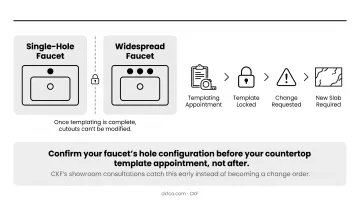
Confirm your faucet's hole configuration before your countertop template appointment, not after. If you're working with a design team that handles cabinetry, countertops, and fixtures together, like CKF's showroom consultations, this gets caught early instead of becoming a change order.
Conclusion
There's no universal winner between single-handle and widespread faucets. The right choice depends on matching your space, budget, and design goals to your specific kitchen or bathroom.
Getting it right pays off in cost control, easier long-term maintenance, and a finished look that feels intentional rather than improvised.
Partnering with a one-stop provider like CKF, which handles design, fabrication, and installation together, helps ensure your fixture choice lines up with your cabinetry and countertop plans from day one, not as an afterthought.
Frequently Asked Questions
Should I get a single or widespread bathroom faucet?
It depends on your vanity size, budget, and style preference. Choose single-handle for smaller spaces or tighter budgets; choose widespread for larger vanities and a classic look.
What faucets do plumbers prefer?
Durability-focused professionals tend to favor solid brass bodies and ceramic disc valves, which resist corrosion and mineral buildup better than lower-grade alternatives. This holds true regardless of single-handle or widespread configuration.
What is the difference between widespread and standard faucets?
"Standard" typically refers to centerset faucets, which have handles spaced 4 inches apart on one base plate. Widespread faucets use separate components spaced 8 to 16 inches apart.
Do faucet holes need to match my countertop cutout?
Yes, your countertop's pre-drilled holes must align with your faucet's spacing before fabrication. If you're switching faucet styles during a remodel, confirm hole spacing early in the design process to avoid costly rework.
How do I know what size faucet fits my existing sink?
Measure the spacing between your sink's pre-drilled holes: 0 inches means single-hole, 4 inches means centerset, and 8 inches or more means widespread. This measurement determines your available options.
Can I install a widespread faucet myself, or do I need a plumber?
Widespread faucets involve aligning three separate components precisely, which is more complex than a single-hole install. Professional installation is generally recommended for the best fit and fewest leaks.