Choosing a cabinet style is also a long-term commitment. According to Houzz's 2025 Kitchen Trends Study, 69% of kitchen renovators replaced all cabinets during a remodel — a decision that touches aesthetics, resale value, daily functionality, and how well the kitchen reads within the rest of the home.
This guide covers the most popular kitchen cabinet styles, what makes each one distinct, and how to pick the right option for your space, lifestyle, and budget.
Key Takeaways
- Cabinet style is defined by door panel design, ornamentation level, and overall silhouette — not just finish or color.
- Shaker is the most popular style by a wide margin, chosen by 61% of renovators in Houzz's 2025 study.
- Flat-panel suits modern kitchens; raised panel suits formal traditional ones; transitional works across both.
- Inset construction adds a furniture-grade look but costs more and requires careful humidity management, especially in the Midwest's variable climate.
- The best style choice balances design direction, kitchen scale, cleaning habits, and budget — not appearance alone.
What Are Kitchen Cabinet Styles and Why Do They Matter?
Cabinet style refers to the visual design of the cabinet door and frame — the panel type, surface texture, level of detail, and overall silhouette. Together, these elements shape whether a kitchen feels sparse and modern, warm and traditional, or somewhere in between.
The choice matters beyond aesthetics for three practical reasons:
- Cost weight: Cabinets represent one of the largest budget line items in any kitchen remodel. A midrange major kitchen remodel averages $82,793 nationally, and cabinetry absorbs a significant portion of that.
- Permanence: Unlike paint colors or hardware, cabinets are disruptive and expensive to replace. Most homeowners live with their choice for a decade or more.
- Practical function: Door profile affects how easy cabinets are to clean, which hardware works with them, and how well they coordinate with countertops and other finishes.
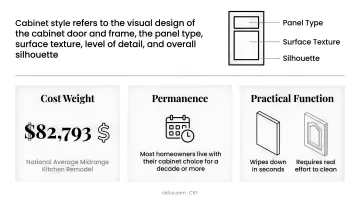
A flat surface wipes down in seconds. A raised panel with curved molding and routed edges requires real effort. That difference plays out every single time someone cooks a meal — and compounds over years of daily use.
Types of Kitchen Cabinet Styles
No single style works for every kitchen. The right option depends on the design direction, the home's existing character, and how the kitchen will actually be used day to day.
Shaker Style
Shaker cabinets feature a five-piece door with a flat recessed center panel framed by four rails — a clean, structured profile that traces its origins to 18th-century Shaker furniture design. The Metropolitan Museum of Art documents the Shaker community's arrival in America in 1774 and their furniture tradition emphasizing utility, proportion, and restrained ornament.
That restraint is what makes Shaker so durable as a design choice. It sits between the plainness of flat-panel and the formality of raised panel — adaptable enough for modern, farmhouse, transitional, and traditional kitchens alike.
It's also the dominant choice by a significant margin. Shaker represented 61% of primary door style selections in Houzz's 2025 study, nearly three times flat-panel's 22%.
Why Shaker works so broadly:
- Available in the widest range of colors and finishes across virtually every cabinet brand
- Pairs naturally with both simple bar pulls and more traditional cup hardware
- Transitions well between paint and stain finishes — white, navy, sage, black, and wood tones all read well
- Compatible with kitchens that open to both traditional and contemporary living spaces
One maintenance note: the recessed panel groove collects grease and dust over time. Regular wipe-downs keep it clean, but it takes more effort than a flat surface.
Flat-Panel (Slab) Style
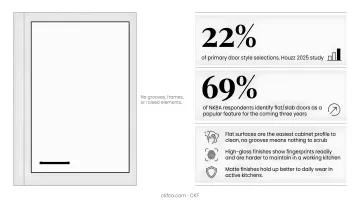
Flat-panel, or slab, cabinets have a single smooth door with no grooves, frames, or raised elements. The entire door face is one uninterrupted surface, which suits modern, contemporary, and minimalist kitchens well.
Because the door provides no decorative detail on its own, visual interest has to come from elsewhere: bold color, premium material, or statement hardware. Without that intentional layering, the result can feel cold or unfinished.
Flat-panel held 22% of primary door style selections in Houzz's 2025 study. Looking ahead, 69% of NKBA respondents identified flat/slab doors as a popular feature for the coming three years — the strongest professional forward-looking signal of any style.
Practical considerations:
- Flat surfaces are the easiest cabinet profile to clean — no grooves means nothing to scrub
- High-gloss finishes show fingerprints readily and are harder to maintain in a working kitchen
- Matte finishes hold up better to daily wear in active kitchens
Raised Panel Style
Raised panel doors have a center panel elevated above the surrounding frame, often with a contoured or profiled edge. The result is a three-dimensional, sculptural door that reads as formal and traditional.
This style suits classic, Tuscan, French country, and formal traditional kitchens. It adds visual weight and elegance that neither Shaker nor flat-panel can replicate — pairing naturally with rich wood stains, ornate hardware, and crown molding details. Raised panel accounted for 12% of primary door style selections in Houzz's 2025 study.
The tradeoffs are real. More surface complexity means more cleaning effort — every profile and contour collects grease in a kitchen environment. Fabrication also involves additional steps compared to simpler profiles, which is reflected in cost.
Inset Style
Inset is a construction method, not just a door profile. The door sits flush inside the cabinet frame rather than overlapping it, leaving the frame visible and creating a seamless, furniture-grade appearance. The hinges become part of the design rather than hidden behind the door.
Inset doors can be combined with any panel style — Shaker, flat, or raised — which makes them flexible. What makes them expensive is precision. Manufacturing and installation require tighter tolerances than overlay doors, and that craftsmanship carries a cost premium.
CKF carries Fieldstone cabinetry, which offers inset construction including the Starling Inset door style in maple. For homeowners who want a truly custom, furniture-quality look, inset is worth exploring at the showroom level.
One critical consideration for Midwest homes: wood movement caused by humidity changes can cause inset doors to stick or misalign over time. Aristokraft recommends maintaining 30–55% relative humidity to minimize seasonal wood expansion and contraction — a real concern given the temperature swings across Iowa, Nebraska, and Kansas.
Glass-Front Style
Glass-front cabinets replace the solid wood panel with glass — clear, frosted, seeded, or leaded — allowing contents to be partially or fully visible. The effect is lighter, more open, and more furniture-like than solid cabinetry.
These work best as accents, not as a full-kitchen approach. Using glass-front doors on a few upper wall cabinets opens up what would otherwise feel like a heavy run of solid cabinetry, while retaining practical closed storage everywhere else. When Houzz asked renovators to name their primary door style, glass-front registered at only 3% — but that figure doesn't capture its widespread use as a selective accent.
What glass-front cabinets require:
- Organized, tidy interiors at all times — everything inside is visible
- Two-step cleaning (interior and exterior glass surfaces)
- Thoughtful content selection — glassware, heirloom dishware, and decorative items work; everyday mismatched items don't
Transitional Style
Transitional design blends traditional warmth — natural materials, subtle detail — with contemporary restraint: cleaner lines and less ornament. The result feels neither dated nor starkly modern.
It's the most popular completed kitchen style in Houzz's 2025 study at 25%. Separately, 72% of NKBA respondents identified transitional/timeless design as the top direction for the next three years. That consistency across two different professional surveys is a strong signal that transitional isn't a trend — it's a long-term safe bet.
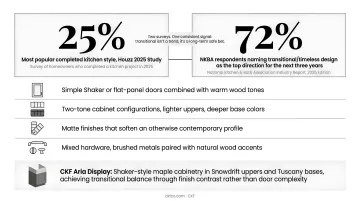
Transitional is often achieved through pairing rather than a single door style. Common approaches include:
- Simple Shaker or flat-panel doors combined with warm wood tones
- Two-tone cabinet configurations (lighter uppers, deeper base colors)
- Matte finishes that soften an otherwise contemporary profile
- Mixed hardware — brushed metals paired with natural wood accents
CKF's showroom displays demonstrate this well: the Aria display pairs Shaker-style maple cabinetry in Snowdrift uppers and Tuscany bases, achieving a transitional balance through finish contrast rather than door complexity.
How to Choose the Right Kitchen Cabinet Style
The right style sits at the intersection of design goals, practical needs, budget, and how you actually use the kitchen — not what's photographed in a showroom.
Match the Style to the Home's Design Direction
Cabinet style doesn't exist in isolation. A sleek flat-panel kitchen that opens directly into a traditionally decorated living space creates visual friction. An ornate raised panel kitchen attached to a clean contemporary home has the same problem.
Look at the architectural character of the home — trim profiles, door styles, ceiling details — and choose a cabinet style that extends rather than contradicts it.
Account for Kitchen Scale
Larger ornamental profiles can make smaller kitchens feel more enclosed. In compact kitchens:
- Flat-panel and transitional styles with lighter finishes keep the space feeling open
- Glass-front uppers on at least a portion of the run add visual depth
- Floor-to-ceiling cabinetry (when ceiling height allows) maximizes storage without making the room feel smaller
In larger kitchens, raised panel and more detailed profiles have room to breathe without overwhelming the space.
Be Honest About Maintenance
What looks stunning in a showroom is cleaned before every visitor. A working kitchen is different. Before choosing a style with intricate profile work or high-gloss finish, consider:
- How often you cook (daily vs. occasional)
- Whether you have young children or a busy household
- Whether you're comfortable with regular detailed cleaning
Flat surfaces and matte finishes are the most forgiving. Raised panel profiles and high-gloss finishes demand more consistent upkeep.
How Cabinet Tier Shapes Your Style Options
Your cabinet style options are partly determined by which construction tier you're working within:
| Tier | What It Means |
|---|---|
| Stock | Fixed standard sizes, most affordable, limited finish options |
| Semi-custom | More sizes, finishes, and modifications at mid-range pricing |
| Custom | Built to exact specifications, broadest choices, highest cost |
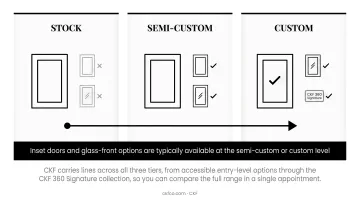
Inset doors and glass-front options are typically available at the semi-custom or custom level — worth knowing before you fall for a look that's out of reach at the stock tier. CKF carries lines across all three tiers, from accessible entry-level options through the CKF 360 Signature collection, so you can compare the full range in a single appointment.
Common Mistakes to Avoid When Choosing Cabinet Styles
Choosing Based on Trend Rather Than Fit
Cabinet installations are costly and disruptive to replace. Styles that read as highly trend-specific — an unusual color combination, a niche door profile, a novelty finish — can feel dated faster than timeless options like Shaker, transitional, or raised panel in neutral tones. The NKBA's 72% transitional/timeless forecast reflects what professionals expect to age well — not what's trending on social media this season.
Evaluating the Door Style in Isolation
The cabinet door is one element in a larger system. It has to work with:
- Countertop material and edge profile
- Hardware finish (brushed nickel, matte black, brass)
- Backsplash texture and pattern
- Flooring and wall color
- Lighting (pendant style, under-cabinet)
Previewing these elements together — not sequentially — is how coordinated kitchens come together. CKF's showroom displays are built specifically for this: complete vignettes that show how cabinetry, countertops, hardware, and sinks read as a whole rather than as separate decisions.
Cleaning Burden Varies More Than You'd Expect
That same decision-making lens applies to upkeep. A louvered door, an intricate raised panel profile, or a high-gloss slab finish that looks perfect in a showroom can become a daily frustration in a real kitchen. Before committing, ask to see a sample in a working environment — or at least think through how you'd clean every surface several times a week.
Conclusion
Kitchen cabinet styles range from the quiet simplicity of flat-panel and Shaker designs to the formal depth of raised panel and glass-front options. Each suits a different home, household routine, and budget — and the right choice depends on how all three intersect.
The strongest cabinet choices come from looking at the whole picture: the home's existing design, the kitchen's scale, your actual cleaning habits, and how long you expect to live with the result. Working with an experienced design team helps avoid the costly mismatches that come from making these decisions in isolation.
CKF's showroom locations across the Midwest are built for exactly this process. Homeowners and trade professionals can work through style, material, and budget decisions with cabinetry, countertops, hardware, and sinks all visible together in one place.
Frequently Asked Questions
What are the different styles of kitchen cabinets?
The main kitchen cabinet styles include Shaker, flat-panel (slab), raised panel, inset, glass-front, and transitional — each defined by its door panel design, level of ornamentation, and the aesthetic it creates. Inset describes how the door fits the frame; transitional describes an overall design direction rather than a specific door construction.
What style kitchen cabinet is most popular?
Shaker-style cabinets are consistently the most popular choice. Houzz's 2025 Kitchen Trends Study found Shaker represented 61% of selected door styles — nearly three times the share of flat-panel at 22%. That popularity comes from how well it adapts to modern, farmhouse, and traditional kitchens alike.
What is the difference between inset and overlay cabinet doors?
Overlay doors sit on top of the cabinet frame (either partial or full overlay), while inset doors are set flush inside the frame. Inset doors create a seamless, furniture-like appearance with visible hinges but require tighter manufacturing tolerances and more precise installation — making them more expensive than standard overlay options.
What is the difference between stock, semi-custom, and custom cabinets?
Stock cabinets come in fixed sizes at the lowest cost; semi-custom offer more finish and size options at mid-range pricing; custom are built to exact specifications at the highest cost. Note that some styles — inset and glass-front in particular — are typically only available at the semi-custom or custom level.
How do I choose a cabinet style that will still look good in 10 years?
Prioritize timeless profiles — Shaker, transitional, and raised panel in neutral tones — over trend-driven styles, and invest in finish quality: well-applied paint or stain on solid materials outlasts novelty finishes that are hard to touch up over time.