Introduction
Standing in the plumbing aisle, faucet in hand, you realize you have no idea if it'll actually fit your sink. Sound familiar?
Homeowners renovating their kitchen hit this wall constantly: pull-down or pull-out faucet? The two look similar in photos, but they behave very differently once installed.
This decision affects more than curb appeal. It shapes how much water splashes onto your counters, whether your faucet clears the cabinet above it, and how comfortably you'll fill a stockpot five nights a week.
This guide breaks down both styles so you can match the right one to your sink depth, cabinet space, and cooking habits.
Key Takeaways
- Pull-down faucets work well with deep sinks, offering a natural, wrist-friendly downward motion for rinsing.
- Pull-out faucets suit shallow sinks and low cabinets, offering better horizontal reach for filling pots.
- Neither style wins universally — sink depth and cabinet clearance decide the winner.
- Coordinate faucet choice with your sink and countertop plans before finalizing either one.
Pull-Down vs. Pull-Out Faucets: Quick Comparison
Here's how the two styles stack up across the factors that matter most during a remodel:
| Factor | Pull-Down Faucet | Pull-Out Faucet |
|---|---|---|
| Spout style & motion | Tall gooseneck spout; spray head pulls straight down into the basin | Lower-profile spout; spray head pulls outward toward the user |
| Best sink type | Deep basins that contain splash from a high-arc spout | Shallow or compact sinks where a tall arc isn't practical |
| Cabinet clearance | Needs headroom; can crowd low cabinets or windows | Flatter profile fits under low-hanging cabinets or shelving |
| Hose reach | Shorter, in-sink focused motion | Longer, sideways reach, better for counter-side pots |
| Ergonomics | Downward pull works with gravity, gentler on wrists | Outward pull plus a wrist twist to aim water |
A quick gut check: if your sink is deep and your cabinet has breathing room above it, lean pull-down. If you're working with a shallow basin or a cabinet that hangs low, pull-out usually wins.
One caveat: hose length numbers on spec sheets aren't apples-to-apples. Delta's 470-DST pull-out lists a 53-inch hose with 34 inches of usable extension, which is a very different number than "total hose length." Always check usable reach, not just the headline figure.
Understanding Pull-Down and Pull-Out Faucets
What Is a Pull-Down Faucet?
A pull-down faucet has a tall, high-arc spout with a spray head that retracts by pulling straight down into the sink. The motion works with gravity, not against it, which is why plumbers often describe pull-down models as gentler on the wrist during repetitive tasks.
Core benefits:
- Wider spout height covers more of a large or deep basin
- Multifunctional heads typically offer stream, spray, and pause settings
- Reduces strain during extended washing sessions
Variations exist across finish and spray technology. Moen's Power Clean feature, for instance, is engineered to deliver 50% more spray power than most pull-down and pull-out faucets while still containing splash. Today's spray heads offer far more control than a basic on/off nozzle.
Best for: Deep single-basin sinks, kitchens with open space above the sink, and cooks who regularly wash oversized pots, sheet pans, or produce.
What Is a Pull-Out Faucet?
A pull-out faucet uses a lower-profile spout, and the spray head extends outward toward the user instead of dropping down. That horizontal motion is the entire point: it's built for reach, not depth.
Core benefits:
- Compact footprint fits tight or low-clearance installs
- Longer horizontal extension makes pot-filling easier
- Dual-function spray heads (stream and spray) are standard on most models
CKF's Lulani faucet collection uses this exact configuration. The line includes the Bali, Bora Bora, Cebu, Maldives, Nassau, and Soneva models, each featuring a two-function pull-out spray head, 360-degree swivel spout, brass body, and ceramic disk valve for drip-free performance.
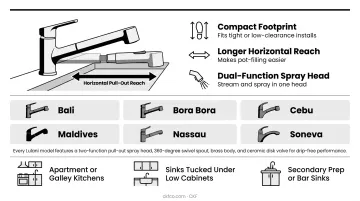
Best for: Apartment or galley kitchens, sinks tucked under low cabinets, and secondary prep or bar sinks where a tall spout would look out of place.
Pull-Down vs. Pull-Out: Which Is Better for Your Kitchen?
There's no universal winner here. "Better" comes down to four practical questions:
- How deep is your sink? Deep basins contain the splash from a pull-down's high arc.
- How much clearance is above the faucet? Low cabinets and windows favor a pull-out's flatter profile.
- How do you use water outside the basin? Filling a stockpot on the counter favors pull-out reach.
- What feels comfortable in your hand and wrist? Downward motion is often gentler over time.
Choose pull-down if:
- Your sink is deep enough to contain splash from a taller spout
- You have open space above the sink
- You prioritize ergonomic, splash-free rinsing over horizontal reach
Choose pull-out if:
- Your sink is shallow or your cabinets hang low
- You frequently fill large pots on the counter
- You want a lower-profile look under a window
Finish and material can tip the scale when both styles otherwise perform equally. Manufacturers like Delta, Kohler, and Moen publish resistance claims for named coating systems, and Delta's Brilliance finish, for example, is tested against more than 100 household cleaners.
Still, no independent source ranks stainless, brass, or matte black as inherently more durable than the others. The coating process matters more than the color itself.
Spray head technology has also narrowed some of the historical gaps between these two styles. Magnetic docking, pause modes, and boosted flow settings mean a well-equipped pull-out can now handle tasks that once required a pull-down. Your daily habits often matter more than the mechanism itself. Stop by a CKF showroom to test pull-down and pull-out models, including our Lulani faucet line, before you decide.
Choosing the Right Faucet for Your Kitchen Remodel
Faucet selection shouldn't happen in a vacuum. It needs to be planned alongside your sink size, countertop overhang, and cabinet layout — otherwise you risk a mismatch that's expensive to fix after installation.
Common planning pitfalls:
- Ordering a pull-down faucet for a shallow sink, then dealing with splash on the counter
- Choosing a tall spout without measuring the cabinet or window clearance above it
- Selecting a sink with no faucet holes (common on some apron-front models) without confirming a wall- or counter-mount faucet fits the space
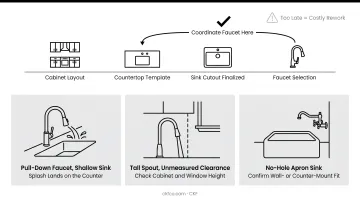
CKF's design team works as part of a one-stop-shop cabinet and countertop service, helping homeowners and trade professionals coordinate faucet placement with custom countertop and sink configurations before cutouts are finalized.
This coordination matters: sink cutouts and counter depth are typically locked in before faucet selection. Getting the sequence right avoids costly rework.
If you're planning a remodel, loop in a countertop and cabinetry specialist early. It's a lot easier to adjust a plan on paper than to redrill a countertop after the fact.
Conclusion
Pull-down faucets excel in deep sinks and ergonomic rinsing. For compact kitchens and pot-filling tasks, pull-out faucets are the better fit. Neither is a universal winner — the right pick depends on your specific sink and layout, not a marketing claim.
Thinking through sink depth, cabinet space, and daily habits before buying prevents a mismatch you'll notice every day at the sink. Pairing that decision with expert countertop and cabinetry guidance, like the in-house design consultations CKF's showroom team provides, helps ensure the faucet, sink, and counter all work together from day one.
Frequently Asked Questions
Which is better, a pull-down or pull-out faucet?
Neither is universally better. Pull-down suits deep sinks and ergonomic rinsing, while pull-out suits shallow sinks and pot-filling. The right choice depends on your sink depth and cabinet space.
What is the difference between pull-out and pull-down?
Pull-down spray heads retract downward into the sink with a taller spout. Pull-out spray heads extend outward toward the user with a lower-profile spout.
Can I install a pull-down faucet in a shallow sink?
Shallow sinks risk splashing with a pull-down's high-arc spout, so it's not recommended. This Old House recommends at least a 10-inch-deep basin; a pull-out or low-arc faucet is safer for shallower sinks.
Do pull-out faucets work well for filling large pots?
Yes. Pull-out faucets typically have longer, sideways-reaching hoses, making them better suited for filling pots placed on the counter beside the sink.
How long do pull-down and pull-out faucets typically last?
Lifespan depends more on hose quality, finish durability, and usage frequency than on mechanism type. Check the manufacturer's warranty details for specific coverage terms.
Which faucet style is best for small kitchens or apartments?
Pull-out faucets generally work best for small or low-clearance kitchens, thanks to their compact profile and cabinet-friendly design.