Introduction
Walk into almost any kitchen showroom and you'll see it: crisp white cabinets paired with a granite slab full of movement and mineral flecks. White amplifies light while granite adds texture that a flat surface just can't match, which is why the pairing stays in demand.
Here's where homeowners get tripped up. They picture "white granite" as pure, snow-white stone. In reality, every slab carries natural veining and undertones in gray, taupe, beige, or gold.
This guide breaks down the best granite colors for white cabinets, how to match stone to your kitchen's style, backsplash pairings that work, and what real maintenance looks like once it's installed.
Key Takeaways
- White granite always contains natural veining or mineral undertones: true pure-white slabs don't exist
- Match your granite's warm or cool undertone to your kitchen's lighting, wood tones, and hardware
- The combo suits farmhouse, traditional, transitional, and modern kitchens alike
- Annual sealing and simple daily cleaning keep white granite looking sharp for decades
Why White Cabinets and Granite Countertops Remain a Timeless Pairing
White cabinets bounce natural and artificial light around a room, making even smaller kitchens feel open. Granite brings the opposite energy: organic movement, depth, and one-of-a-kind pattern that a solid-color surface simply can't replicate. Put them together and you get a kitchen that feels bright but never sterile.
This pairing isn't a passing trend. It's one of the most consistently requested combinations in kitchen design, and the numbers back that up.
White cabinets remain the top choice among renovating homeowners. Houzz's 2024 Kitchen Trends Study found white was the most common cabinet color at 46% of renovated kitchens, up six points year over year. That figure comes from a survey of 3,437 U.S. homeowners renovating their kitchens.
Even as wood tones have gained ground more recently, white has held strong as a leading choice rather than fading out.
Resale value reinforces the appeal. An upscale kitchen remodel featuring custom white cabinetry and stone countertops recouped 35.7% of project cost at resale, per the 2025 Cost vs. Value report. That figure covers the entire remodel, not granite alone, but it confirms buyers still associate white cabinetry and stone counters with a premium, well-finished kitchen.
Best Granite Countertop Colors for White Cabinets
Before you fall in love with a photo online, "white granite" is a category, not a single color. It refers to stone with a light, dominant background carrying natural speckling or veining in gray, taupe, brown, or gold. No two slabs read exactly the same, even within the same variety.
That variation is the whole appeal. It's also why choosing the right undertone matters more than chasing the "whitest" option.
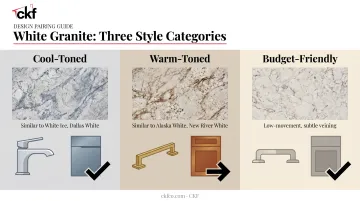
Cool-Toned White Granite (Best for Modern & Contemporary Kitchens)
Cool-toned slabs carry blue-gray, silver, or charcoal veining against a light field. Think styles similar to White Ice or Dallas White. These pair naturally with:
- White or light gray cabinetry
- Chrome or polished nickel fixtures
- Cool-toned tile backsplashes
- Minimalist, low-clutter kitchen layouts
CKF's catalog includes comparable cool-white options like White Napoli, a light gray-to-white base flecked with darker gray and black mineral markings.
Warm-Toned White Granite (Best for Traditional & Farmhouse Kitchens)
Warm-toned white granite leans into brown, gold, or rose undertones, closer to styles like Alaska White or New River White. These slabs complement:
- Wood tones in flooring, beams, or open shelving
- Brass and matte gold hardware
- Warmer lighting temperatures
- Raised-panel or shaker cabinet doors
CKF stocks similar warm-neutral options, including White Alamo (white background with brown and black speckling) and Delicatus Ice (creamy beige and gray tones with varied movement).
Budget-Friendly White Granite Picks
Lower-variation, more uniform stones deliver the white granite look without the premium price tag of dramatic, high-movement slabs. Options in this category, similar to Moon White or White Ornamental, usually cost less than high-movement slabs.
At CKF, Majestic White and White Napoli fall into the entry-level Tier A pricing category, while more dramatic patterned options like White Lava and Tangier sit in the higher Tier D range.
Photos only tell part of the story with natural stone. Screen colors and lighting can shift how a slab actually reads, so seeing the real slab beside your cabinet door sample is the only way to know it works.
CKF's in-house fabrication facility and long-standing supplier relationships let you compare granite slabs and cabinet finishes side by side before you sign off.
Design Styles: Matching Granite to Your Kitchen Aesthetic
The right granite should reinforce the overall style you're going for, not only match your cabinets.
Modern & Contemporary Kitchens
Cool-toned granite with minimal, tight veining suits flat-panel white cabinets well. CKF's 360 Signature line, for example, is shown with white flat-panel doors in a minimalist setup. Pair that with:
- A waterfall-edge island for a sleek, continuous look
- Minimal hardware or handle-less doors
- Polished chrome or satin nickel fixtures
Traditional & Classic Kitchens
Warmer, more dramatic granite patterns feel right at home with raised-panel white cabinetry, like the Aria Snowdrift line's raised-panel doors. Round out the classic look with:
- Ornate cabinet hardware
- An ogee-edge countertop profile
Farmhouse & Transitional Kitchens
Mixed-neutral granite pairs naturally with shaker-style white cabinets. CKF's Fieldstone and 360 Elements lines both offer white shaker doors well suited to this look. Add an apron-front sink and natural wood open shelving for warmth.
Two design moves worth calling out:
- Two-tone kitchens. White uppers with contrasting lower cabinets (navy, sage, charcoal) are increasingly common. The granite acts as the visual bridge between both tones.
- Statement islands. A bolder or darker granite on the island against white perimeter cabinets creates instant contrast. NKBA's 2024 Kitchen Trends Report found 68% of designers pair islands with a different cabinet color or finish than the rest of the room.
Backsplash & Finishing Touches to Complement White Cabinets and Granite
Your backsplash choice can either let the granite shine or compete with it. Classic subway tile remains the safest, most timeless route: it's neutral, low-maintenance, and keeps the countertop pattern as the visual focal point.
Extended-granite backsplashes, where the same slab runs partway or fully up the wall, do the same job while adding a seamless look. CKF's in-house fabrication supports full-height granite backsplash work cut to match the countertop slab precisely.
Want more texture? Consider:
- Herringbone-pattern tile for subtle movement
- Natural stone mosaics for organic contrast
- Patterned tile in neutral tones only (busy patterns plus busy granite quickly overwhelm a space)
Hardware finishes matter more than most people expect. Brass or matte gold fixtures amplify warm-toned granite's gold and brown flecks, while chrome or nickel finishes sharpen cool-toned, gray-veined slabs. Match the metal to the stone's undertone, not just the cabinet color.
Pros, Cons & Maintenance Tips for White Granite Countertops
Granite earns its reputation honestly. Consumer Reports rated granite highly for stain, heat, and scratch resistance, noting it's harder and less porous than several other natural stone options. It even survived a weighted, 400°F heated-pan test without marking.
Pros:
- Heat resistant enough to handle hot pans directly
- Scratch-resistant for daily kitchen use
- Adds long-term resale value and design versatility
- No two slabs look alike, so every kitchen gets a one-of-a-kind surface
Cons:
- Requires periodic sealing since granite is naturally porous
- Light color shows spills, crumbs, and fingerprints more visibly than darker stone
- Natural variation means the slab you install may differ from the showroom sample
For upkeep, keep it simple:
- Wipe down daily with mild dish soap and warm water
- Test the seal annually: drop water on the surface; if it beads up, the seal is holding; if it soaks in, it's time to reseal
- Avoid acidic or abrasive cleaners like citrus sprays, vinegar (undiluted), or bleach, which break down sealant over time

CKF applies sealer before installation and recommends more frequent resealing for high-traffic kitchens. Pros can handle resealing later if you prefer not to DIY.
Some materials, like Sensa Granite by Cosentino, include a 15-year transferable warranty and built-in stain resistance that cuts how often sealing is needed. Ask your design team for a sealant schedule that matches how you actually use the kitchen.
Frequently Asked Questions
Is white granite a good choice for kitchen countertops?
Yes. It offers strong heat and scratch resistance along with design flexibility that lasts for years, so it holds up well in a busy kitchen. It does require periodic sealing to maintain stain resistance.
Are white countertops still in style?
Yes. Light-toned countertops remain a popular choice, especially paired with white or two-tone cabinetry, and they still suit both classic and modern kitchens.
What's the difference between white granite and white quartz for a white kitchen?
Granite is natural stone with unique veining in every slab and needs occasional sealing, while quartz is engineered for a more uniform look and doesn't require sealing at all. Both perform well against heat and scratches.
Does granite have to match the cabinet color exactly?
No — and honestly, it often looks better when it doesn't. Complementary or contrasting undertones create a more dynamic, layered look than an exact color match.
How much do white granite countertops cost?
Pricing depends on the slab's rarity, pattern, and origin, with both budget-friendly and premium options available. Getting a personalized quote is the best way to nail down actual cost for your kitchen.
How often does white granite need to be sealed?
Most kitchens benefit from resealing about once a year, though high-traffic kitchens may need it more often. A simple water-bead test tells you exactly when it's due.