Cabinets can account for 40% or more of a total kitchen remodel budget, which means a misinformed choice is expensive to correct. Yet most homeowners are comparing solid wood, plywood, MDF, laminate, and thermofoil based on showroom appearance alone — not performance specs.
This guide breaks down each major cabinet material: what it's made from, where it performs best, and where it fails. The goal is to help you match material to location, budget, and lifestyle before making a commitment you'll live with for decades.
Key Takeaways
- Cabinet material directly affects durability, moisture resistance, maintenance load, and long-term cost
- Natural materials like solid wood and plywood offer beauty and longevity; engineered options like MDF and laminate prioritize consistency and low upkeep
- No single material is best for every location — matching material to kitchen zone matters as much as matching it to budget
- Midwest humidity swings make moisture resistance a deciding factor for any wood-based cabinet material
- Most kitchens benefit from mixing materials rather than relying on a single option throughout
Why Cabinet Material Matters More Than You Think
Most homeowners treat cabinet material as an aesthetic choice — it's actually a performance decision.
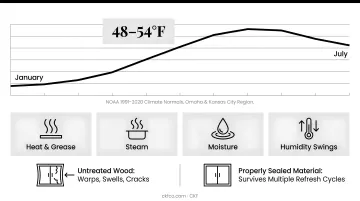
The kitchen is one of the most demanding environments in a home. The same material that looks flawless in a climate-controlled showroom can warp, swell, peel, or crack within a few years when exposed to real kitchen conditions:
- Heat and grease from cooking surfaces
- Steam from dishwashers and boiling water
- Moisture splashes near the sink
- Seasonal humidity swings that cause expansion and contraction
In Omaha and Kansas City, this is especially consequential. NOAA's 1991–2020 climate normals show mean temperature differences of 48–54°F between January and July across the region.
Those swings drive humidity changes that most renovation guides underestimate. Untreated or poorly sealed wood expands, contracts, and — over several winters — begins to distort or crack.
Material choice also determines how well cabinets survive future renovations. Higher-quality materials tend to survive multiple design refresh cycles — new paint, new hardware, updated countertops — while lower-grade options often require full replacement when they fail. Getting the material decision right the first time is the highest-ROI move you can make in a kitchen remodel.
Natural & Wood-Based Cabinet Materials
These materials use real wood in some form — either solid or as a structural layer — and generally offer superior beauty, longevity, and refinishability. The trade-offs center on moisture sensitivity and cost. Here's how each option stacks up.
Solid Wood
Solid wood cabinets are made from continuous, unbroken pieces of natural hardwood — typically oak, maple, cherry, walnut, or hickory. Each piece carries its own grain, color, and natural character.
Strengths:
- Can be sanded and refinished multiple times, making a complete style refresh possible without replacement
- Holds screws and hardware firmly due to natural wood density
- Delivers aesthetic warmth no engineered material matches
- Among the strongest long-term investments for visible, high-traffic cabinet elements
Trade-offs:
- Highest cost of all cabinet materials — custom maple or birch cabinets run $300–$400 per linear foot; cherry runs $500–$700
- Natural wood expands and contracts with humidity changes — a significant concern in Midwest climates where seasonal swings are substantial
Best for: Cabinet doors, drawer fronts, kitchen islands, and high-visibility pieces in properly climate-controlled spaces
Where solid wood excels on aesthetics, plywood wins on structure — which is why most quality cabinet boxes are built from it.
Plywood
Plywood is built from multiple thin wood layers (plies) cross-glued under heat and pressure. The alternating grain direction gives it structural integrity that solid wood and particleboard can't match.
Strengths:
- Resists warping under humidity changes better than most wood-based alternatives
- Holds screws and fasteners reliably even under daily stress
- Handles heavy loads without sagging — critical for pantry shelving and base cabinets
- Available in multiple grades under ANSI/HPVA HP-1-2020, with Type I and Type II bond lines rated for different moisture exposure levels
Trade-offs:
- Higher upfront cost than MDF or particleboard
- Raw edges require edge banding to look finished
Best for: Cabinet boxes and carcasses, sink base cabinets, pantry shelving under heavy loads, and drawer boxes — anywhere structural performance matters more than surface appearance
Wood Veneer
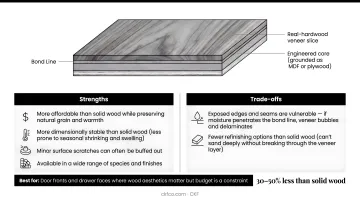
Wood veneer cabinets feature thin slices of real hardwood bonded onto an engineered core — usually MDF or plywood. The result looks and feels like real wood at a lower cost — typically 30–50% less than solid wood.
Strengths:
- More affordable than solid wood while preserving natural grain and warmth
- More dimensionally stable than solid wood (less prone to seasonal shrinking and swelling)
- Minor surface scratches can often be buffed out
- Available in a wide range of species and finishes
Trade-offs:
- Exposed edges and seams are vulnerable — if moisture penetrates the bond line, veneer bubbles and delaminates
- Fewer refinishing options than solid wood (can't sand deeply without breaking through the veneer layer)
Best for: Door fronts and drawer faces where wood aesthetics matter but budget is a constraint
Engineered & Surface Cabinet Materials
These are man-made materials engineered for consistency, cost-efficiency, and surface performance. They dominate the mid-range and budget cabinet market because they deliver predictable quality at a fraction of the cost of natural wood.
MDF (Medium-Density Fiberboard)
MDF is made by breaking down wood fibers and bonding them with resin under heat and pressure, which produces a dense, grain-free panel.
Strengths:
- Ideal paint-grade surface — no wood grain telegraphs through the finish, producing a clean, uniform result that solid wood can't match for painted doors
- Dimensionally stable; won't expand seasonally the way solid wood does
- Easy to machine into detailed decorative profiles and door styles
- Custom MDF cabinetry typically runs $300–$400 per linear foot
Trade-offs and best uses:
- Poor moisture resistance — swells and degrades with standing water exposure
- Heavy material that can strain hinges and require extra support
- Doesn't hold screws as well as plywood after repeated adjustment cycles
- Some MDF contains formaldehyde — look for products compliant with EPA TSCA Title VI, which sets a limit of 0.11 ppm for MDF
- Best for painted cabinet doors, interior shelving in dry zones, and decorative moldings — never for sink bases or moisture-prone areas
High-Pressure Laminate (HPL)
HPL is made by fusing melamine-impregnated decorative paper with phenolic-treated kraft paper under high heat and pressure. The result is a separate laminate sheet bonded to a substrate — distinct from standard melamine, where the surface layer is fused directly to the core during manufacturing.
Strengths:
- Highly resistant to scratches, stains, and everyday impact
- Available in an extensive range of colors, textures, and realistic wood-grain patterns
- Easy to clean — a damp cloth handles most messes
- Budget-friendly relative to natural materials
Trade-offs and best uses:
- Chips and edge damage are permanent — HPL cannot be sanded or refinished once damaged
- Quality varies significantly between grades; NEMA's ANSI/NEMA LD 3 standard covers performance and thickness specifications, so ask for grade documentation rather than taking marketing claims at face value
- Lacks the depth and warmth of natural materials
- Best suited for busy family kitchens, rental properties, and contemporary designs where easy maintenance outweighs refinishability
Thermofoil
Thermofoil is a vinyl film heated and vacuum-pressed onto an MDF or engineered wood core, wrapping cabinet profiles in a seamless surface with no visible seams or joints.
Strengths:
- Very affordable entry point
- Seamless surface leaves no gaps where dirt or moisture can accumulate — easy to wipe clean
- Available in matte and high-gloss finishes
- Vinyl surface resists moisture better than raw MDF
Trade-offs and best uses:
- Heat-sensitive — product-specific documentation from manufacturers like OMNOVA lists maximum surface temperatures as low as 140°F, meaning placement near ovens and dishwashers carries real risk
- Once peeling begins, it cannot be repaired — the door requires full replacement
- Good fit for contemporary cabinet styles, budget renovations, and secondary cabinet areas away from direct heat sources
How to Choose the Right Material for Your Kitchen
The decision shouldn't start with aesthetics. It should start with location.
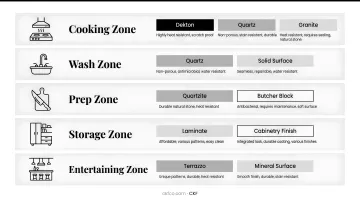
Match Material to Kitchen Zone
| Location | Recommended Material |
|---|---|
| Cabinet boxes/carcasses | Plywood (structural strength, moisture resistance) |
| Sink base cabinets | Plywood or HPL (moisture-prone area) |
| Painted door fronts | MDF (smooth, grain-free paint surface) |
| Wood-look door fronts | Solid wood or wood veneer |
| Near ovens or dishwashers | Avoid thermofoil — use HPL or solid wood |
| Pantry shelving (heavy loads) | Plywood |
Factor In Lifestyle
- Prioritize HPL or thermofoil in high-traffic homes with kids — both clean easily and resist surface damage
- Choose solid wood or plywood construction for long-term value that survives multiple design refreshes
- Pair plywood boxes with HPL or MDF door fronts for a budget-conscious hybrid that doesn't sacrifice performance
Account for Midwest Climate
Seasonal humidity swings in the Midwest — nearly 50°F in mean temperature between winter and summer — create real moisture movement in wood-based materials. Untreated or poorly sealed solid wood and veneer cabinets are vulnerable to warping, joint stress, and surface cracking over time.
If you're committing to wood in a Midwest kitchen, proper sealing and climate control are non-negotiable.
CKF's Midwest showrooms let homeowners compare cabinet materials alongside countertop options in a single visit — so you can see exactly how door fronts, box materials, and countertop surfaces work together before committing to any of them.
Common Mistakes to Avoid
Even well-researched buyers make avoidable errors. These three come up repeatedly — and they're worth knowing before you commit to a material.
Choosing by Showroom Appearance Alone
A thermofoil door and a painted MDF door can look nearly identical in a showroom but behave very differently near a hot oven. Ask about durability ratings and real-world performance specs before committing.
Using the Same Material Everywhere
Applying MDF to sink base cabinets is one of the most common — and costly — cabinet material mistakes. Matching material to function within the kitchen is as important as matching it to budget.
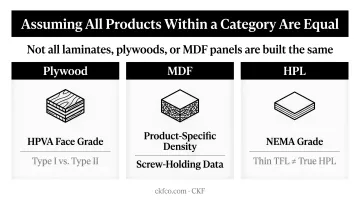
Assuming All Products Within a Category Are Equal
Not all laminates, plywoods, or MDF panels are built the same. Before finalizing a spec, ask for:
- Plywood: HPVA face grade and bond-line type (Type I vs. Type II) — not just the word "plywood"
- MDF: Product-specific density and screw-holding data
- HPL: NEMA grade and thickness — thin thermally fused laminate and true HPL are not interchangeable
Frequently Asked Questions
What type of material is best for kitchen cabinets?
Solid wood and plywood are top choices for durability and longevity, while HPL and thermofoil suit budget-conscious or high-maintenance kitchens. The best material depends on where it's used, your climate, lifestyle, and budget — no single option wins across every situation.
Is solid wood or plywood better for kitchen cabinet boxes?
Plywood is generally the better choice for cabinet boxes due to its superior moisture resistance, dimensional stability, and screw-holding strength. Solid wood is better suited for visible door fronts and panels where its natural beauty adds value.
What is the most durable material for kitchen cabinet doors?
Solid wood offers the greatest long-term durability and refinishability. High-pressure laminate is the most durable for scratch and impact resistance in high-traffic environments. If you expect heavy daily wear, HPL holds up better on the surface; if you want a door you can sand and refinish decades later, solid wood is the stronger long-term investment.
How does humidity affect kitchen cabinet materials?
Solid wood and wood veneer expand and contract with humidity changes, which can cause warping or cracking if unsealed — especially relevant in Midwest climates with significant seasonal shifts. Engineered materials like MDF and thermofoil are more dimensionally stable, but chips or scratches that expose the core can allow moisture to swell the substrate.
Can you mix different cabinet materials in the same kitchen?
Yes — and it's often the smartest approach. Using plywood for structural cabinet boxes while choosing solid wood or laminate for door fronts balances performance and cost more effectively than a single-material approach throughout.
What cabinet colors won't date quickly?
Neutral tones — whites, warm grays, soft creams, and natural wood stains — hold up consistently across design eras. Swapping hardware or adding accent pieces refreshes the look without a full repaint — something bold or trend-driven colors rarely allow.