Not all faucets are built the same. Spout style, handle configuration, and mounting type all affect how well a faucet performs and whether it even fits your sink. A gooseneck spout that looks stunning in a showroom photo might splash constantly in a shallow bowl, while a touchless model won't work if your sink only has one pre-drilled hole.
This guide breaks down all 12 major kitchen faucet types and gives you a clear framework for choosing the right one for your space.
Key Takeaways
- Faucets differ by handle count, spout style, and activation type: manual, touch, or touchless
- Your sink's pre-drilled holes and countertop cutout matter more than style preference
- High-arch and pull-down designs suit deep sinks; low-profile styles fit tight clearance
- Involving a fabricator early prevents mismatched holes and costly rework mid-remodel
What Is a Kitchen Faucet and Why Does the Right Type Matter?
A kitchen faucet is the fixture that controls water flow, temperature, and delivery at your sink. Its spout releases the water, its handle operates the internal valve, and that valve determines how hot, cold, or fast the water comes out.
That sounds simple. But the faucet you pick shapes your daily routine far more than most people expect.
Faucet choice affects:
- How easily you can wash oversized pots or fill a stockpot
- Whether you can multitask (rinsing dishes while filling a coffee maker, for instance)
- The overall look and feel of your kitchen
- How the fixture interacts with your countertop height and cabinet clearance
Choosing incorrectly usually shows up in a few predictable ways:
- A faucet that doesn't match your sink's hole configuration
- A spout that's ergonomically awkward for daily use
- A fixture that clashes with your counter or cabinet height
This is why CKF's design team factors faucet and sink compatibility into countertop planning during a remodel, rather than treating it as an afterthought once the stone is already cut.
12 Types of Kitchen Faucets
Faucets get grouped by three things: how many handles they use, how the spout delivers water, and how the fixture mounts to your sink or counter. Keep in mind these categories overlap. A single faucet can be single-handle, high-arch, pull-down, and touchless all at once.
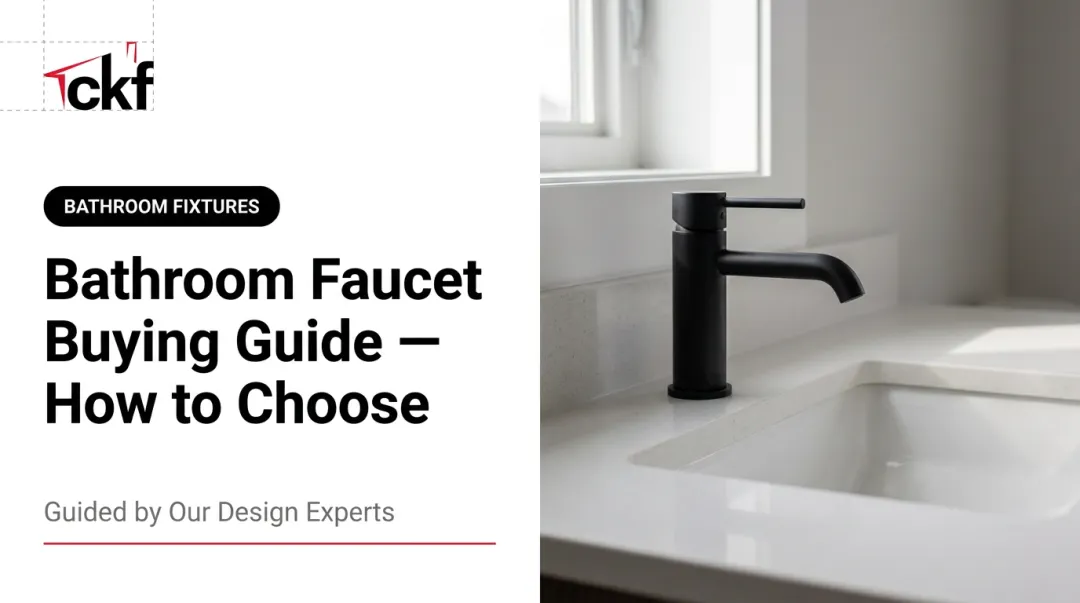
Single-Handle Faucet
One lever controls both temperature and water flow, and the design usually needs just a single drilled hole. Best for: tight spaces and quick one-hand adjustments while your other hand is full. Trade-off: less precise temperature control than a two-handle setup.
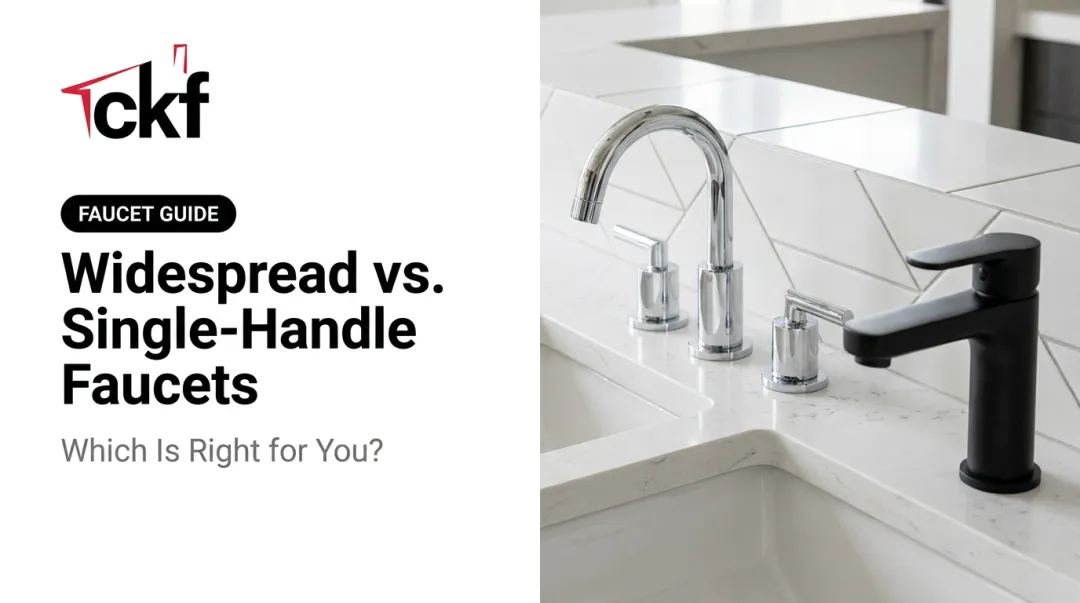
Double-Handle Faucet
Separate hot and cold handles give you fine-tuned control, but this configuration requires at least three sink holes. Best for: larger sink layouts where precise temperature and pressure control matter. Trade-off: bulkier footprint that eats up counter space.
Pot Filler Faucet
This wall-mounted, jointed-arm faucet swings out over the stovetop or a secondary basin, letting you fill heavy pots without carrying them from the sink. Best for: cooks who regularly fill large stockpots. Trade-off: it's rarely a primary sink faucet and needs its own dedicated water line.
Bridge Faucet
A horizontal bar connects separate hot and cold handles to the spout, creating a vintage-inspired focal point above the counter. Best for: large sinks and kitchens built around a traditional design statement. Trade-off: needs multiple holes and more counter real estate than compact designs.
Gooseneck Faucet
Named for its tall, curved silhouette, this high-arch spout gives serious clearance for washing large pots and pans. Consumer Reports notes that while high-arch spouts handle bulky cookware well, they can splash more in shallow sinks. Best for: deep, open basins. Trade-off: won't fit under low cabinets or short windowsills.
Straight Spout Faucet
A low-profile, horizontal design that keeps a compact vertical footprint. Best for: sinks tucked beneath cabinets or a short windowsill. Trade-off: less clearance for tall pots or pitchers.
Pull-Out Spout Faucet
The spray head detaches and pulls outward on a flexible hose, giving you extended horizontal reach. Best for: wide sinks where you need edge-to-edge coverage. Trade-off: the hose can feel heavier once fully extended.
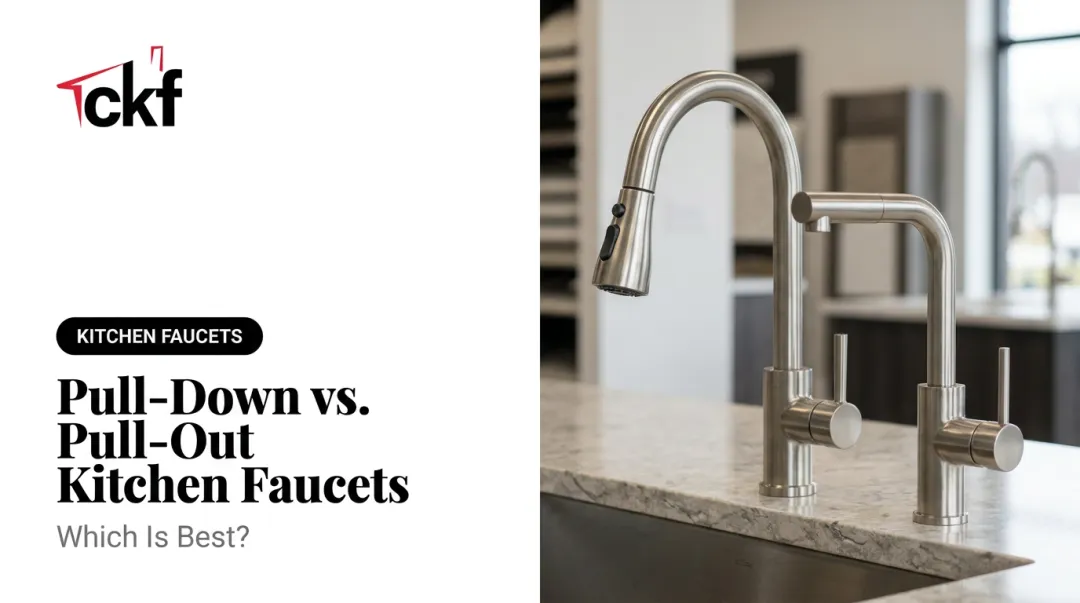
Pull-Down Spout Faucet
Similar concept, different direction. The sprayhead extends downward into the basin rather than outward. Best for: deep sinks and thorough rinsing of large cookware. Trade-off: less lateral reach compared to pull-out styles.
Touchless Faucet
Motion sensors start and stop the flow without any physical contact, paired with a single handle for temperature. Moen's MotionSense technology typically runs on six AA batteries for about a year, or an optional AC adapter. Best for: hygiene-focused kitchens and reducing mess when your hands are dirty. Trade-off: higher upfront cost and dependency on battery or power backup.
Touch-Activated Faucet
Tap anywhere on the spout or handle to turn water on or off, with a side handle still controlling temperature. Best for: households with kids, or anyone who cooks with messy hands. Trade-off: pricier than a standard manual faucet.
Stationary Faucet
A fixed, no-movement spout that keeps things simple. Best for: small sinks where reliability matters more than flexibility. Trade-off: no ability to redirect water flow across the basin.
Swivel Spout Faucet
The spout rotates side to side, letting you direct water between basins. Some residential models offer a full 360-degree swivel, which works particularly well over an island sink. Best for: wide or double-basin sinks. Trade-off: limited horizontal reach compared to pull-down or pull-out designs.
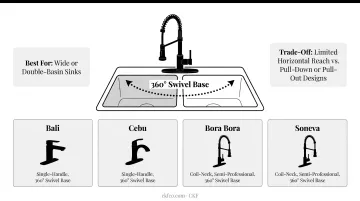
CKF's Lulani collection covers most of these configurations in-house, including single-handle models like the Bali and Cebu, as well as coil-neck, semi-professional styles like the Bora Bora and Soneva — all with a 360-degree swivel base built in.
Kitchen Faucet Mounts and Mechanics Explained
Before you fall in love with a faucet style, check whether your sink can actually accommodate it. Mount configuration is the real gatekeeper here.
Three common mount types:
| Mount type | Hole count | Typical faucets |
|---|---|---|
| Single-hole | 1 hole | Single-handle, pull-down, touchless |
| Widespread/three-hole | 3+ holes | Double-handle, bridge, some touch models |
| Wall-mount | 0 deck holes | Pot fillers, some bridge styles |
Delta's own installation guidance points buyers to each product's specification sheet for exact hole size and spacing, since these figures vary by model rather than following one universal standard.
To identify your existing setup:
- Count the visible holes in your sink deck or countertop
- Note where handles sit relative to the spout
- Check underneath the sink for manufacturer stamps or model numbers
- Remember a deck plate can hide extra holes, so a single visible faucet doesn't always mean a single-hole sink
Once you've confirmed your mount type, the next question is what's happening inside the faucet body itself. A CKF design consultant can verify your setup in person and walk you through compatible options, including our Lulani faucet lineup, before you finalize a sink or countertop cutout.
Internal Valve Types
Four valve mechanisms handle the actual on/off and temperature control inside the faucet body:
- Ball valves use a rotating ball with springs and seals
- Ceramic disc valves align ports in hardened discs to control flow
- Cartridge valves enclose the working parts in one replaceable unit
- Compression valves shut off water using a washer pressed against a seat
Delta reports that its ceramic disc technology is engineered to reduce leak points and last twice as long as standard industry valves, making ceramic disc and cartridge designs a common upgrade pick over older compression valves.
How to Choose the Right Kitchen Faucet
The "right" faucet isn't about trends. It comes down to sink compatibility, how you use your kitchen, and the physical layout above your sink.
Confirm sink hole count first. Whether your sink is single-hole, widespread, or wall-mount determines which faucets are even on the table. Check this before you fall for a style online.
Measure spout height and reach. A gooseneck that towers over a low window or clips an upper cabinet is a daily annoyance, not a minor detail.
Match the faucet to household habits:
- Frequent cooks filling large pots may prefer pull-down or gooseneck styles
- Families with kids benefit from touch or touchless activation
- Anyone with limited grip strength may find lever-style single-handle designs easier to operate
Once fit and function are settled, coordinate finishes intentionally. Stick to one or two finishes across your faucet, cabinet hardware, and appliances rather than mixing four or five metals in one kitchen.
With faucet and finish selected, loop in your fabricator early. Coordinating faucet choice with countertop drilling and deck plate needs before the stone is cut avoids expensive mismatches later. CKF's in-house design and fabrication team confirms faucet, sink, and countertop compatibility during the planning stage, not after templating is done.
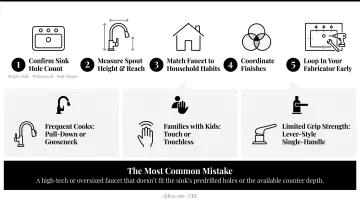
The most common mistake homeowners make: falling for a high-tech or oversized faucet before confirming it fits the sink's predrilled holes and the available counter depth.
Conclusion
Twelve faucet types exist because kitchens aren't one-size-fits-all. Sink configurations, cooking habits, and design goals all differ from home to home.
Match handle style, spout type, and mount configuration to your sink and your lifestyle. That pairing decides whether your faucet performs well for years or ends up replaced within two.
Working with CKF's in-house design and fabrication team simplifies coordinating faucet, sink, and countertop choices into a single, well-planned process.
Frequently Asked Questions
What are the common types of kitchen sink faucets?
The main categories include single-handle, double-handle, pull-down/pull-out, touchless, and specialty styles like pot fillers and bridge faucets. Most are further defined by spout shape and mounting style.
How do I identify my kitchen sink faucet?
Check the number of holes in your sink deck, note the handle placement, and look for manufacturer markings on the faucet base or underneath the sink. These details point you to the model and mount type.
What are the different types of kitchen sink faucet mounts?
The three main configurations are single-hole, widespread/three-hole, and wall-mount. Each supports a different set of compatible faucet styles.
How many holes do I need in my sink for a kitchen faucet?
It depends on the faucet: single-handle designs typically need one hole, while widespread or bridge faucets need three or more. Deck plates can cover extra unused holes if you switch styles.
What is the most durable kitchen faucet valve type?
Ceramic disc and cartridge valves are the most drip-resistant and long-lasting compared to older compression valves. Look for this valve type in quality faucet lines, including CKF's Lulani collection, for dependable leak resistance over years of daily use.
Can I install a new faucet style without replacing my countertop?
Often, yes, as long as the new faucet's hole count matches your existing cutout. Switching to a different configuration (say, single-hole to widespread) usually requires new cutouts, so it's worth confirming with a fabricator like CKF before you purchase.