Choosing a countertop material is not a small decision. You're committing to something that has to survive decades of cooking, cleaning, and daily wear before you'll swap it out again. That means you need real answers on durability, cost, and upkeep before you sign a contract.
This guide breaks down what Dekton is actually made of, where it shines and where it falls short, how it stacks up against quartz and granite, and what it takes to keep it looking new for years.
Key Takeaways
- Dekton's sintered, inorganic surface absorbs just 0.1% water — it never needs sealing
- It resists heat and sun better than quartz, but chips without expert fabrication
- Expect higher costs than granite or quartz due to Dekton's energy-intensive manufacturing
- Professional installation matters most with Dekton, more than almost any other material
What Is Dekton and How Is It Made?
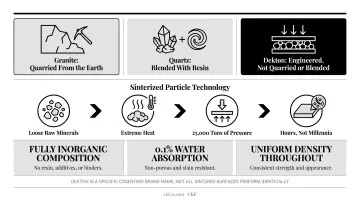
Granite is quarried from the earth, and quartz gets blended with resin. Dekton skips both approaches. Cosentino engineers this ultra-compact surface from a mixture of raw minerals also found in glass, porcelain, and quartz.
The manufacturing process, called Sinterized Particle Technology, mimics the geological forces that form natural stone, only faster. The process exposes raw minerals to extreme heat, then compresses them under 25,000 tons of pressure, fusing them into a dense, non-porous slab in hours rather than thousands of years.
That compression is what gives Dekton its defining traits:
- Fully inorganic composition with no resin binder listed in Cosentino's technical documentation
- Extremely low porosity, tested at just 0.1% water absorption
- Uniform density throughout the slab, unlike layered natural stone
One thing worth knowing before you shop: Dekton is a specific Cosentino brand name. Other manufacturers sell "sintered stone" products under different labels, and their manufacturing processes, quality control, and warranties can vary significantly. Not all sintered surfaces perform identically, so don't assume a generic product matches Dekton's tested specifications.
The Pros and Cons of Dekton Countertops
Like any material, Dekton has genuine strengths and real trade-offs. Here's an honest look at both sides.
Advantages of Choosing Dekton
Dekton's non-porous structure is its biggest selling point. Because moisture can't penetrate the surface, it resists staining without ever needing a sealant, which lowers long-term maintenance costs compared to natural stone.
Heat resistance is another standout feature. You can set a pan straight off the stove onto Dekton without a trivet, something that would scorch many resin-based quartz surfaces over time.
Additional advantages include:
- UV stability — color pigments don't fade or degrade under direct sunlight, making Dekton a strong candidate for outdoor kitchens
- Scratch resistance from the dense, compressed mineral structure
- Large-format slabs up to roughly 126" x 55", which minimize visible seams on big islands
- Fire resistance, with Cosentino classifying it as A1 non-combustible
Disadvantages to Consider
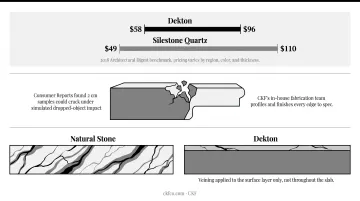
Dekton typically costs more than granite or standard quartz. A 2018 Architectural Digest cost comparison put installed Dekton at $58 to $96 per square foot, versus $49 to $110 for Silestone quartz, a gap driven largely by Dekton's energy-intensive sintering process.
Treat these as historical benchmarks rather than current quotes, since pricing shifts by region, color, and thickness.
The bigger trade-off is edge durability. Dekton's hardness makes it brittle at unprotected edges, and Consumer Reports testing found that 2 cm samples could crack under a simulated dropped-object impact.
This isn't a knock against the material so much as a reminder that fabrication quality matters. CKF's in-house fabrication team profiles and finishes every edge to spec, reducing that risk before installation.
One more detail buyers often miss: veining patterns are applied to the surface layer only, not throughout the slab. Natural stone veining runs all the way through; Dekton's does not.
Dekton vs. Quartz and Granite: How Does It Compare?
Here's how the three most common countertop materials stack up side by side:
| Factor | Dekton | Quartz | Granite |
|---|---|---|---|
| Composition | Sintered minerals, no resin | ~90-94% crushed quartz + resin | Natural quarried stone |
| Heat resistance | Excellent, direct contact okay | Moderate, resin can scorch | Good, trivet still recommended |
| Stain resistance | Non-porous, no sealing needed | Stain-resistant, softer surface | Requires sealing in most cases |
| UV/outdoor use | Excellent, color-stable | Poor, resin fades in sunlight | Varies by stone type |
| Impact/chip risk | Can chip at unprotected edges | Absorbs impact better | Can chip at cutouts and edges |
Heat resistance sets Dekton apart. It passes official thermal-shock testing and can take hot cookware directly, while quartz manufacturers like Cosentino's own Silestone brand instruct owners to always use a trivet since resin degrades under sustained heat.
Outdoor durability follows a similar pattern. Dekton is documented and marketed for outdoor countertops thanks to its UV stability, whereas quartz brands often carry the opposite warning: sunlight exposure can visibly change color and shade over time.
Impact resistance flips the script. Quartz's resin content helps it absorb sudden impacts better than Dekton, which, despite its overall hardness, needs careful edge treatment to avoid chipping during fabrication or heavy use.
Dekton Colors, Finishes, Edge Styles, and Sizes
Dekton's color library leans heavily on neutral and earthy tones, designed to complement most kitchen styles, with a smaller selection of bold and metallic finishes for industrial-inspired spaces.
Colors like Khalo, inspired by Patagonian stone with subtle black, gold, and coffee-brown flecks, and Bergen, modeled after Portobello stone with sculptural grey veining, show the range between quiet neutrals and statement patterns. Neural Velvet offers a softer, matte-adjacent look popular in coffee bar and accent applications.
Finish and texture options include:
- Matte
- X-Gloss (a high-polish technology used on select colors like Khalo)
- Velvet
- Matte and Textured Velvet
Finish availability is color-specific, so not every texture comes in every shade. Confirm which finishes pair with your chosen color before falling in love with a swatch.
With color and finish decided, slab dimensions and edge treatment round out the planning picture. Standard specs to know:
- Slab size: approximately 126" x 56" (with a larger Jumbo format also available)
- Thickness options: 8mm, 12mm, 20mm, and 30mm
- Edge styles: bullnose, simple bevel, and Flutepoint, plus mitered skirt options for veined designs
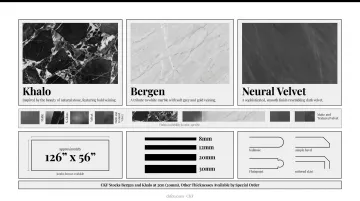
CKF typically stocks its current Dekton catalog, including colors like Bergen and Khalo, at 2cm (20mm) thickness, with other thicknesses available by special order depending on the project.
Dekton Lifespan, Care, and Maintenance
Cosentino backs Dekton with a 25-year residential warranty, according to its official warranty page, provided you register the product within six months of purchase and keep proof of purchase on file. That's a strong indicator of long-term confidence in the material, though warranty length isn't the same as a guaranteed service-life figure.
Daily cleaning requires no special products:
- Soap and water handle most messes
- No sealing is ever required, thanks to the non-porous surface
- Cosentino's care guidelines permit diluted bleach-based disinfectants
That last point answers a question a lot of homeowners have: yes, disinfecting wipes are generally safe on Dekton. Its chemical-resistant, non-porous composition means bleach won't etch or stain the surface the way it might damage some natural stones.
A few precautions help extend the lifespan:
- Skip abrasive scouring pads, which can dull certain finishes over time
- Handle heavy pots, appliances, or cutting boards carefully near unsupported edges
- Avoid hydrofluoric-acid-based cleaning products entirely
Here's the thing most people miss: the majority of Dekton complaints, especially edge chipping, trace back to fabrication quality rather than the material itself. A poorly cut or under-supported edge is far more likely to fail than the slab surface. That's exactly why choosing an experienced fabricator matters as much as choosing the material. CKF's in-house fabrication team follows Cosentino's edge-support guidelines on every Dekton installation, backed by our own warranty and repair service.
Why Work With a Trusted Fabricator Like CKF for Your Dekton Countertops
Given how much Dekton's real-world performance depends on fabrication, who cuts and installs your slab is just as important as the slab itself.
CKF's in-house fabrication facility combines advanced equipment with over 20 years of stone and solid-surface expertise, which directly addresses the edge-chipping risk that comes up so often with ultra-compact surfaces. Rather than outsourcing cutting and edge profiling to a third party, the work stays under one roof from templating through installation.
CKF also runs a one-stop-shop model. You can select cabinets, countertops, and closets in a single appointment across its five Midwest showrooms, including Des Moines/Urbandale, Omaha, and Kansas City, rather than coordinating separate vendors for each piece of your renovation.
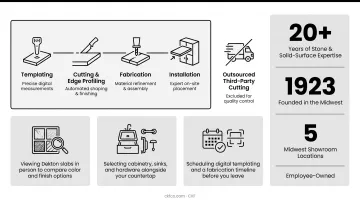
Each showroom appointment typically covers:
- Viewing Dekton slabs in person to compare color and finish options
- Selecting cabinetry, sinks, and hardware alongside your countertop
- Scheduling digital templating and a fabrication timeline before you leave
That combination of experience and convenience isn't new for CKF. The company has operated in the Midwest since 1923, and its employee-owned structure means the people fabricating your countertop have a direct stake in getting it right the first time.
Frequently Asked Questions
What are the pros and cons of Dekton countertops?
Dekton offers superior heat, stain, and UV resistance compared to most engineered surfaces. The trade-offs are a higher price point and a greater risk of edge chipping if fabrication isn't handled by an experienced professional.
What is the lifespan of Dekton?
Cosentino backs Dekton with a 25-year residential warranty when registered within six months of purchase. With proper fabrication and care, the material is built to perform well beyond typical kitchen renovation cycles.
Can I use Clorox wipes on Dekton?
Yes. Dekton's non-porous, chemical-resistant surface resists staining and etching from bleach-based disinfectants, unlike many natural stones that can discolor with repeated exposure.
Is Dekton more expensive than quartz or granite?
Generally, yes. Dekton's energy-intensive manufacturing process pushes installed costs higher than most granite and standard quartz options, though exact pricing varies by color, thickness, and fabricator.
Can Dekton countertops crack or chip?
Yes, particularly at unprotected edges under heavy impact. CKF's in-house fabrication team addresses this risk with precise edge radiusing and careful installation to help avoid damage.
Is Dekton a good choice for outdoor kitchens?
Absolutely. Its UV stability and weather resistance make it one of the top picks for outdoor countertops, where sun exposure and temperature swings would challenge less durable materials.