But they aren't interchangeable. The material you pick affects your budget, your maintenance routine, and how your countertop holds up against a Midwest summer grill session or a January freeze. This guide breaks down composition, cost, durability, and real-world use cases so you can match the right surface to your project.
Key Takeaways
- Dekton withstands extreme heat and UV exposure better than most engineered stones
- Quartz costs less upfront and offers a warmer, more forgiving surface for everyday indoor kitchens
- Dekton's edges can chip under heavy impact; quartz's resin can scorch under direct heat
- 39% of homeowners chose quartz for their kitchen remodel in 2025, per Houzz research
- CKF's fabrication team works with both materials and can show you samples side-by-side
Dekton vs Quartz: Quick Comparison
Here's how the two materials stack up across the factors that matter most to homeowners and builders.
| Factor | Dekton | Quartz |
|---|---|---|
| Composition | Sintered glass, porcelain, and quartz particles fused with heat and pressure; no resin | 90-93% natural quartz bound with polymer resin and pigments |
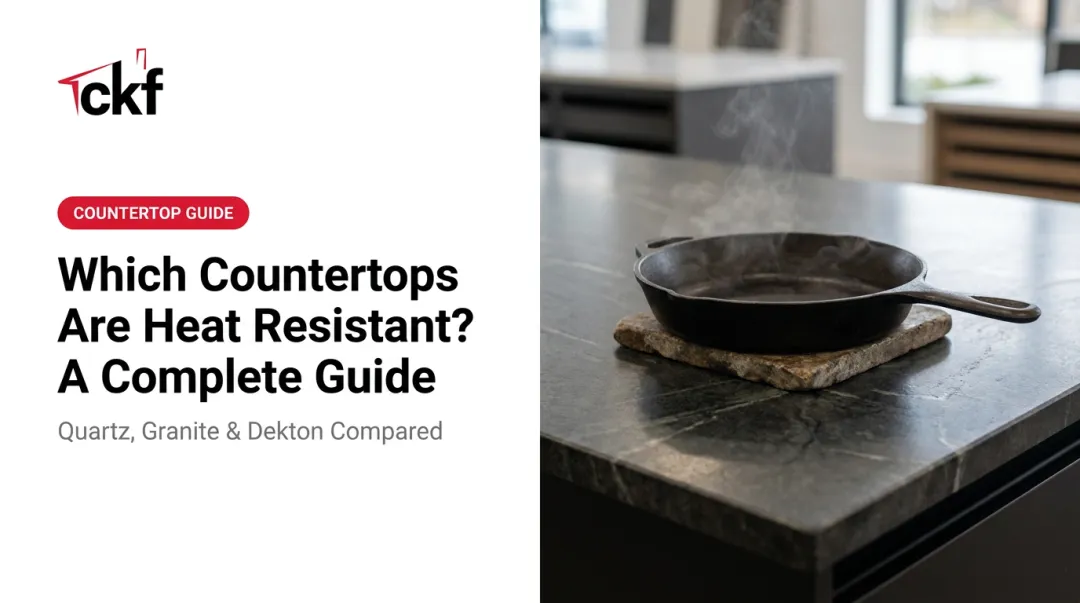
| Heat Resistance | Can handle direct hot cookware on standard slabs; protection recommended on thinner 4mm profiles | Resin-based, so trivets and hot pads are a must under hot pans |
| Durability | Extremely scratch and stain resistant; edges can chip under heavy impact | Excellent daily-use scratch resistance; more sensitive to sudden heat |
| Indoor/Outdoor Use | UV-stable, freeze-thaw resistant, built for outdoor kitchens and cladding | Best kept indoors; prolonged sun exposure can fade the resin |
| Cost | Premium pricing reflecting fabrication complexity | Generally more budget-friendly, ranging $50-$150 per sq. ft. installed per MSI's 2025 pricing guide |
CKF prices both materials across an A-H tier system based on color, slab availability, and fabrication complexity. Because Dekton involves specialized sintering and edge work, it typically lands at a higher price point than comparable quartz colors.
The exact gap depends on the specific slab you choose. A design consultation is the fastest way to get an accurate quote for your square footage.
What Is Dekton?
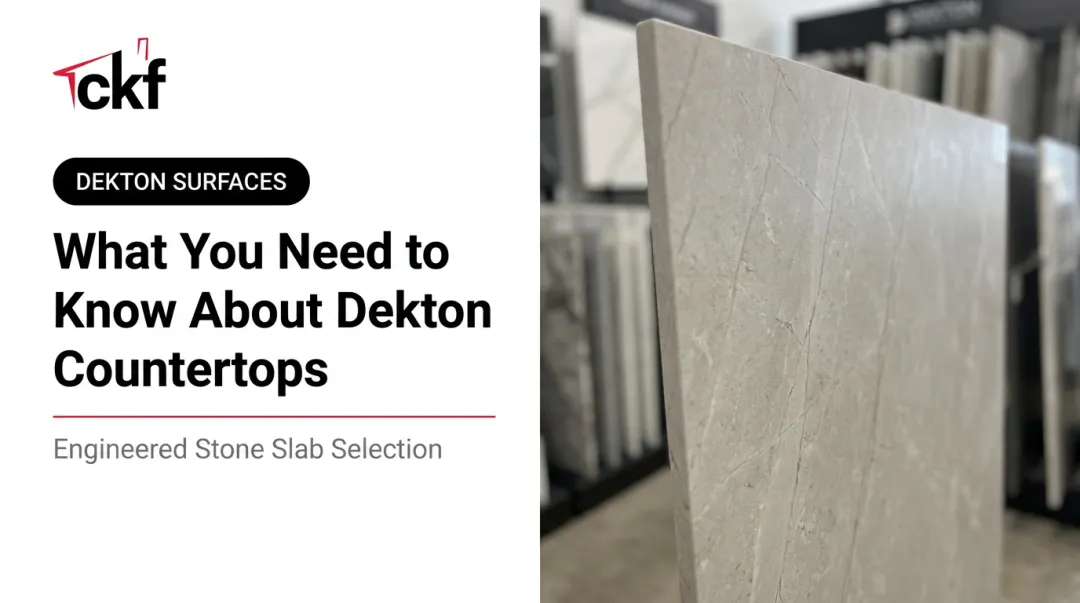
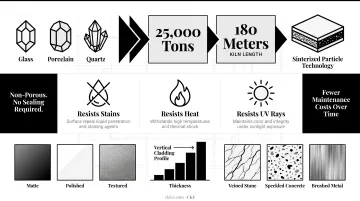
Dekton is Cosentino's ultra-compact surface, built using what the company calls Sinterized Particle Technology. Raw materials, including glass, porcelain, and quartz, get compressed under roughly 25,000 tons of pressure and heated to extreme temperatures inside a kiln that stretches nearly 180 meters long. The process compresses in hours what nature takes millennia to form.
That density matters. It makes Dekton non-porous, meaning it resists stains, heat, and UV rays without sealing. Fewer maintenance headaches down the road translate into real savings over the life of the countertop.
Available finishes and formats:
- Matte, polished, and textured surface options
- Multiple thicknesses, including thinner profiles for vertical cladding
- Colorways that mimic natural stone, concrete, or raw metal
Use Cases of Dekton
Dekton shines where heat, sun, and moisture would wear down softer materials. Outdoor kitchens, fireplace surrounds, and commercial facades are where it earns its reputation.
CKF's fabrication team has put this to the test locally. In 2023, they completed their first Dekton exterior facade at the Access Systems headquarters in Waukee, Iowa, using the Portum colorway to withstand direct Midwest weather exposure year-round.
On the residential side, the team has installed Dekton in Kelya around multiple fireplace surrounds, including one at their Omaha showroom. They've also used Dekton in Rem to surround a Big Green Egg kamado grill and outdoor pizza oven, both of which routinely exceed 700°F.
What Is Quartz?
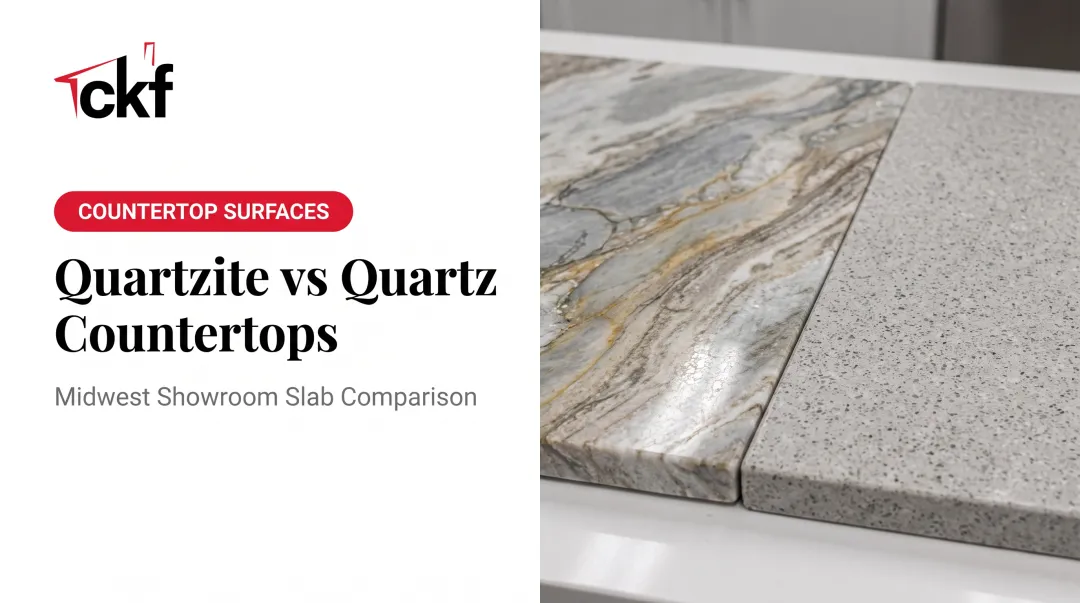
Quartz countertops are engineered, not natural. Manufacturers crush natural quartz crystal and bind it with polymer resins and pigments, typically landing around 90% quartz content. That resin is what makes quartz non-porous straight out of the factory, with no sealing required, ever.
This composition keeps costs down without sacrificing daily durability. For homeowners balancing style against budget, that combination is hard to beat.
Variety across brands:
- CKF carries Silestone, Envi, Compac, Elantra, Quantra, Revolux, and ASMI collections
- Silestone alone spans price Tiers B through G with polished and suede finish options
- Envi offers more accessible Tier A and B pricing with a polished-only finish
Use Cases of Quartz
Quartz dominates everyday kitchen countertops, bathroom vanities, and new-construction builds where color consistency and predictable pricing matter more than extreme heat tolerance.
Its popularity shows up in the numbers. 39% of homeowners upgrading their kitchen countertops in 2025 chose engineered quartz, according to Houzz's 2025 U.S. Kitchen Trends Study, based on a survey of over 1,600 homeowners.
That's down slightly from 2024, but quartz still leads among engineered surfaces for indoor projects. Busy family kitchens, in particular, benefit from quartz's forgiving surface and easy cleanup between meals.
Dekton vs Quartz: Which Is Better For Your Project?
The right choice comes down to five questions: What's your budget? How much heat exposure will the surface see? Is it indoors or outdoors? What look are you after? How fast do you need it fabricated and installed?
Choose Dekton if:
- You cook frequently with cast iron, woks, or high-heat cookware
- You're building an outdoor kitchen or fireplace surround
- Maximum scratch and UV resistance is non-negotiable
Choose quartz if:
- You want a warmer look with faster, simpler fabrication
- Budget predictability matters more than extreme heat resistance
- The project stays entirely indoors
A Real-World Comparison
At CKF's Goldenrod Companies office project in Omaha, the design team used both materials rather than picking one over the other. Private Studio Collection Quartz in Et Noir handled standard workstation surfaces, while Dekton in Entzo created a striking art-like installation in a feature room. The decision came down to matching each material to the job it does best.
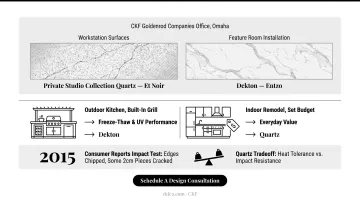
That's often how these decisions actually play out. Homeowners planning an outdoor kitchen with a built-in grill typically land on Dekton because of freeze-thaw and UV performance. Families remodeling an indoor kitchen on a set budget usually land on quartz.
A 2015 Consumer Reports impact test found that Dekton samples chipped at the edges, and some 2cm-thick pieces cracked under significant force. Even durable materials have limits worth understanding before installation. Quartz carries its own tradeoff: less heat tolerance in exchange for better everyday impact resistance.
CKF's in-house fabrication team works with both materials daily. Their Midwest showrooms let you handle physical samples side-by-side, so the decision isn't theoretical. Schedule a design consultation to compare Dekton and quartz slabs before you commit to either one.
Conclusion
Neither material wins outright. Dekton earns its premium price with heat resistance, UV stability, and outdoor durability that quartz simply can't match. Quartz counters with a warmer look and faster fabrication, plus a price that fits more remodeling budgets.
The right pick comes down to how you'll use the space, not which material sounds more impressive. Bring your project details to CKF's design team, and they'll help you land on a countertop that fits your kitchen and your budget.
Frequently Asked Questions
Is Dekton better than quartz countertops?
The right choice comes down to your specific use case. Dekton outperforms in heat and UV resistance, while quartz offers easier fabrication and a lower price point for standard indoor kitchens.
How much more expensive is Dekton than quartz countertops?
Quartz typically runs $50-$150 per square foot installed. Dekton generally costs more due to its complex fabrication process, though exact pricing varies by tier and color.
Can I use Clorox wipes on Dekton countertops?
Dekton tolerates most disinfectant solutions well, according to Cosentino's care guidance. Check the specific product label and avoid leaving undiluted disinfectant on the surface for extended periods.
Can Dekton be used outdoors in cold Midwest climates?
Yes. Dekton passes freeze-thaw resistance testing and maintains UV stability, making it a strong choice for year-round outdoor kitchens and patios in the Midwest.
Does Dekton chip or crack easily?
Dekton resists scratches and stains exceptionally well, but its edges can chip under significant impact. Cracked slabs typically require full replacement rather than a simple repair.
Is quartz or Dekton better for a busy family kitchen?
Quartz offers a warmer, more forgiving surface for daily wear and tear. Dekton offers maximum resistance to heat and heavy use, so the better fit depends on your cooking habits and priorities.