There's just one problem. "European style" isn't one thing.
Homeowners often picture a single aesthetic, when in reality the term covers several design philosophies and cabinetry systems, each with its own construction logic and finish palette. This guide breaks down what actually defines the style, explores its major variations (including the ever-popular Scandinavian look), covers where the trend is heading in 2026, and gives you practical steps for bringing it into a Midwest home.
Key Takeaways
- Clean lines, integrated appliances, and handleless cabinets define the modern European look
- Scandinavian, German, Italian, and French styles all share one functional core
- 2026 trends favor warm minimalism, hidden storage, and sculptural stone islands
- Achieving the look takes smart storage and tonal palettes, not a full remodel
What Defines a Modern European Kitchen Style?
At its simplest, a European kitchen is a system-based design approach built around clean lines, integrated appliances, and storage-first planning. Decoration comes second. Function comes first.
That priority isn't new. It traces back to the Frankfurt Kitchen, designed by architect Margarete Schütte-Lihotzky in 1926-1927 for Frankfurt's municipal housing program. Roughly 10,000 units were installed in apartments by the late 1920s, based on time-motion studies of how women actually moved through a kitchen while cooking.
The Frankfurt Kitchen, now held by London's V&A Museum, applied factory-efficiency thinking to a domestic space, and that DNA still shows up in European cabinetry a century later.
Signature Design Elements
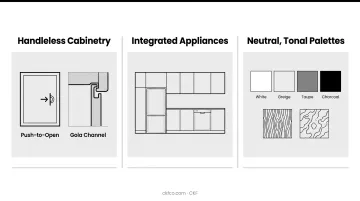
Three features tend to separate a European kitchen from other styles at a glance:
- Handleless cabinetry. This isn't one system. Push-to-open mechanisms release a door with light pressure, while recessed "Gola" channels give fingers a grip point built directly into the cabinet. Both remove hardware from the visual field, but they open differently.
- Integrated appliances. Refrigerators, dishwashers, and sometimes ovens sit behind panels that match the surrounding cabinetry, so the kitchen reads as one continuous composition instead of a row of separate boxes.
- Neutral, tonal palettes. Whites, greiges, taupes, and charcoals create a quiet backdrop that lets material texture, not color contrast, do the visual work.
European vs. American Kitchen Design
Cabinet construction, not door style, creates the real difference between European and American kitchens.
| Feature | European-Style | Traditional American-Style |
|---|---|---|
| Cabinet construction | Frameless, edge-banded box | Framed, with a solid-wood face frame |
| Interior access | Full, unobstructed opening | Slightly reduced by the frame |
| Door/hardware attachment | Mounted to box sides | Attached to the face frame |
| Appliance treatment | Panel-integrated, concealed | Often a statement stainless piece |
| Storage approach | Drawer-heavy, vertical organization | Mix of cabinets and drawers |
According to the Kitchen Cabinet Manufacturers Association, the traditional American face frame typically measures 1.5 inches wide and 0.75 inch thick, while frameless (European-style) construction skips that frame entirely for wider interior access.
Most Midwest homeowners we work with don't want a strictly European kitchen. They want a European-influenced one: frameless upper cabinets paired with a familiar shaker profile below, or handleless drawers under a warm wood island. The result borrows from both traditions rather than replicating either one.
Popular Modern European Kitchen Styles to Explore
"European kitchen" is really an umbrella. Underneath it sit several distinct design languages, each rooted in a different regional sensibility, but all sharing that same function-first backbone.
Scandinavian Style Kitchens
Scandinavian kitchens are light, functional, and connected to natural materials without feeling austere. Think pale wood tones, white or soft-toned cabinetry, and almost no ornamentation. Architectural Digest points to light wood and white stone countertops as the defining hallmarks of this look, and it's a style that photographs calm because it is calm.
For homeowners chasing this feel, a Shaker door in a soft Snowdrift-style finish over maple, paired with an icy-white quartz surface with fine veining—CKF's Silestone and Compac lines both offer options in this palette—gets you most of the way there without a complete style overhaul.
German-Engineered Cabinetry
German cabinetry is less about a specific look and more about precision manufacturing. These systems are frameless, highly customizable, and known for advanced hardware, including soft-close mechanisms and handleless profiles engineered for decades of daily use.
Germany's own quality mark, the "Golden M," tests furniture against durability, safety, and environmental standards under RAL-GZ 430 criteria. Certification applies to specific products, not to every German-made cabinet automatically.
Italian-Inspired Drama
Italian kitchens trade Scandinavian restraint for bold visual drama. Bold stone, glossy lacquers, and sculptural islands define this variation, and it leans design-forward rather than restrained. High-gloss monolacquer finishes remain a staple of Italian manufacturers, often paired with a heavily veined stone island that acts as the room's centerpiece rather than a workhorse surface tucked into the background.
Dekton slabs, available through CKF's showrooms, capture this same dramatic veining while adding scratch and heat resistance beyond what natural stone offers.
French Country Influence
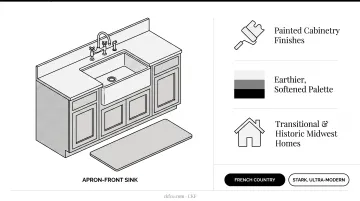
French-inspired kitchens soften the European system with painted finishes and farmhouse sinks, favoring earthier palettes over stark contrast. The apron-front sink, in particular, is a defining feature of this look, giving the kitchen a strong visual anchor that suits transitional or historic Midwest homes better than a stark, ultra-modern approach.
Materials, Colors & Finishes for Timeless Elegance
The palette that keeps a European kitchen from feeling dated is narrower than most people expect:
- Soft whites, greiges, and taupes as the primary cabinetry tone
- Natural wood accents for warmth against the neutral base
- Black or brass hardware, used sparingly rather than everywhere
Stone remains the material of choice for European-style islands and workspaces, whether that's quartz, quartzite, or marble. CKF's in-house fabrication facility crafts custom stone and solid-surface countertops using the latest cutting and edge-profiling technology. That precision matters here because the fit and finish of a stone slab makes or breaks that seamless European look.
Beyond countertops, expect to see:
- Matte lacquers replacing high-gloss finishes in more spaces
- Wood veneers used as accent panels rather than full cabinet runs
- Mixed metals, like brushed brass paired with matte black, used with restraint so the kitchen doesn't feel busy
Top European Kitchen Trends to Watch
For 2026, kitchens are trading stark contrast for warmth and texture.
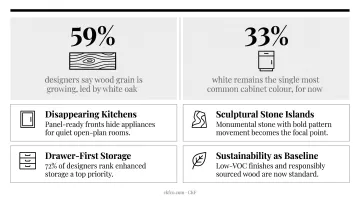
Warm minimalism is replacing stark white. The NKBA's 2026 Kitchen Trends Report found that 59% of surveyed designers identified wood grain as growing in popularity, with white oak leading the pack. That said, Houzz's research still puts white as the single most common cabinet color at 33%, and it remains dominant for now — but the balance is clearly shifting toward warmer tones.
Other trends worth watching:
- Concealed, disappearing kitchens. Panel-ready fronts hide appliances so open-plan living spaces stay visually quiet.
- Sculptural stone islands. Monumental stone treatments with strong pattern movement are becoming architectural focal points rather than just workspaces.
- Drawer-based storage over sheer square footage. NKBA reports enhanced storage as a priority for 72% of respondents, with more drawers and appliance garages driving that number.
- Sustainability as a baseline expectation. Low-VOC finishes, responsibly sourced wood, and energy-efficient integrated appliances are shifting from nice-to-have to standard ask.
None of these trends require ripping a kitchen down to the studs. They're mostly about material choice and storage planning.
How to Bring European Elegance Into Your Midwest Kitchen
You don't need a full architectural overhaul to get this look right. Start smaller and build from there.
Start with the cabinet line. A simplified flat-front or hybrid shaker profile, paired with one unified neutral palette, gives you the European foundation without committing to a total frameless rebuild.
Prioritize internal organization first. Pull-outs, drawer dividers, and concealed bins should come before any decorative decision. Function drives this aesthetic, not the reverse.
Work with a team that understands both sides of the equation. European-style cabinetry and custom stone countertops involve sourcing and cost realities that vary a lot in the Midwest compared to coastal design markets.
This is where CKF's one-stop-shop model helps, moving cabinets, countertops, and closets through a single design process instead of four separate vendor appointments.
Backed by a cost-conscious design team and a century of craftsmanship since 1923, it's a practical way to bring a European vision into a workable Midwest budget.
If you're not sure where to start, a design consultation is the fastest way to see what a European-influenced kitchen would actually cost and look like in your specific space.
Frequently Asked Questions
What is a modern European kitchen style?
Modern European kitchen style is a system-based, function-first design approach built on clean lines, integrated appliances, and minimal ornamentation. Storage planning and cabinet construction matter more than decorative trim.
What is the new kitchen trend for 2026?
The shift is toward warm minimalism: creamy neutrals, wood-grain accents, concealed appliances, sculptural stone islands, and a growing expectation around sustainable materials.
What is a Scandinavian style kitchen?
A Scandinavian kitchen uses light wood tones, white or soft cabinetry, and minimal ornamentation to create a bright, calming, nature-connected space.
What is the difference between European and American kitchen cabinets?
European cabinets use frameless, edge-banded box construction with full interior access, while American cabinets typically use a framed box with a face frame that hardware attaches to.
How much does a modern European-style kitchen remodel typically cost?
Costs vary widely based on cabinetry line, stone selection, and project scope. A local design and fabrication team, like CKF, can give you an accurate, cost-conscious estimate for your specific space.
Can European kitchen design work in a smaller kitchen?
Yes, often even better than in large kitchens. Vertical storage, integrated appliances, and handleless fronts are especially effective at making compact layouts feel open and uncluttered.