A mismatched sink and countertop is one of the most expensive mistakes in a kitchen remodel. Re-fabrication, leaks around a poorly sealed cutout, and cabinetry that doesn't support an apron-front sink all cost real money to fix after the fact. This guide walks through mounting styles, material compatibility, and the practical factors that determine whether your sink and countertop actually work together.
Key Takeaways
- Sink-countertop pairing hinges on three factors: mounting style, material compatibility, and visual cohesion
- Undermount sinks need non-laminate, water-resistant surfaces like quartz, granite, or solid surface
- Farmhouse sinks require custom-cut countertops and often modified cabinetry
- Getting the fit right the first time avoids costly re-cuts and mismatched aesthetics
- Working with one fabricator for both sink and countertop simplifies fit and installation
What Is Sink-and-Countertop Pairing?
Sink-and-countertop pairing is the process of matching a sink's mounting style, material, and dimensions to a countertop's material and cutout capabilities, so the finished installation is watertight, structurally sound, and visually consistent.
Sink Mounting Styles and Their Countertop Requirements
Each mounting style places different demands on the countertop material and fabrication process.
| Mounting Style | How It Works | Countertop Requirement |
|---|---|---|
| Undermount | Sink attaches beneath the counter for a seamless edge | Non-porous, moisture-resistant material (quartz, granite, solid surface) |
| Drop-in/top-mount | Rim rests on top of a countertop cutout | Compatible with nearly any material, including laminate |
| Farmhouse/apron-front | Exposed front panel replaces part of the cabinet face | Custom-measured and cut after the sink is set; often needs modified base cabinetry |
| Integrated | Sink and countertop come from a single slab | Eliminates seams but limits future replacement options |
Undermounts dominate current kitchen design for good reason. Roughly 85% of homeowners choose an undermount sink in new kitchen projects, according to the NKBA's 2024 Kitchen Trends Report.
That popularity comes with a catch, though: undermounts only work with countertop materials that can handle an exposed, sealed edge without swelling or delaminating. Laminate doesn't hold up here without special reinforcement, which is why quartz, granite, and solid surface remain the standard pairing.
Material Compatibility Between Sinks and Countertops
Weight and porosity matter as much as looks.
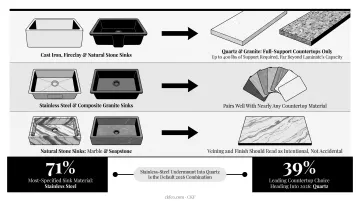
- Heavy sinks (cast iron, fireclay, natural stone) need full-support materials like quartz or granite; fireclay farmhouse sinks can require support rated for 400 pounds, far beyond laminate's capacity.
- Stainless steel and composite granite sinks pair well with nearly any countertop material thanks to their lighter weight and installation flexibility.
- Natural stone sinks (marble, soapstone) look best against matching or complementary stone countertops, since veining and finish need to read as intentional, not accidental.
Stainless steel remains the most-specified sink material at 71%, and quartz leads countertop material choices heading into 2026 at 39% market share. Put those two numbers together and it's clear why stainless-steel-undermount-into-quartz has become the default combination in most remodels.
Why the Right Pairing Matters
A properly sealed undermount installation keeps water from seeping between the sink rim and the countertop edge. That gap, if left unsealed or paired with the wrong material, slowly damages the cabinetry underneath, often before anyone notices.
Beyond that functional risk, how the two pieces look together carries its own weight. A sink and countertop that share complementary tones, finishes, or veining reads as a considered design choice, which matters when resale value enters the conversation.
- Prevents moisture damage: Correct sealing and material pairing stops water infiltration at the sink edge
- Supports resale value: Cohesive finishes signal a considered renovation that buyers notice
- Avoids costly rework: Getting material compatibility right upfront means no re-cutting or sink swaps later
What to Consider When Pairing a Sink with Your Countertop
These six factors move the decision from Pinterest board to finished installation.
Kitchen Layout and Design Style
A modern kitchen with clean lines typically calls for an undermount sink against quartz or granite. A farmhouse-style kitchen leans toward an apron-front sink with natural stone or butcher block. Sink placement, whether it's centered on an island, tucked in a corner, or set under a window, can also limit which mounting style fits your countertop thickness.
Material Compatibility and Durability
Mismatched hardness or porosity between a sink and its countertop can cause chipping right at the cutout edge over time. Heavier sink materials, think fireclay, cast iron, or natural stone, need full-support surfaces like quartz or granite rather than thinner laminate that can't bear the load.
Mounting Style and Installation Requirements
With undermount and farmhouse sinks, fabricators must custom-template the countertop after setting the sink in place, which extends the installation timeline compared to a drop-in. Drop-in sinks remain the most flexible retrofit option since they don't require removing an existing countertop at all.
Size, Configuration, and Daily Use
Single-bowl sinks suit smaller kitchens or households without a dishwasher. Double or triple-basin configurations fit larger households that cook frequently or entertain often. Finalize basin count and depth before templating begins, because the cutout is permanent once the slab is cut.
Budget and Long-Term Value
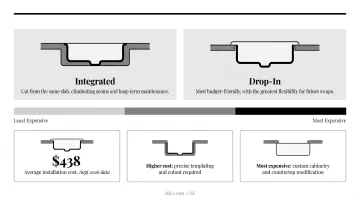
Integrated sinks, cut from the same slab as the countertop, cost more upfront but eliminate seams and long-term maintenance headaches. Drop-in sinks offer the most budget-friendly path with the greatest flexibility for future swaps.
Costs vary widely by material and mounting style:
- Drop-in sink installation: Generally the least expensive, with average sink installation running around $438 according to Angi's 2026 cost data
- Undermount installation: Higher cost due to templating and precision cutout requirements
- Farmhouse installation: Typically the most expensive, given custom cabinetry and countertop modifications
Professional Fabrication and Precision Templating
An experienced fabricator needs to measure and cut undermount and farmhouse sinks precisely. Skip this step and you risk gaps, leaks, or an uneven reveal around the sink edge. Working with a single provider for both sink selection and countertop fabrication also removes the measurement-error risk that comes from coordinating between separate vendors. CKF's in-house fabrication teams handle digital templating and cutting under one roof, so the sink and countertop are matched precisely before installation day.
How CKF Can Help
Pairing a sink with a new countertop involves more decision points than most homeowners expect. CKF's in-house fabrication facility and one-stop-shop model take the guesswork out of that process. Instead of coordinating separately with a plumber, a countertop fabricator, and a cabinet company, CKF's design team helps customers select compatible sink and countertop materials in a single appointment.
What that looks like in practice:
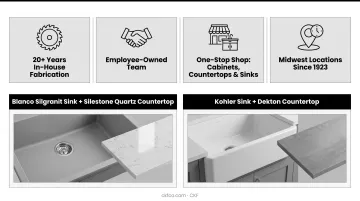
- Over 20 years of in-house stone and solid-surface fabrication experience, including precise sink cutouts for undermount, farmhouse, and integrated designs
- An employee-owned team personally invested in getting every measurement and installation detail right
- A true one-stop shop offering cabinets, countertops, and sinks together, so there's no separate appointment needed just to pick a sink
- Multiple Midwest locations backed by a track record spanning more than a century of service since 1923
CKF's showroom displays put this into practice already, pairing products like a Blanco Silgranit sink with Silestone quartz, or a Kohler sink alongside a Dekton countertop, so customers can see real combinations rather than guessing from a catalog.
Conclusion
The right sink-countertop pairing depends on your layout, material preferences, and how you actually use your kitchen day to day. A busy household with a large family cooks differently than a couple who entertains on weekends, and the sink setup should reflect that.
Before finalizing a sink choice, talk to a professional fabricator, like the design team at a CKF showroom. It's the surest way to avoid a costly cutout mistake or an unplanned sink replacement. And as your kitchen habits change over the years, it's worth revisiting whether your current pairing still works, especially before your next remodel or when you're prepping a home for resale.
Frequently Asked Questions
What is the best sink material to pair with granite or quartz countertops?
Stainless steel and composite granite sinks pair well with both. Heavier fireclay or natural stone sinks need the added structural support that quartz or granite provides over laminate.
Do I need a special countertop thickness for a farmhouse sink?
Farmhouse sinks typically require the countertop to be custom-cut after the sink is mounted in place. The cabinetry underneath may also need modification to support the exposed front panel.
Is an undermount or drop-in sink better for quartz countertops?
Undermount sinks create a seamless look that suits quartz's non-porous surface well. Drop-in sinks remain the simpler, more budget-friendly option for a straightforward retrofit.
Can I install a new sink without replacing my existing countertop?
Drop-in sinks can often be swapped without touching the countertop at all. Undermount and farmhouse sinks, on the other hand, usually require a new or re-cut countertop.
Which sink and countertop combination holds up best in a busy kitchen?
Stainless steel or composite granite sinks, such as Blanco Silgranit, paired with quartz or granite countertops hold up best against heat, scratches, and stains in high-use kitchens.
Should my sink color match my countertop exactly?
Matching tones create a seamless, unified look, but that's a preference, not a rule. A contrasting sink, like black or stainless against a light stone countertop, can be just as intentional a design choice.