That last decision matters more than it seems. The edge profile affects how the stone reads visually in your kitchen, how it interacts with your cabinetry style, how easy it is to clean, and what you'll pay for fabrication. With a material as visually distinctive as quartzite, getting the edge right means the stone gets to do what you paid for—draw attention to its natural beauty.
Here's what you need to know to make that call confidently.
Key Takeaways
- The eased edge is the most versatile choice for quartzite—its clean profile keeps veining as the visual centerpiece
- Mitered edges are the top pick for islands where you want visual weight and uninterrupted vein flow from top to face
- Quartzite's Mohs 7 hardness means it can technically hold ornate profiles, but simpler edges let the stone's veining do the work
- Veining intensity should directly influence edge complexity—bolder stone deserves a simpler edge
- Always ask for edge-specific pricing upfront—mitered and waterfall profiles carry meaningful cost premiums
What Are Quartzite Countertop Edge Profiles?
An edge profile is the finished shape applied to the exposed edges of a countertop slab—the part you see from the side and feel when you run your hand along the counter. Profiles range from flat and nearly invisible to deeply curved and ornate.
Quartzite's material properties give fabricators real flexibility here. The Natural Stone Institute rates quartzite at 7 on the Mohs hardness scale—comparable to quartz mineral and harder than marble's dominant calcite mineral, which rates around 3. That hardness means quartzite can hold almost any edge profile without the chipping vulnerability softer stones face. The real constraint on edge selection isn't structural—it's visual.
Why Edge Profiles Matter More With Quartzite
Quartzite is chosen for its visual presence—the sweeping veins, the depth of movement, the sense that you're looking at something natural. An ornate edge profile introduces competing geometry that pulls the eye away from the stone's surface. The edge should frame the slab, not fight it.
Edge complexity also carries a real fabrication cost. Stone World's fabricator roundtable confirms that true quartzite demands:
- Dedicated diamond blades rated for harder stone
- Adjusted CNC feed rates and reduced material removal per pass
- Slower overall cutting speeds to avoid micro-fracturing
More intricate profiles mean more of that careful, time-intensive work—and higher fabrication costs to match.
Top Edge Profile Options for Quartzite Countertops
These are the most commonly fabricated profiles for quartzite, from the everyday standard to high-impact statement options.
Eased Edge
The eased edge, sometimes called a pencil edge, is a square profile with softened corners. No sharp angles, no curves — just a clean, flat finish that reads as confidently contemporary.
It's the most popular edge choice for quartzite across kitchen and bath applications, and with good reason:
- Works equally well in modern, transitional, and traditional kitchens
- Doesn't compete with dramatic veining—the stone stays the focal point
- Crevice-free surface wipes clean quickly
- Most cost-effective fabricated profile
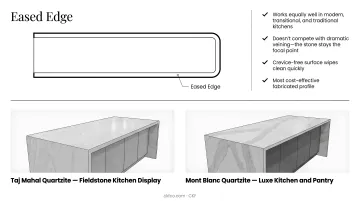
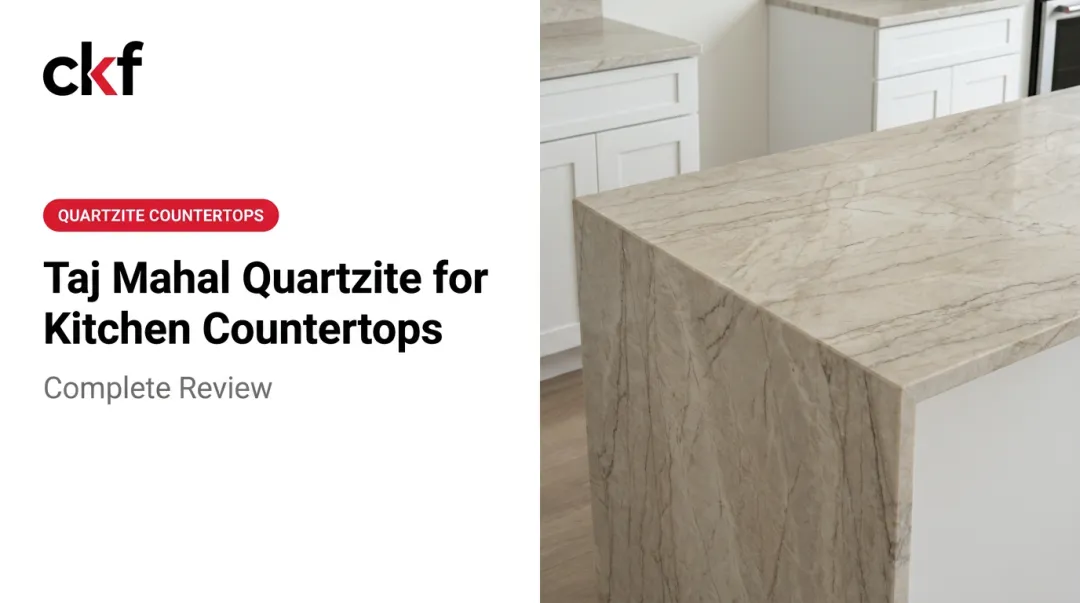
CKF's own showroom displays reflect this preference. The Taj Mahal quartzite island in the Fieldstone kitchen display uses an eased edge, as does the Mont Blanc quartzite in the Luxe Kitchen and Pantry case study—two different stones, same smart edge choice.
Mitered Edge
The mitered edge is a fabrication technique more than a traditional profile. Two pieces of stone are cut at 45-degree angles and joined, allowing a standard 3 cm slab to appear 2, 3, or more inches thick.
The veining flows continuously from the top surface down the vertical face, with no visible seam interrupting the pattern.
This is the right choice when you want visual weight and sculptural presence. Best applications:
- Kitchen islands as a focal point
- Waterfall-style installations
- Any surface where "substantial" is the goal
On quartzite, mitered cuts require real precision. Diamax's tooling data shows miter cuts on quartzite run at roughly 60% of straight-cut speed—slower work that requires specialized equipment and skilled hands. The cost reflects that. CKF has executed mitered island edges in multiple projects, including the Lavish Chef's Kitchen and Charming Kitchen and Bar, both demonstrating what a clean miter looks like in practice.
Beveled Edge
A beveled edge introduces a 45-degree angled cut along the top edge of the stone. It catches light differently than a flat profile and adds geometric definition without curves.
It's a solid middle-ground option for homeowners who want a little visual interest without committing to an ornate profile. The bevel reads well in transitional and traditional kitchens and pairs naturally with detailed cabinet hardware.
One honest note: the angled corner, while durable on quartzite, can show wear over time more visibly than a fully rounded profile.
Half Bullnose Edge
The half bullnose is rounded on top with a flat bottom — a softer, more approachable shape that avoids the key functional problem of the full bullnose (more on that below).
It's a strong third-choice option for:
- Family kitchens where softer aesthetics matter
- Bathroom vanities
- Spaces where you want warmth without ornate detailing
The flat bottom keeps spills from traveling under the countertop, which is a real advantage over its fully rounded counterpart.
Waterfall Edge
The waterfall edge is an installation approach rather than a traditional profile. The countertop stone continues vertically down the side of an island or cabinet, creating a floor-to-counter stone panel.
The effect is dramatic: quartzite's veining runs across an entire vertical surface, not just the horizontal top.
Architectural Digest notes that pattern matching must be planned before cutting, and that natural stone makes alignment more demanding because every slab is unique. The NKBA's 2024 Kitchen Trends data shows 53% of respondents expected waterfall edges to be popular—which reflects genuine staying power backed by real homeowner demand.
Reserve it for a focal-point island where the investment is fully visible.
What to Consider When Choosing Your Quartzite Edge Profile
The best edge isn't the most popular one—it's the one that works for your specific stone, your kitchen, and how you actually live in the space.
Your Kitchen's Design Style
Design aesthetic is the first filter:
| Style | Best Edge Options |
|---|---|
| Contemporary / Minimalist | Eased, Mitered |
| Transitional | Eased, Beveled, Half Bullnose |
| Traditional / Formal | Beveled, Ogee (carefully) |
| Organic / Natural | Eased, Waterfall |
Look at your cabinetry lines, hardware style, and backsplash texture. The edge profile should echo those choices — not contradict them.
How the Veining Interacts With the Edge
This is the factor most homeowners overlook. Quartzite slabs vary enormously — even within the same variety — and the veining scale changes everything. Bold, sweeping movement calls for a simpler edge; a quieter, more uniform slab can carry a more detailed profile without visual competition.
Look at your actual slab—not a 4-inch sample chip—when making this decision. The veining scale and movement only read clearly at full slab size.
Application: Kitchen, Island, or Bathroom
Location within the home should shift your thinking:
- Perimeter countertops: High daily wear; prioritize practical, easy-to-clean profiles (eased, beveled)
- Islands: Natural showpiece; mitered or waterfall edges make the biggest impact here
- Bathroom vanities: Lower traffic and moisture exposure means more design flexibility; half bullnose and beveled edges both work well
Where the countertop lives affects how you use it — and how it wears. That same logic extends to how different profiles behave day to day.
Practical Factors: Maintenance, Safety, and Spill Behavior
Different profiles behave differently in daily use:
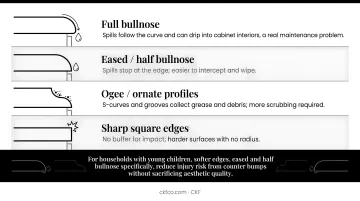
- Full bullnose: Spills follow the curve and can drip into cabinet interiors—a real maintenance problem
- Eased / half bullnose: Spills stop at the edge; easier to intercept and wipe
- Ogee / ornate profiles: S-curves and grooves collect grease and debris; more scrubbing required
- Sharp square edges: No buffer for impact; harder surfaces with no radius
For households with young children, softer edges—eased and half bullnose specifically—reduce injury risk from counter bumps without sacrificing aesthetic quality.
Budget and Fabrication Complexity
Standard profiles (eased, beveled, half bullnose) are typically machine-cut at similar price points. Mitered edges and waterfall installations cost noticeably more on quartzite. Slower sawing, specialized tooling, additional material for vein matching, and extra installation labor all contribute to the gap.
Ask your fabricator for edge-specific pricing before you fall in love with a particular look. The gap between a standard profile and a mitered edge on quartzite is worth knowing before you commit.
Edges to Approach With Caution
Full bullnose: The appeal is obvious—soft, rounded, approachable. The problem is functional. Home Depot's countertop edge guidance specifically flags that the full bullnose's continuous curve allows spills to travel to the underside and into cabinetry. An eased or half bullnose achieves the same soft aesthetic without the plumbing problem.
Ornate profiles (ogee, DuPont): Quartzite's hardness means these profiles won't chip the way they might on marble. The concerns here are design-based and practical:
- Grooves collect grease in working kitchens, making cleaning more demanding
- Visual complexity tends to compete with quartzite's natural veining rather than complement it
- Both profiles work better in lower-traffic applications—powder room vanities, furniture pieces—where the intricate detail can be appreciated up close
Designer opinion on ornate edges isn't unanimous, though. A 2025 Livingetc piece noted decorative edges "popping up" in designers' work, with ogee described as a nod to tradition. If your kitchen leans traditional and your quartzite is relatively subtle, ogee can still work—just go in with clear eyes about the cleaning commitment.
How CKF Can Help You Find the Perfect Edge
CKF has been fabricating countertops since 2000, with stone specifically added to its capabilities in 2003. That experience matters when you're working with quartzite—a material that demands specialized tooling, slower cutting speeds, and fabricators who know how to handle its particular requirements.
What sets CKF apart is context. Edge decisions happen alongside cabinetry selections—not in a separate appointment weeks later. You can see how a mitered quartzite island edge reads next to specific cabinet door styles and hardware finishes, not just imagine it from a brochure.
That's possible because CKF operates as a one-stop shop for cabinets, countertops, and closets across its Midwest showroom locations.
CKF's showrooms also feature quartzite edge profiles applied to real stone—including Taj Mahal quartzite displays with eased edges in both the Diamond Bar and Fieldstone kitchen displays. You see the actual stone, the actual profile, in a complete kitchen setting—not a generic sample chip.
That same hands-on approach carries into fabrication. For complex profiles—mitered edges, waterfall treatments—CKF's team has the tooling and the stone-specific experience to execute them cleanly on quartzite.
- One-stop selections: Edge, cabinet, and hardware decisions made together in a single visit
- Real stone displays: See actual quartzite profiles in finished kitchen contexts, not sample chips
- Stone-specific fabrication: Equipment and techniques calibrated for quartzite's hardness and grain
- Over 20 years of stone experience: Fabricating stone countertops since 2003
Conclusion
The best quartzite edge is the one that serves the stone. You chose quartzite for its veining—for the natural movement and drama that no engineered surface can replicate. The edge profile should give that investment room to breathe.
Simpler profiles tend to produce the strongest outcomes for exactly that reason. Eased and mitered edges consistently show up in the best quartzite installations because they step back and let the stone lead.
The one thing that will tell you more than any article is holding an actual edge sample against your actual slab. At CKF's Midwest showrooms, you can view quartzite-specific edge samples alongside actual slabs — not brochure images — with fabricators who work with natural stone daily. That's the conversation that turns a good decision into the right one.
Frequently Asked Questions
What is the best edge for quartzite countertops?
The eased edge is the best all-around choice for quartzite—its clean, subtle profile keeps the stone's natural veining as the visual focus. For islands where visual weight and vein continuity from top to face matter most, the mitered edge is the stronger option.
Does the edge profile affect the cost of quartzite countertop fabrication?
Standard profiles (eased, beveled, half bullnose) are priced similarly as efficient machine cuts. Mitered and waterfall edges cost more on quartzite due to slower sawing speeds, specialized diamond tooling, and the extra labor for precise angled cuts and seam finishing.
Is a mitered edge worth it for a quartzite kitchen island?
For a focal-point island with dramatic quartzite veining, a mitered edge is often worth the investment. It creates the illusion of a thicker slab and carries veining continuously from the top down the face in a way standard profiles can't match.
Can quartzite hold elaborate edge profiles like ogee without chipping?
Yes—quartzite's Mohs 7 hardness means it holds ornate profiles far better than softer stones like marble. The main reasons fabricators steer toward simpler profiles are design fit and maintenance in working kitchens, not durability concerns.
How does the edge profile affect countertop maintenance and cleaning?
Simpler profiles (eased, beveled, half bullnose) wipe clean easily with no grooves to trap grease or debris. Ornate profiles with S-curves or multiple transitions take more effort and tend to collect buildup in busy kitchen environments.