Introduction
Countertop sticker shock is real. Ask a contractor for a quote on natural marble or premium quartzite, and you'll often hear numbers north of $150 per square foot installed. For most Midwest homeowners, that price point puts the dream kitchen on hold indefinitely.
Modern manufacturing has genuinely closed the gap between budget and premium surfaces. High-pressure laminate now reproduces Calacatta marble veining at photorealistic scale. Engineered quartz in entry-level colorways delivers the same scratch resistance as its luxury counterparts.
According to the 2025 Houzz Kitchen Trends Study, engineered quartz remains the most popular countertop choice among renovating homeowners — and the entry-level tier of that category is more accessible than ever.
This guide covers the five best-looking budget countertop options in 2026, what they actually cost installed, and how to choose the right one based on your style, maintenance tolerance, and project scope.
Key Takeaways
- Budget countertops span $15–$110/sq ft installed — the right choice depends on durability needs, not just price
- Laminate offers the lowest entry cost; budget quartz delivers the most premium look per dollar
- Mixing materials — laminate perimeter with a stone island — cuts total project cost without sacrificing the look
- Simple edge profiles and remnant slabs can meaningfully reduce fabrication costs
- CKF's design team helps Midwest homeowners match the right surface to their budget across five showroom locations
Why Budget Countertops Have Come a Long Way
"Budget countertop" used to mean settling. Today, it means being strategic.
Manufacturing technology has driven most of that change. High-pressure laminate printing now operates at true-to-scale resolution — Formica's 180fx line reproduces granite, marble, and woodgrain patterns at full scale, not the tiled repeats that made older laminate look fake from six feet away. Wilsonart HD takes it further, pairing detailed stone and wood designs with coordinated surface textures that you can actually feel underhand — not just see.
On the engineered stone side, quartz manufacturing has matured to the point where entry-level colorways — solid whites, soft grays, warm creams — are produced on the same equipment as luxury slabs, just in simpler, higher-volume patterns.
The result: a budget countertop in 2026 typically means an installed price under roughly $110/sq ft, not a compromise on surface quality. The five options below represent the best of this generation, chosen because they hold up in real kitchens, look sharp at a distance and up close, and are consistently available through professional fabricators.
Best Budget Countertop Options in 2026
These materials were evaluated on installed cost per square foot, visual versatility, durability relative to price, maintenance demands over 5–10 years, and availability through professional fabricators. The cheapest option isn't always the best value — grout resealing, butcher block oiling, and laminate replacement after heat damage all carry real long-term costs worth factoring in upfront.
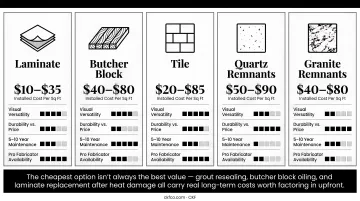
Laminate Countertops
Laminate is the most accessible countertop material available, and it has undergone a genuine design transformation. Products like Formica 180fx and Wilsonart HD feature photorealistic stone and wood patterns at a fraction of natural material costs — often indistinguishable in photos and surprisingly convincing in person.
Key limitations:
- Non-porous, easy to clean, requires no sealing
- Available in virtually unlimited colors and patterns
- Direct cutting causes permanent damage — always use a cutting board
- Not compatible with direct hot pan placement; use trivets consistently
| Attribute | Details |
|---|---|
| Price Range (Installed) | ~$15–$60/sq ft |
| Best For | Full kitchen replacements, rental properties, tight budgets |
| Style Match | Modern, Scandinavian, transitional, farmhouse |
The verdict: Laminate delivers the highest visual return per dollar in the budget category. The trade-off is permanent vulnerability to cutting and direct heat — habits matter more with this surface than any other.
Butcher Block Countertops
Butcher block brings warmth that stone and engineered surfaces genuinely can't replicate. End-grain or edge-grain hardwoods — typically maple, red oak, or walnut — develop character over time in a way no manufactured surface does.
The real advantage for budget buyers: surface damage can be sanded out and the countertop re-oiled, giving it a renewable lifespan that laminates and engineered surfaces can't match.
Maintenance realities:
- Requires regular oiling (monthly, or when the wood looks dry)
- Minor scratches sand out with fine-grain paper (~200 grit), working with the grain
- Prolonged moisture exposure causes warping and staining — keep it dry around the sink
- Species pricing varies significantly: maple and red oak cost far less than walnut
| Attribute | Details |
|---|---|
| Price Range (Installed) | ~$30–$100/sq ft for maple/oak; walnut can reach $100–$120+ |
| Best For | Farmhouse, cottage, Scandinavian kitchens; island accent surfaces |
| Style Match | Rustic, warm, organic, or as a contrast to quartz perimeter counters |
In practice: Butcher block works best for homeowners who enjoy maintaining their surfaces. It rewards care with a surface that genuinely improves with age.
Ceramic and Porcelain Tile Countertops
Tile offers the most design flexibility of any surface in the budget category. Large-format stone-look porcelain slabs, bold graphic patterns, classic subway configurations — the aesthetic range is enormous, and so is the price range.
Porcelain specifically resists heat and scratching well — Daltile and Crossville both make options built for heavy cooking use, making tile a real durability upgrade over laminate for buyers who cook heavily.
Grout is the variable:
- Cement grout requires sealing every 1–3 years to prevent staining (per MAPEI's guidelines)
- Epoxy grout eliminates most maintenance concerns but adds installation cost
- Large-format porcelain minimizes grout lines and elevates the final look significantly
- Individual tile materials can cost as little as $4–$6 per tile, making this one of the most DIY-accessible options
| Attribute | Details |
|---|---|
| Price Range (Installed) | ~$25–$75/sq ft for ceramic and standard porcelain tile; gauged porcelain slabs run higher |
| Best For | DIY-friendly projects, Mediterranean or eclectic kitchens, heat-heavy cooking environments |
| Style Match | Mediterranean, Bohemian, contemporary (large-format stone-look) |
Worth noting: Tile's biggest liability isn't the tile — it's the grout. If grout maintenance sounds unappealing, budget up to epoxy grout or consider a different surface.
Solid Surface Countertops
Solid surface — the category Corian pioneered, now joined by Wilsonart Solid Surface and HIMACS — creates a non-porous, homogeneous surface from acrylic or polyester resin with mineral fill. The fabrication capabilities are what make it stand out: integrated sinks, invisible seams, and custom edge profiles that look considerably more expensive than the price suggests.
Surface scratches and minor damage buff out with fine-grit sandpaper, making it one of the most repair-friendly options available. The integrated sink option also eliminates the countertop-to-sink gap that collects grime on undermount installations.
Tradeoffs to weigh:
- Requires hot pads and heat shields — direct hot cookware damages the surface
- Softer than stone, so it can show wear in high-traffic kitchens over time
- Seamless fabrication capability is a genuine advantage for bathrooms and laundry rooms
- Corian's care guide confirms repairability through progressive sanding and buffing
| Attribute | Details |
|---|---|
| Price Range (Installed) | ~$50–$150/sq ft depending on brand, thickness, and edge treatment |
| Best For | Bathrooms, laundry rooms, minimalist kitchens prioritizing clean lines |
| Style Match | Modern, minimalist, transitional |
Best for: Buyers who want a seamless, hygienic surface with repair-friendly properties — particularly in bathrooms where integrated sinks add practical value.
Budget Quartz and Entry-Level Granite
This is the most aspirational entry in the budget category. Budget quartz uses the same engineered stone manufacturing process as premium quartz, just in simpler, high-demand colorways — solid whites, soft grays, neutral tones — that cost significantly less than exotic or heavily veined slabs.
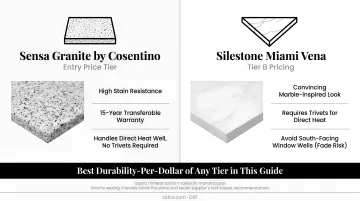
Entry-level granite achieves similar savings through widely available color tiers. CKF carries Sensa granite by Cosentino, with options at the entry price tier offering classic speckled patterns in natural stone with high stain resistance and a 15-year transferable warranty.
On the quartz side, CKF's entry-level options include Silestone's Miami Vena — a neutral white base with light grey veining available at Tier B pricing — which delivers a convincing marble-inspired look at an accessible price point.
What the tier difference means:
- Budget quartz and premium quartz are not identical — quartz mineral content varies by manufacturer and product line
- Quartz can fade with prolonged direct sunlight exposure; avoid installations in south-facing window wells
- Granite handles direct heat well; quartz requires trivets
- Granite sealing intervals vary — follow the stone and sealer supplier's test-based recommendations rather than a fixed schedule
| Attribute | Details |
|---|---|
| Price Range (Installed) | Budget quartz: ~$55–$110/sq ft; entry-level granite: ~$43–$95/sq ft |
| Best For | High-traffic family kitchens, homeowners wanting stone durability long-term |
| Style Match | Contemporary, transitional, traditional |
The verdict: For buyers who want genuine stone credibility without the luxury price, entry-level granite and budget quartz deliver the best durability-per-dollar of any option in this guide.
Smart Tips to Get More From Your Countertop Budget
The material is only part of the equation — these decisions can cut your final cost without changing what lands on your counters.
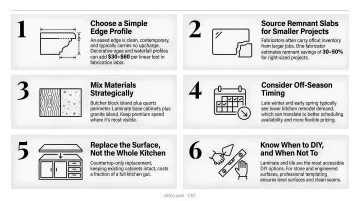
1. Choose a simple edge profile. An eased edge is clean, contemporary, and typically carries no upcharge. Decorative ogee and waterfall profiles can add $30–$60 per linear foot in fabrication labor. For a 30-linear-foot kitchen, that's a significant line item — one that rarely changes how the space looks from the doorway.
2. Source remnant slabs for smaller projects. Fabricators — including CKF, which maintains an outlet section with discounted full and remnant slabs — often carry offcut inventory from larger jobs. Remnants work particularly well for bathroom vanities, small kitchen islands, and bar tops. One fabricator estimates remnant savings of 30–50% for right-sized projects, though actual savings depend on what's available when you shop.
3. Mix materials strategically. Butcher block island plus quartz perimeter. Laminate base cabinets plus granite island. This approach creates visual interest while keeping premium spend where it's most visible — a genuine design move, not a workaround.
4. Consider off-season timing. Contractors tend to be busier in warmer months — late winter and early spring typically see lower kitchen remodel demand, which can translate to better scheduling availability and potentially more flexible pricing. Ask CKF's team about current availability.
5. Replace the surface, not the whole kitchen. Countertop-only replacement — keeping existing cabinets intact — costs a fraction of a full kitchen gut. If your cabinet boxes are structurally sound, a new surface and hardware can deliver a dramatic visual upgrade.
6. Know when to DIY — and when not to. Laminate and tile are the most accessible DIY options. For stone and engineered surfaces, professional templating ensures level surfaces, clean seams, and proper overhang. A skilled fabricator's work holds up over years in ways that self-installation often doesn't.
Frequently Asked Questions
What is the least expensive type of countertop?
Laminate is the least expensive option, with installed costs starting around $15–$60 per square foot. It comes in a wide range of styles including realistic stone and wood prints from brands like Formica and Wilsonart.
What looks like quartz but costs less?
High-resolution laminate products — particularly Formica's 180fx line and Wilsonart HD — mimic quartz veining convincingly at a fraction of the cost. Solid surface materials can also replicate quartz's smooth, seamless aesthetic for less, particularly when fabricated with integrated seams.
What is the most durable budget countertop option?
Entry-level granite and budget quartz offer the strongest durability per dollar — both resist scratches and daily wear effectively. Butcher block is the most durable natural option when properly maintained through regular oiling and prompt drying.
Can budget countertops actually look high-end?
Yes — today's manufacturing has made budget materials harder to distinguish from premium ones. The key is pairing the right pattern and edge profile with complementary cabinetry and hardware, something CKF's design team helps with regularly across its Midwest showrooms.
Is it worth mixing countertop materials in one kitchen?
Mixing materials is a smart, widely used design strategy. Butcher block island with a quartz perimeter, or laminate base cabinets with a granite island, creates visual interest while keeping overall project cost lower than using premium surfaces throughout.
How much does professional countertop installation typically cost?
Angi's 2026 data puts countertop installation at $20–$50/sq ft, depending on material complexity, edge profiles, cutouts, and regional labor rates. A templated quote from a local fabricator gives you the most accurate number for your specific project.