This mix-up isn't just a vocabulary slip. In a recent Houzz survey, 85% of homeowners upgraded their sink and 82% upgraded their faucet during a kitchen renovation, meaning most projects involve buying both, separately, and getting the pairing right the first time. Confusing the two can throw off your budget, delay your countertop fabrication, or leave you with a faucet that physically won't fit your new sink.
This guide breaks down exactly what a sink does, what a faucet does, the types of each, and how to make sure they work together without a headache.
Key Takeaways
- A sink holds and drains water, while a faucet controls the flow into it
- These fixtures are purchased separately but must match on hole count, spacing, and mount type
- Common sink styles include drop-in, undermount, and farmhouse mounts
- Faucets range from single-handle to widespread and wall-mount configurations
- Finish coordination and countertop cutout planning prevent leaks and mismatches
Sink vs Faucet: Quick Comparison
Before we go further, here's how the two fixtures stack up side by side.
| Factor | Sink | Faucet |
|---|---|---|
| Function | Basin that receives water and connects to the drain line | Spout, handle, and valve that deliver and control water flow and temperature |
| Installation Location | Set into a countertop or cabinet deck, or exposed as an apron front | Mounts through the sink deck, the countertop, or the wall behind the sink |
| Material Options | Stainless steel, granite composite, fireclay, enameled cast iron, vitreous china | Solid brass, zinc alloy, stainless steel, with some plastic internal components |
| Cost Drivers | Material, bowl count, dimensions, mounting style, included accessories | Valve type, finish, technology features (touch control, pull-down sprayers) |
| Durability Considerations | Gauge thickness and material resistance to heat, scratching, and impact | Body material (brass outlasts zinc) and valve type (ceramic disc resists mineral buildup) |
Notice that cost and durability depend heavily on the specific product, not just the category. A stainless steel sink and a granite composite sink can sit at wildly different price points depending on gauge, brand, and bowl configuration, and the same is true for faucets. That's why comparing spec sheets matters more than comparing generic labels.
What is a Sink?
A sink is the basin fixture that holds water and drains it away, installed into a countertop or cabinet. It's the passive half of the equation. It doesn't move water on its own; it just contains it and directs it to the drain.
In kitchens, the sink anchors food prep and dishwashing workflows. In bathrooms, it supports daily hygiene routines. The size, depth, and bowl configuration you choose directly affects how much usable counter space you have left and how the room functions day to day.
Material Matters More Than People Expect
According to Consumer Reports' sink buying guide, stainless steel gauge had little relationship to actual tested performance, meaning a thinner gauge doesn't automatically mean lower quality.
Fireclay, on the other hand, resisted heat and scouring well but cracked under a five-pound impact test. It's tougher against everyday wear but less forgiving if you drop a cast iron pan.
Common sink materials include:
- Stainless steel: affordable, widely available, resists corrosion
- Granite composite (like Blanco Silgranit): resists heat, scratches, and stains
- Fireclay: classic look, heat and stain resistant, but brittle under impact
- Vitreous china: non-porous surface with less than 0.5% water absorption, common in bathroom sinks
- Enameled cast iron: heavy-duty and long-lasting, but the enamel coating can chip
CKF carries this range in-house, including Blanco Silgranit, Kohler Neoroc, ProFlo, and vitreous china and cast iron options, so you're comparing real samples rather than guessing from a photo.
Types of Sinks
- Drop-in/top-mount: rests on the countertop with a visible rim; often includes an integral faucet deck, but hole count still varies by model
- Undermount: mounts below the countertop for a seamless look; can still include one to three faucet holes depending on the model
- Farmhouse/apron-front: deep basin with an exposed front, usually requiring a customized undermount installation
- Bar/prep sink: a secondary, smaller sink for beverage or food prep stations
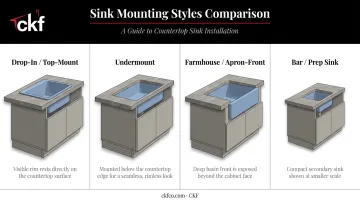
Sink choice directly affects your countertop cutout size and edge finishing. That's why CKF's in-house fabrication team programs each cutout using CAD drawings and robotic cutting equipment rather than cutting by hand.
That level of precision matters more once you realize hole configurations aren't standardized across sink types, even within the same style category.
What is a Faucet?
A faucet is the mechanical fixture that controls the flow, temperature, and direction of water delivered to the sink. Where the sink is passive, the faucet is active: it has moving parts, a handle or handles, and an internal valve that regulates everything.
Every faucet shares three core components:
- Spout — carries water into the sink
- Handle — opens, closes, and adjusts the valve
- Valve or cartridge — meters flow and, in mixing faucets, blends hot and cold water
The Four Faucet Valve Types
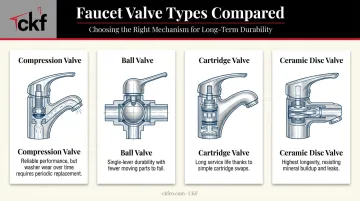
Homeowners often ask what the four types of faucets actually are. This refers to the internal valve mechanism, not the visible style:
- Compression — uses a rubber washer pressed against a valve seat; the oldest and simplest mechanism
- Ball — a slotted ball regulates hot and cold mixing in a single-handle body
- Cartridge — encloses the working parts in a replaceable cartridge, common in modern faucets
- Ceramic disc — two sliding ceramic discs control flow and resist mineral buildup better than the other three
Kitchen vs. Bathroom Faucets
Kitchen faucets typically feature pull-down or pull-out sprayers and higher flow rates to handle pot filling and dishwashing. Bathroom faucets run cooler on flow, usually centerset or widespread, and prioritize splash control over spray versatility.
Flow rate isn't arbitrary. The EPA's WaterSense program caps labeled bathroom faucets at 1.5 gallons per minute, and switching to a labeled model can save an average household roughly 700 gallons of water annually. Kitchen faucets aren't eligible for that label since prep and cleanup tasks demand higher flow.
Finish is another decision point. CKF's Lulani faucet line alone spans Chrome, Brushed Nickel, Champagne Gold, Matte Black, Gun Metal, Brushed Gold, Rose Gold, and Oil Rubbed Bronze, across single-handle, centerset, widespread, and vessel-height configurations.
That range matters because finish choice needs to coordinate with cabinet hardware and sink material, not just match the current trend.
Speaking of trends, Houzz's 2026 kitchen study found 45% of homeowners chose at least one specialty faucet feature, with water efficiency leading at 24% and touch control close behind at 19%. Efficiency, not just smart-home novelty, is driving most upgrade decisions.
Sink and Faucet Compatibility: Making Them Work Together
Here's where most renovation headaches actually start. Sinks and faucets are sold independently, which means nothing forces them to match unless you check yourself.
Hole Count and Spacing
Faucets require a specific number of holes, spaced a specific distance apart:
- 1 hole — single-handle faucets
- 3 holes on 4-inch centers — standard centerset configuration
- 3 holes spanning 8 to 16 inches — widespread configuration
- 4 holes — often three faucet holes plus one accessory hole for a soap dispenser or sprayer
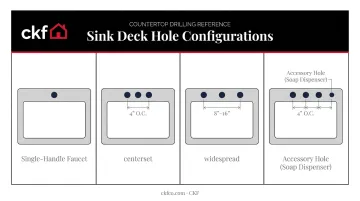
To check compatibility, measure from the center of the far-left hole to the center of the far-right hole, and measure each hole's diameter. Compare those numbers against the faucet's spec sheet before you buy. Mismatched hole counts are one of the most common reasons sinks get returned after purchase.
When Holes Don't Match
If your faucet's base doesn't cover your sink's existing holes, a deck plate (also called an escutcheon) can bridge the gap, but it only solves a hole-coverage mismatch. It won't fix incompatible spacing or a spout that's too short to clear a deep basin.
This is a real consideration at CKF, since several sink lines in the showroom ship with no pre-drilled faucet holes at all, requiring a wall-mounted or counter-mounted faucet instead.
A customer who buys a standard deck-mount faucet for one of these sinks without checking the spec sheet first will hit a wall, literally.
Mounting Decisions Come Before Fabrication
Whether your faucet mounts through the countertop or off the wall behind the sink needs to be settled before the countertop gets cut. Change your mind afterward and you're looking at a new cutout, a patched hole, or a completely new slab.
Pre-purchase checklist:
- Confirm hole count on both the sink and faucet
- Measure hole spacing (center-to-center, outer holes)
- Decide mount type: deck-mounted or wall-mounted
- Coordinate finish across faucet, sink, and cabinet hardware
- Check cabinet clearance requirements (some undermount sinks need a minimum 36-inch base cabinet)
This is exactly why CKF built its business around a one-stop-shop model. When cabinets, countertops, sinks, and faucets are coordinated under one roof, the design and fabrication team can cross-check hole count and spacing before the cutout is ever cut, instead of leaving that discovery for installation day.
Conclusion
A sink and a faucet are interdependent fixtures, each handling a specific job, with neither one more important than the other. The right combination comes down to your room's function, your water flow needs, and how well the pieces coordinate visually and physically.
Getting the pairing right the first time means fewer installation delays, no unexpected leaks, and no exposed holes staring back at you from the countertop. Working with a partner like CKF, who handles sink, faucet, and countertop selection together rather than juggling three separate vendors, takes most of the guesswork out of the process.
Frequently Asked Questions
Are a sink and a faucet the same thing?
No. A sink is the basin that holds and drains water, while a faucet is the fixture that controls water flow into it. They're sold and installed separately but must be compatible.
What are the 4 types of faucets?
The four valve types are compression, ball, cartridge, and ceramic disc. Ceramic disc valves resist mineral buildup best, while compression valves are the oldest and simplest design.
Can any faucet fit any sink?
Not automatically. Faucets must match the sink's hole count and spacing. Mismatches can sometimes be solved with a deck plate or escutcheon, but not every combination is interchangeable.
What's the difference between a sink and a basin?
"Basin" often refers specifically to bathroom sinks, while "sink" is a broader term covering kitchen, bathroom, bar, and utility fixtures.
Do I need to replace my sink and faucet at the same time?
Not necessarily. You can replace just one, but you still need to check hole compatibility and finish coordination before finalizing the purchase. CKF's showroom consultants can verify these details in person before you buy.
How do I know how many holes my sink has for a faucet?
Look underneath the sink deck or countertop with a flashlight and count the visible holes, typically one to four. Then measure the spacing between the two outermost holes to confirm faucet compatibility.