Introduction
Marble countertops remain one of the most requested upgrades for kitchens and bathrooms across the Midwest. Nothing else delivers that soft, veined elegance quite the same way.
But the price behind that beauty varies more than most homeowners expect. A slab of Makrana marble costs a fraction of what an imported Calacatta slab runs, and that's before installation, edges, or sealing enter the picture.
According to HomeAdvisor, installed marble countertops typically fall between $40 and $150 per square foot, with most full kitchen projects landing between $2,000 and $5,000.
There's no single "correct" price for marble. It depends on stone type, grade, slab versus tile, edge profile, and installation complexity. This guide breaks down what drives those numbers, where budgets typically go wrong, how marble compares to granite and quartz, and how to plan a realistic budget for your own project.
Key Takeaways
- Installed marble typically runs $40-$150 per sq. ft., with most kitchen projects totaling $2,000-$5,000
- Stone type, not grade, drives price the most: $12/sq. ft. Makrana vs. $180/sq. ft. Calacatta
- Edge profiles, finishes, and cutouts can add hundreds to thousands to a base quote
- Sealing, resurfacing, and repairs are recurring costs many homeowners forget to budget for
- A one-stop fabricator, like CKF, simplifies comparing quotes across Midwest markets
How Much Do Marble Countertops Cost? (Pricing Overview)
Marble doesn't have a fixed rate. It's priced per square foot, and that number shifts based on the stone variety, its grade, and the finishing choices you select. Two kitchens the same size can land thousands of dollars apart depending on which slab walks out the door.
Three budgeting mistakes show up again and again:
- Underestimating labor and installation fees: the sticker price on a slab rarely reflects your final invoice
- Falling in love with a stone before checking availability: rare imports can mean long lead times or price swings
- Forgetting resealing and maintenance costs: marble needs upkeep that granite and quartz don't
Typical Cost Ranges
| Tier | Material Examples | Material Cost (per sq. ft.) |
|---|---|---|
| Entry-level | Makrana, Carrara | $12-$40 |
| Mid-range | Statuario, Danby | $50-$80 |
| High-end/exotic | Calacatta, rare imports | $150-$180+ |
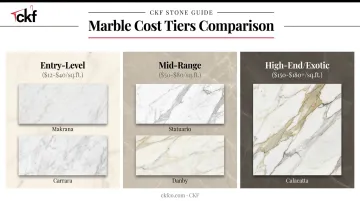
These figures cover material and standard fabrication. They typically exclude demolition, custom edge upgrades, and sealing, all of which get added on top.
Cost Tier Breakdown
Entry-level: Includes a standard edge (eased or bullnose) and basic cutouts for a sink and faucet. It's a solid fit for smaller kitchens, secondary bathrooms, or first-time remodels where budget matters more than rarity.
Mid-range: Adds upgraded edge options, a wider color and veining selection, and moderate layout customization. Most standard kitchen remodels (full countertop runs plus a modest island) land here.
Premium: Brings in rare or imported slabs, waterfall edges, and complex multi-piece layouts requiring precise vein matching. This tier suits luxury renovations and statement islands where the countertop is the design centerpiece.
Key Factors That Affect the Cost of Marble Countertops
Marble pricing comes down to three things: the stone itself, how complex the job is, and the fabricator's process.
Type, Grade, and Format of Marble
Marble is classified on an A-through-D soundness scale set by the Natural Stone Institute. It's tempting to assume Grade A means the highest price and Grade D means bargain-bin, but that's not quite accurate.
The grade measures how many natural fissures or voids need reinforcement during fabrication, not the stone's beauty or resale value. A Grade C slab with dramatic veining can easily outprice a "cleaner" Grade A slab.
What actually moves the price needle is variety and origin:
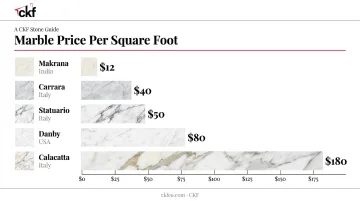
- Makrana (India): around $12/sq. ft. (the most affordable true marble)
- Carrara (Italy): around $40/sq. ft. (widely available, classic white background)
- Statuario (Italy): around $50/sq. ft. (bolder veining from a small number of quarry seams)
- Danby (Vermont): around $80/sq. ft. (domestic, bright white base)
- Calacatta (Italy): around $180/sq. ft. (rare, dramatic veining, the benchmark for luxury kitchens)
Format affects the budget just as much as variety. Full slabs run roughly $40-$100 per sq. ft. in material cost and deliver continuous veining with far fewer seams. Tile drops material costs to around $10-$15 per sq. ft., but you'll live with visible grout lines across the whole surface. For a small vanity, tile can make sense; for a kitchen island, most homeowners choose slab.
Size, Layout, and Edge Complexity
Bigger islands, curved edges, and multiple cutouts all add fabrication time and material waste:
- Sink cutout: $100-$300
- Cooktop cutout: $120-$400
- Faucet or outlet cutout: $20-$125
- Custom curves or corners: $50-$150 each
A waterfall edge alone can add roughly 6 extra square feet of matched material per side, since the veining needs to flow continuously from counter to floor.
Edge profile shapes the bill as well. Standard edges cost less because they require less shaping:
- Beveled, bullnose: $10-$12 per linear ft.
- Ogee, mitered, Dupont: $20-$25 per linear ft.
- French cove, double bevel: $30-$40 per linear ft.
Finish matters too. Polished delivers the glossy look most people picture. Honed gives a matte finish that hides etching better. Leathered adds texture and camouflages fingerprints, though pitted areas can take more effort to clean.
Installation, Labor, and Local Sourcing
Marble installation labor typically runs $35-$45 per hour, and a standard 10-hour install adds roughly $350-$450. Broader countertop labor rates can climb to $100 per hour depending on region and complexity.
Sourcing matters just as much as labor. Slabs shipped long distances add freight costs and lead time. This is where CKF's in-house fabrication facility and regional stone supplier relationships help Midwest customers: templating, cutting, and installation happen under one roof instead of juggling separate vendors for each step.
Cost Breakdown of a Marble Countertop Project
Total project cost extends well beyond the price of the stone. Here's what to budget for, one-time and ongoing:
| Cost Item | Timing | What It Covers |
|---|---|---|
| Material purchase | One-time | Slab or tile cost, driven by stone type and grade |
| Installation & setup | One-time | Templating, fabrication, cutting, professional install |
| Old countertop removal | One-time | Demolition and haul-away, roughly $100-$800 |
| Add-ons | One-time | Backsplash, extra cutouts, plumbing coordination |
| Sealing | Recurring | About $100-$200 per treatment |
| Repairs | Periodic | $200-$1,200 for chips, cracks, or etching |
Some fabricators, including CKF, require homeowners to handle old countertop removal and disconnect plumbing before installation day. That keeps labor costs predictable, but it means you'll need to budget separately for demolition and disposal rather than assuming it's bundled into the install fee.
Beyond installation, ongoing upkeep adds its own costs over time:
- Refinishing a dull or scratched surface: $4-$20 per sq. ft.
- Polishing alone: $2-$7 per sq. ft.
- Repairs for chips, cracks, or etching: $200-$1,200, as noted above
Not every marble countertop needs this level of care, but budgeting a maintenance line now helps you avoid surprises later.
Marble vs. Granite vs. Quartz — Which Costs More?
There's a common myth that granite always beats marble on price, or that quartz is always the priciest option. In reality, supply and demand for a specific slab matters more than the material category it falls into.
| Material | Installed Cost Range | Sealing Needs |
|---|---|---|
| Marble | $40-$150/sq. ft. | Periodic sealing required |
| Granite | $70-$185/sq. ft. | Periodic sealing required |
| Quartz | $50-$200/sq. ft. | None (nonporous engineered surface) |
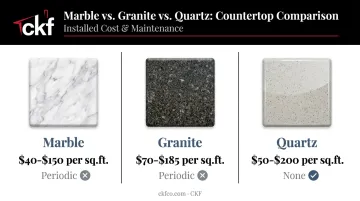
Entry-level marble like Makrana can undercut premium granite or quartz, while exotic Calacatta can exceed both. The material name on the spec sheet tells you less than the specific slab, which comes down to:
- Quarry origin and rarity
- Current market demand for that pattern
- Fabrication complexity, like bookmatching or waterfall edges
Maintenance is where the categories diverge most. Sealer helps marble resist staining, but it doesn't stop acid etching from lemon juice, wine, or vinegar. Granite shares this vulnerability to acid etching, but quartz avoids it entirely since it's a nonporous engineered material.
If you love the look of Calacatta but want zero sealing, CKF also carries marble-inspired quartz and Dekton surfaces that replicate the aesthetic with a different maintenance profile. Options like Et Calacatta Gold and Rem draw their veining from Calacatta Lincoln, delivering the look without the upkeep.
How to Estimate the Right Budget for Your Marble Countertop
The "right" cost depends on fit for your kitchen, not the lowest quote you receive. Weigh these factors before committing:
- Kitchen size and layout complexity: more cuts and corners mean more labor
- Desired stone rarity: common Carrara versus rare Calacatta changes everything
- Edge and finish preferences: ogee and waterfall edges cost more than standard bullnose
- Long-term sealing and maintenance commitment: factor in recurring costs, not just day one
Get multiple itemized quotes so you're comparing apples to apples. Confirm each one specifies:
- Same stone grade
- Same edge type
- Same installation inclusions
A quote missing removal or sealing costs is incomplete, not cheaper.
Working with a full-service provider simplifies this. CKF's process starts with a free design consultation, either in-showroom or online. You'll then receive a design packet with a project estimate and tiered pricing (Tier A through Tier H) based on material selection. Bundling material, fabrication, and installation into a single transparent quote across CKF's Midwest locations cuts out the guesswork of coordinating separate vendors.
What Most People Miss When Budgeting for Marble
Three blind spots trip up most first-time marble buyers:
- Fixating on the per-square-foot sticker price while ignoring installation, edge, and finish upcharges that can add $500-$2,000 or more to a base quote
- Underestimating sealing and refinishing costs over the countertop's lifespan — a $150 sealing treatment every few years adds up over 20+ years of ownership
- Overlooking remnant slabs or less-popular colors, which can lower costs by hundreds of dollars without sacrificing the natural stone look you actually want
CKF's outlet locations stock discounted remnant and full slabs, including less-common veining patterns, so buyers can get genuine natural stone without paying full price.
Frequently Asked Questions
How much does marble cost per square foot?
Material costs range from about $12 per sq. ft. for Makrana to $180 for Calacatta. Installed pricing, which includes fabrication and labor, typically runs $40-$150 per sq. ft.
Are marble countertops expensive?
It depends entirely on the variety. Budget-friendly options like Makrana or Carrara sit well below premium granite, while rare Calacatta slabs can exceed $150 per sq. ft. installed.
Is marble more expensive than granite countertops?
Not necessarily. It depends on the specific stone you choose, not the material category. Entry-level marble can beat premium granite, while exotic marble can cost more than either.
How long do marble countertops last?
With proper sealing and care, marble typically lasts at least 20 years and can last 50 or more. Impact damage and acid etching remain the biggest risks over time.
Can I save money by choosing marble tile instead of a slab?
Yes — tile material costs roughly $10-$15 per sq. ft. versus $40-$100 for slab. The tradeoff is visible grout lines and more ongoing seam maintenance.
What additional costs should I budget for beyond the countertop itself?
Plan for demolition and haul-away ($100-$800), periodic sealing ($100-$200 per treatment), and any edge or finish upgrades beyond the standard profile.